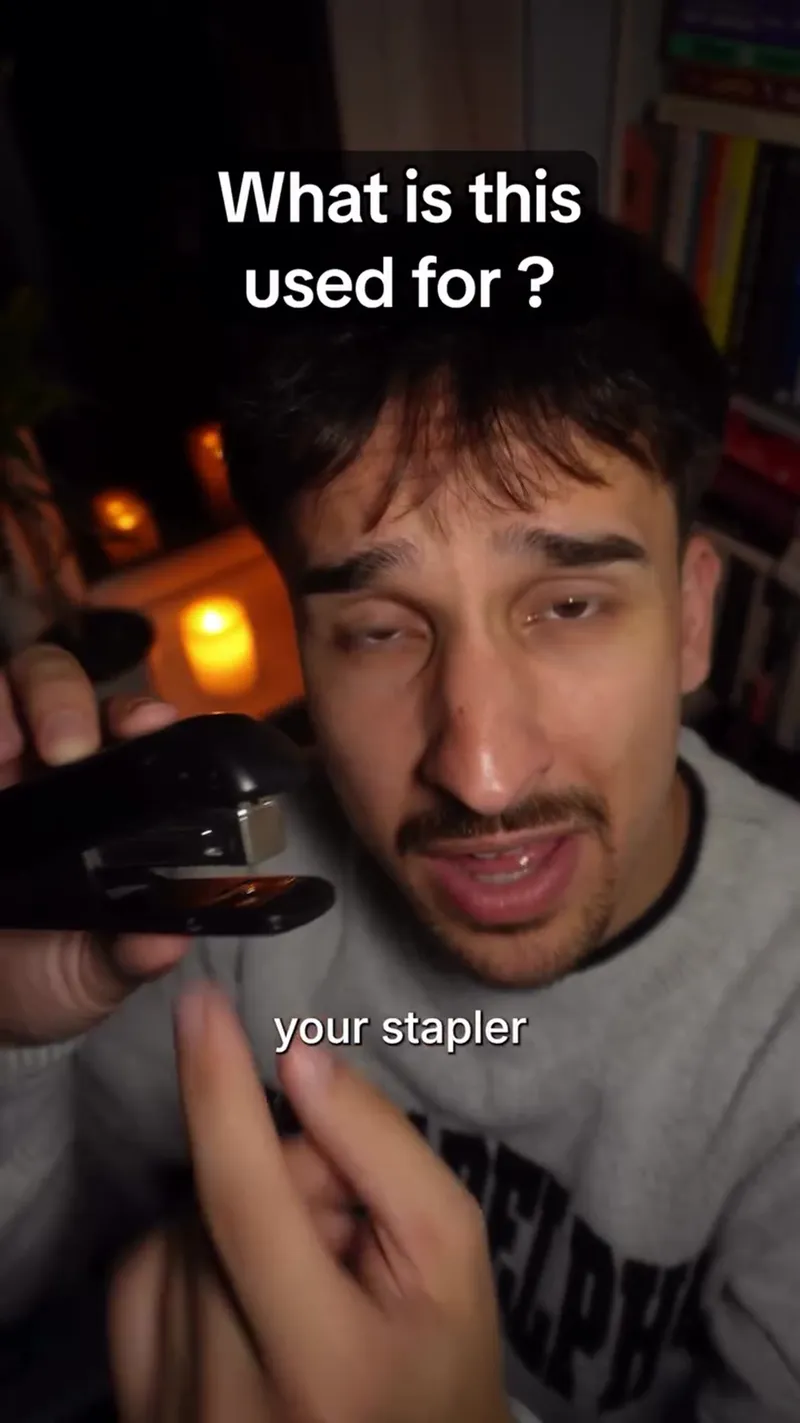
This video reveals a hidden rotating plate on staplers that allows for temporary pinning instead of permanent binding. It uses this example to explore several other everyday objects with designs rooted in historical needs that are no longer common today.
The Hidden Reason Why Your Stapler Has Two Modes
A presenter demonstrates how turning a stapler’s metal plate changes staples from a permanent hold to an easier-to-remove hold. He then connects the feature to other everyday objects with design details whose original purpose may be overlooked.
- Views
- 7.3M
- Likes
- 761.1K
- Comments
- 3K
- Stapler alternate settingEveryday object design
Analysis
A presenter demonstrates how turning a stapler’s metal plate changes staples from a permanent hold to an easier-to-remove hold. He then connects the feature to other everyday objects with design details whose original purpose may be overlooked.
- Talking headDemoExplainer
- Spoken
- Original
“There's a second setting on your stapler that you've never used.”
- On-screen text
- Original
“What is this used for ?”
- Visual
- Text-led composition with a supporting object demonstrationA close, slightly high-angle view of a presenter facing the camera; the presenter brings a stapler into the foreground and points toward it. A prominent question headline sits above, with speech subtitles lower in frame.
- The presenter holds up and points to the stapler as he introduces its hidden setting. The sampled later frames show him speaking, while captions display parts of his narration.
“There's a second setting on your stapler that you've never used. It's been there your entire life and nobody told you it existed. And the reason no one told you is the people that designed it assumed someone else would tell you about it. But no one did. So. Hi Will. Welcome to one fact today where we really your algorithm into getting you smart and cultured. One fact a day keeps the brain right away. Flip your stapler over. There are two functions on your stapler. There's a small rotating metal pit called the anvil in the position that you've always used. It curves the staples inwards. Locked, permanent. Not going anywhere. Flip it 180 degrees now. It bends the staples outwards. It still goes through the paper, but one gentle pull separates the pages apart. No torn corners. No staple remover. Nice and clean. But what's the point of that? It's designed for documents that need to travel together but separate cleanly. Medical files, legal folders, anything that gets refiled. And here's the thing that gets me this isn't a stapler problem. The small pocket inside your jeans has been used to carry wristwatches back in the day. The hole in a pasta spoon measures one serving of spaghetti. The indents on the bottom of a wine bottle helped glassblowers stabilize the bottle during production. And the ridges on the edge of a coin are put there to prevent shaving. Every object around you is holding decisions made by people you don't know. Solving problem you've never had for a world that no longer exists. But the design stayed. How many things in your life are you using wrong? Not because you're careless, but because no one finished explaining them to you. Follow for more, and let's retrain your algorithm to teach you and not tease you. And that's why.”
- 01Unexpected feature and premise
Raises the question of what the feature does and frames the piece as one installment in a continuing fact-based series.
Introduces an overlooked feature, explains why it may have gone unnoticed, then gives a brief recurring-series welcome and promise.
“There's a second setting on your stapler that you've never used. It's been there your entire life and nobody told you it existed. And the reason no one told you is the people that designed it assumed someone else would tell you about it. But no one did. So. Hi Will. Welcome to one fact today where we really your algorithm into getting you smart and cultured. One fact a day keeps the brain right away.”
- 02Demonstrate the two modes
Resolves what the feature does through a clear before-and-after comparison, showing the consequences of each setting.
Directs the viewer to inspect the object, names its mechanism, and contrasts the default mode with the rotated setting and its practical effect.
“Flip your stapler over. There are two functions on your stapler. There's a small rotating metal pit called the anvil in the position that you've always used. It curves the staples inwards. Locked, permanent. Not going anywhere. Flip it 180 degrees now. It bends the staples outwards. It still goes through the paper, but one gentle pull separates the pages apart. No torn corners. No staple remover. Nice and clean.”
- 03Explain the use and broaden the insight
Makes the demonstrated feature useful in context, then expands the central idea from one object to hidden functions in familiar things.
Asks what the alternate mode is for, answers with a use case, then lists other everyday designs with less obvious purposes and draws a broader conclusion about design decisions.
“But what's the point of that? It's designed for documents that need to travel together but separate cleanly. Medical files, legal folders, anything that gets refiled. And here's the thing that gets me this isn't a stapler problem. The small pocket inside your jeans has been used to carry wristwatches back in the day. The hole in a pasta spoon measures one serving of spaghetti. The indents on the bottom of a wine bottle helped glassblowers stabilize the bottle during production. And the ridges on the edge of a coin are put there to prevent shaving. Every object around you is holding decisions made by people you don't know. Solving problem you've never had for a world that no longer exists. But the design stayed.”
- 04Reflect and invite continued viewing
Leaves viewers with a personal reflection and restates the creator's promise as the reason to follow.
Turns the examples into a question about overlooked features, reassures viewers that the oversight is understandable, and closes with a follow invitation tied to the series premise.
“How many things in your life are you using wrong? Not because you're careless, but because no one finished explaining them to you. Follow for more, and let's retrain your algorithm to teach you and not tease you. And that's why.”