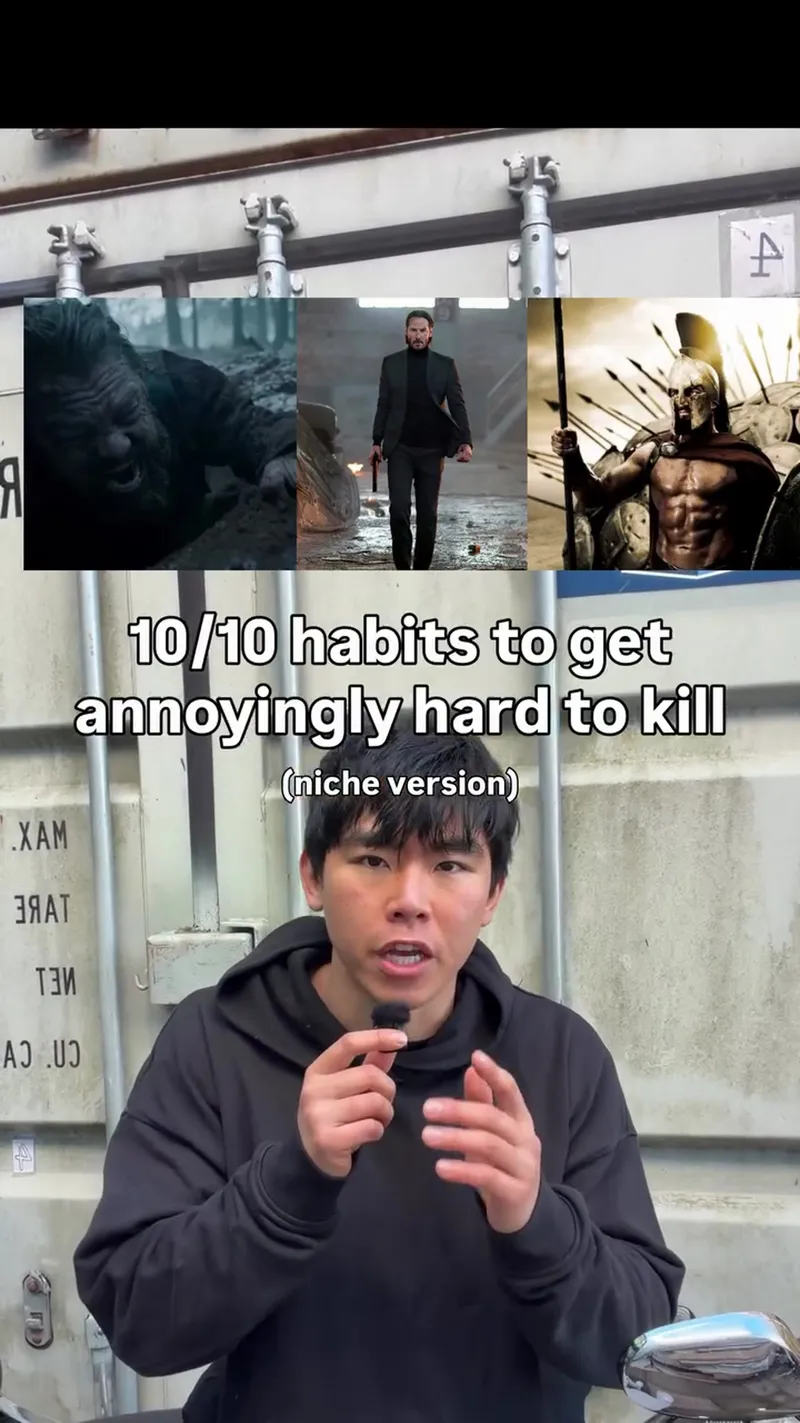
The video outlines ten unconventional and niche habits designed to build extreme physical and mental resilience. It features specific drills like grip conditioning with rice and sensory deprivation to train the nervous system for high-stress situations.
10 Niche Habits to Become Unstoppably Hard to Kill
A presenter lists extreme habits framed as ways to build toughness, including rice-bucket hand exercises, dead hangs, crawling, and sitting in darkness. He links some practices to military training and resilience.
- Likes
- 28.3K
- Comments
- 135
- Grip strength trainingPain tolerance trainingSensory deprivation trainingMilitary fitness habits
Analysis
A presenter lists extreme habits framed as ways to build toughness, including rice-bucket hand exercises, dead hangs, crawling, and sitting in darkness. He links some practices to military training and resilience.
- Talking headListicleTutorialVoiceover
- Spoken
- Original
“10 out of 10 habits to get annoyingly hard to kill, but they progressively get more niche”
- On-screen text
- Original
“10/10 habits to get annoyingly hard to kill (niche version)”
- Visual
- Text-led composition with illustrative image stripA centered speaker faces the camera in a medium shot, beneath a prominent headline and a horizontal strip of three cinematic figures above it.
- The presenter speaks to camera while inset images illustrate the habits, including hands in rice and a person stretching. The visuals support the spoken examples but do not demonstrate all the described exercises.
“10 out of 10 habits to get annoyingly hard to kill, but they progressively get more niche Condition your grip by opening and closing your hands inside a bucket of dry rice. Special forces use it to rebuild hand strength after injury. Dead Hang until your hands physically fail, not until your forearms burn. Drag your knuckles across rough concrete once a week to build hand density. Sit in a sauna fully clothed until the discomfort stops being about heat. Train your pain tolerance by pressing into discomfort and breathing instead of pulling away. Crawl on your elbows across 30 meters of rough ground once a week. It's how soldiers train to move under fire without burning out their shoulders. Sit in complete darkness and silence for 20 minutes without moving. Special forces use sensory deprivation to train the nervous system to stay calm when input disappears and get so hard to kill that your body starts solving problems before your brain even notices them.”
- 01Announce escalating list
Sets the topic and promises an ordered progression toward increasingly unusual examples.
Introduces a perfect-score list of habits for becoming difficult to defeat and says the items get progressively more niche.
“10 out of 10 habits to get annoyingly hard to kill, but they progressively get more niche”
- 02Present and justify the habits
Delivers the promised sequence through actionable examples and explanations, with each new habit advancing the list toward its most unusual challenge and concluding payoff.
Lists concrete exercises and challenges, sometimes adding a brief explanation of their training purpose or a military example; the final challenge is followed by a larger claimed benefit.
“Condition your grip by opening and closing your hands inside a bucket of dry rice. Special forces use it to rebuild hand strength after injury. Dead Hang until your hands physically fail, not until your forearms burn. Drag your knuckles across rough concrete once a week to build hand density. Sit in a sauna fully clothed until the discomfort stops being about heat. Train your pain tolerance by pressing into discomfort and breathing instead of pulling away. Crawl on your elbows across 30 meters of rough ground once a week. It's how soldiers train to move under fire without burning out their shoulders. Sit in complete darkness and silence for 20 minutes without moving. Special forces use sensory deprivation to train the nervous system to stay calm when input disappears and get so hard to kill that your body starts solving problems before your brain even notices them.”