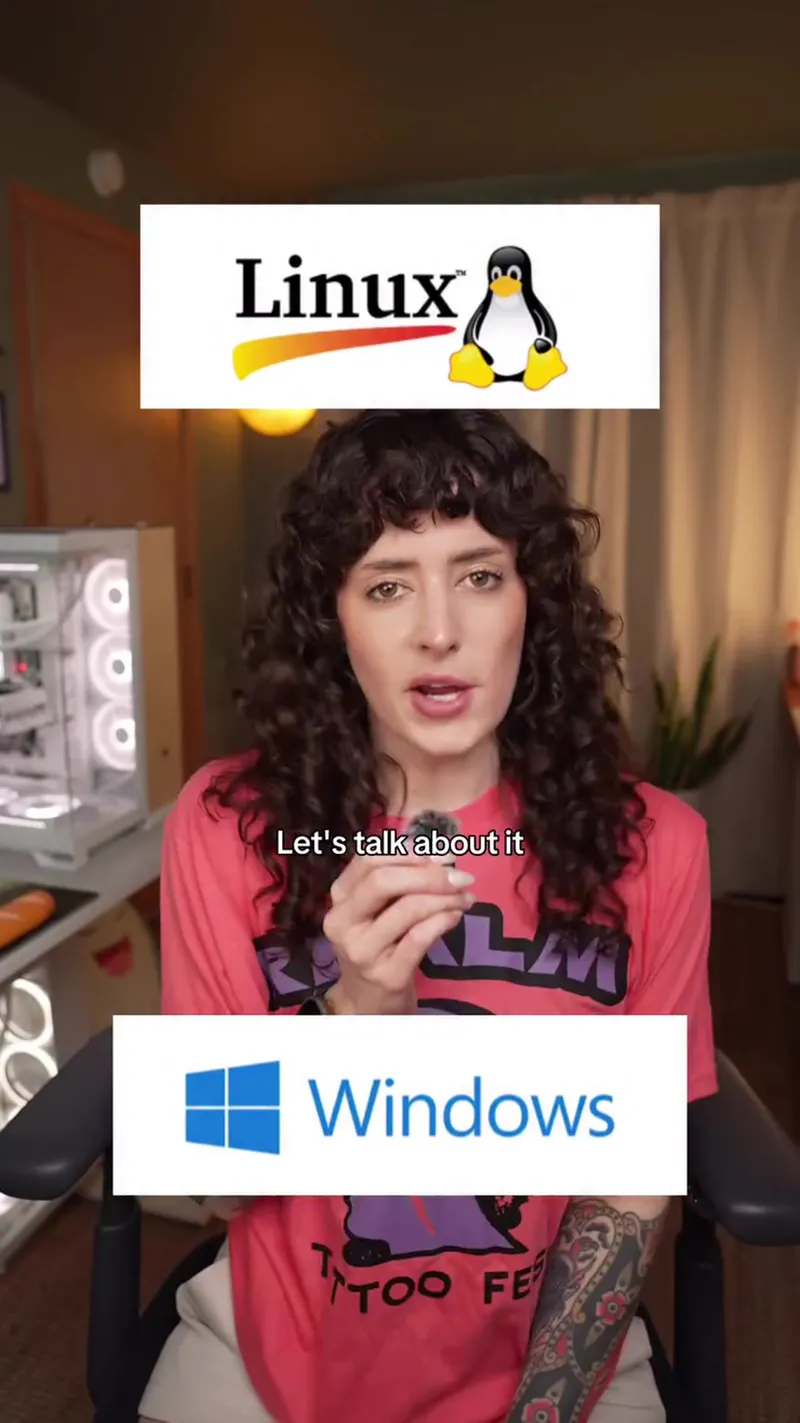
The creator explores the long-standing debate between Linux and Windows operating systems. She breaks down the trade-offs between Windows' ease of use and Linux's deep customization and privacy features.
Is Linux Actually Better Than Windows?
A presenter compares Windows and Linux, covering ease of use, software support, cost, customization, updates, and pre-installed apps. She recommends Windows for simplicity and Linux for customization, and mentions Linux Mint as a beginner option.
- Likes
- 25.8K
- Comments
- 1.1K
- Linux versus WindowsOperating system featuresLinux beginner options
Analysis
A presenter compares Windows and Linux, covering ease of use, software support, cost, customization, updates, and pre-installed apps. She recommends Windows for simplicity and Linux for customization, and mentions Linux Mint as a beginner option.
- Talking headComparisonExplainer
- Spoken
- Original
“Is Linux actually better than Windows?”
- Visual
- Text-led compositionA centered presenter faces the camera in a medium shot. Linux and Windows logo panels appear above and below her in the later opening sample, making the comparison's two subjects visible. The question is also shown as a subtitle.
- The presenter speaks directly to camera as subtitles reflect her words. Linux and Windows logos appear during the opening comparison.
“Is Linux actually better than Windows? Let's talk about it. Linux people are always saying that Linux is a better operating system than Windows, but what's the actual difference? Let's start with Windows. Windows is the most commonly used operating system in the world. And overall Windows works super well. It runs every game and every program that you're going to throw at it and it's pretty simple to use. But it's important to keep in mind that this isn't free. Don't illegally download things. It's a really good default option that pretty much anyone can pick up and use without any problems. But that doesn't mean that it doesn't have any drawbacks. Windows can force updates and restart your PC on its own, like it did with mine last night, which was like really annoying because I get up here and I have a bunch of work to do and my PC's like updating, I didn't ask for the update. I don't know, kind of weird. There's also a lot of pre installed apps that you're gonna have on Windows that you didn't download. And they can kind of be like a more on the bloatware side, if that makes sense. Like I feel like the bloatware on Windows is the most common complaint that I hear. But how does that compare to Linux? Linux is open source, so everyone can see how it's built and it's free to use. If you are the tink type. There's a lot of customization that you can do in Linux, especially compared to Windows. There's also no forced bloatware, no telemetry and no ads. But in my opinion, Linux is a lot less beginner friendly than Windows. So out of the box things aren't going to work like they did on Windows. There is definitely a learning curve, so you have to be aware of that when you go into it. And there are some versions of Linux that are easier to use than others. Like if you're a beginner Linux, Mint is a really good place to start and you should probably skip Arch. Nobody needs to be using Arch. Fight me in the comments. Overall, if you want something easy that will always work, Windows is going to be the best choice. But if you're looking for a more customized experience, Linux is the better choice because you can customize so many things. Have you ever tried Linux? If you have, do you think it was better than Windows? Let me know in the comments.”
- 01Frame the comparison
Sets up the central decision and establishes that the answer will come through comparison.
Raises a direct question about which of two options is better, then promises to examine the difference.
“Is Linux actually better than Windows? Let's talk about it. Linux people are always saying that Linux is a better operating system than Windows, but what's the actual difference?”
- 02Establish the familiar option’s advantages and drawbacks
Gives the familiar option a fair account of its benefits before grounding its downsides in concrete inconveniences; the closing comparison question leads into the alternative.
Starts with Windows, noting its wide use, compatibility, and simplicity; adds a qualification about cost, then explains forced updates and preinstalled apps as drawbacks, including a personal update anecdote.
“Let's start with Windows. Windows is the most commonly used operating system in the world. And overall Windows works super well. It runs every game and every program that you're going to throw at it and it's pretty simple to use. But it's important to keep in mind that this isn't free. Don't illegally download things. It's a really good default option that pretty much anyone can pick up and use without any problems. But that doesn't mean that it doesn't have any drawbacks. Windows can force updates and restart your PC on its own, like it did with mine last night, which was like really annoying because I get up here and I have a bunch of work to do and my PC's like updating, I didn't ask for the update. I don't know, kind of weird. There's also a lot of pre installed apps that you're gonna have on Windows that you didn't download. And they can kind of be like a more on the bloatware side, if that makes sense. Like I feel like the bloatware on Windows is the most common complaint that I hear. But how does that compare to Linux?”
- 03Present the alternative’s strengths and learning curve
Completes the comparison by pairing the alternative’s freedoms with its usability cost, then gives a concrete entry point and a playful opinion before the final decision rule.
Describes Linux as open source, free, customizable, and free of several unwanted features, then counters with its greater difficulty for beginners and a learning curve. It distinguishes easier distributions, recommends Mint for beginners, jokes that Arch is unnecessary, and invites disagreement.
“Linux is open source, so everyone can see how it's built and it's free to use. If you are the tink type. There's a lot of customization that you can do in Linux, especially compared to Windows. There's also no forced bloatware, no telemetry and no ads. But in my opinion, Linux is a lot less beginner friendly than Windows. So out of the box things aren't going to work like they did on Windows. There is definitely a learning curve, so you have to be aware of that when you go into it. And there are some versions of Linux that are easier to use than others. Like if you're a beginner Linux, Mint is a really good place to start and you should probably skip Arch. Nobody needs to be using Arch. Fight me in the comments.”
- 04Give a conditional verdict and invite responses
Resolves the comparison without declaring one option universally best, matching the choice to different priorities; the closing question invites audience participation.
Recommends one option for ease and reliability, the other for customization, then asks whether viewers have tried it and requests their view in the comments.
“Overall, if you want something easy that will always work, Windows is going to be the best choice. But if you're looking for a more customized experience, Linux is the better choice because you can customize so many things. Have you ever tried Linux? If you have, do you think it was better than Windows? Let me know in the comments.”