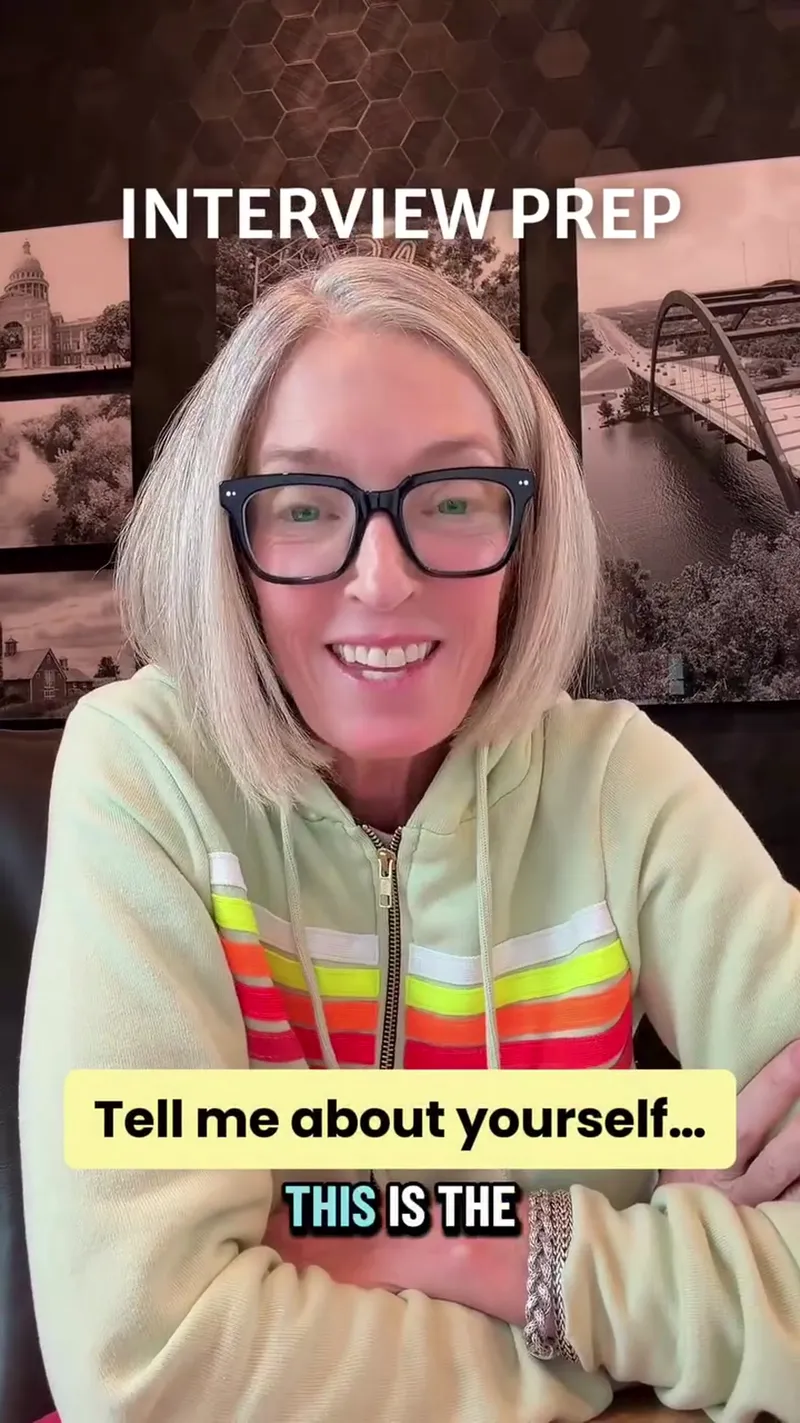
An experienced recruiter provides a structured framework for answering the "Tell me about yourself" interview question. She explains why the question is difficult and offers a specific formula focused on recent experience and relevant projects to help candidates make a strong first impression.
How to Ace the "Tell Me About Yourself" Interview Question
A recruiter explains why “Tell me about yourself” can be difficult and gives a framework for answering it. She recommends focusing on recent experience, a relevant achievement, and why the company and role, in under two minutes.
- Views
- 185.2K
- Likes
- 5.3K
- Comments
- 60
- Interview answer preparationTell-me-about-yourself responseCareer interview coaching
Analysis
A recruiter explains why “Tell me about yourself” can be difficult and gives a framework for answering it. She recommends focusing on recent experience, a relevant achievement, and why the company and role, in under two minutes.
- Talking headTutorialExplainer
- Spoken
- Original
“Tell me about yourself. This is the hardest interview question I think for a whole lot of people.”
- On-screen text
- Original
“INTERVIEW PREP; Tell me about yourself...”
- Visual
- Text-led compositionA centered speaker faces the camera in a medium close-up. A large white topic title sits above them; a highlighted prompt appears across the lower part of the frame.
- The speaker addresses the camera while on-screen captions emphasize the interview question and parts of her spoken advice.
“Tell me about yourself. This is the hardest interview question I think for a whole lot of people. I've been, I'm a recruiter, I've been doing this for 20 plus years. I've got a business helping people craft their tell me about yourself stories. And here's why I think this really freaks people out. It is a question that you're going to have to talk about yourself. It is an open ended question. You, you don't really know how far back into your career people are looking for you to go. So you start at the beginning, which for some of us can be a very long time ago. It feels a little bit like it's a test, like what are you expecting me to say? Is this personal? Is this professional? And people just don't really know how to handle it. And so in the moment that it happens, if you have not really prepared for this, your brain freezes. And, and like I said, you start back at the beginning, like, hey, I graduated from college when. And I'm like, oh my God, are they seriously going to talk about college? And this is where we are making our first impression with each other. So what I want to say to those of you that really struggle with this, there is a very clear framework to think about it. Most interviewers really only care about the last five years of your experience. That's where you've done the work that is of most interest to me in the job that you are applying to. So you frame your tell me about yourself with two to three very broad sentences about your background, the industries you've worked for, the sizes of companies you've worked for, et cetera. And then you share with me a project, a initiative, a sales goal, whatever it is that you're really proud of that aligns directly with the role that you are interviewing for. And then you close the conversation with why the company and why the role. And all of that should take place in roughly under 2 minutes, minutes time. So I hope that that's helpful. Drop into the comments, any questions that you have and good luck out there. Practice.”
- 01Name the difficult prompt and establish credibility
Frames the problem and establishes why the advice is relevant before explaining what makes the question hard.
Introduces a commonly difficult question, then gives the creator’s relevant experience and connection to helping people answer it.
“Tell me about yourself. This is the hardest interview question I think for a whole lot of people. I've been, I'm a recruiter, I've been doing this for 20 plus years. I've got a business helping people craft their tell me about yourself stories.”
- 02Explain the source of uncertainty and the common response
Makes the difficulty understandable through its causes and a recognizable example, setting up the need for a clear response framework.
Describes the prompt’s open-ended, personal nature, the uncertainty about what the questioner wants, and how lack of preparation can lead to freezing or an unfocused answer.
“And here's why I think this really freaks people out. It is a question that you're going to have to talk about yourself. It is an open ended question. You, you don't really know how far back into your career people are looking for you to go. So you start at the beginning, which for some of us can be a very long time ago. It feels a little bit like it's a test, like what are you expecting me to say? Is this personal? Is this professional? And people just don't really know how to handle it. And so in the moment that it happens, if you have not really prepared for this, your brain freezes. And, and like I said, you start back at the beginning, like, hey, I graduated from college when. And I'm like, oh my God, are they seriously going to talk about college? And this is where we are making our first impression with each other.”
- 03Give the framework and close with a practical constraint
Resolves the stated struggle with actionable steps, then closes by making the advice manageable and inviting follow-up.
Offers a three-part response: briefly summarize relevant background, give a role-aligned example of work, and explain interest in the company and role. Ends with a suggested time limit, invitation for questions, and encouragement.
“So what I want to say to those of you that really struggle with this, there is a very clear framework to think about it. Most interviewers really only care about the last five years of your experience. That's where you've done the work that is of most interest to me in the job that you are applying to. So you frame your tell me about yourself with two to three very broad sentences about your background, the industries you've worked for, the sizes of companies you've worked for, et cetera. And then you share with me a project, a initiative, a sales goal, whatever it is that you're really proud of that aligns directly with the role that you are interviewing for. And then you close the conversation with why the company and why the role. And all of that should take place in roughly under 2 minutes, minutes time. So I hope that that's helpful. Drop into the comments, any questions that you have and good luck out there. Practice.”