A venture capital perspective on a viral video featuring a small drone that autonomously hunts insects. The creator explains how investors look past the immediate product to see the underlying technical capabilities and the founder's strategic background.
Why This "Bug Zapper" Drone Is Actually a Defense Tech Powerhouse
A venture investor explains how a small autonomous drone that intercepts moths could point to broader uses, from pest control to defense. He also discusses the founder’s background and how investors assess a startup’s capabilities and team.
- Likes
- 147.6K
- Comments
- 2K
- Autonomous insect interceptionStartup investment evaluationDefense technology applications
Analysis
A venture investor explains how a small autonomous drone that intercepts moths could point to broader uses, from pest control to defense. He also discusses the founder’s background and how investors assess a startup’s capabilities and team.
- Talking headGreen screenExplainerCase study
- Spoken
- Original
“Alright, so did you see this YC backed company, Tornyal, just post this video.”
- On-screen text
- Original
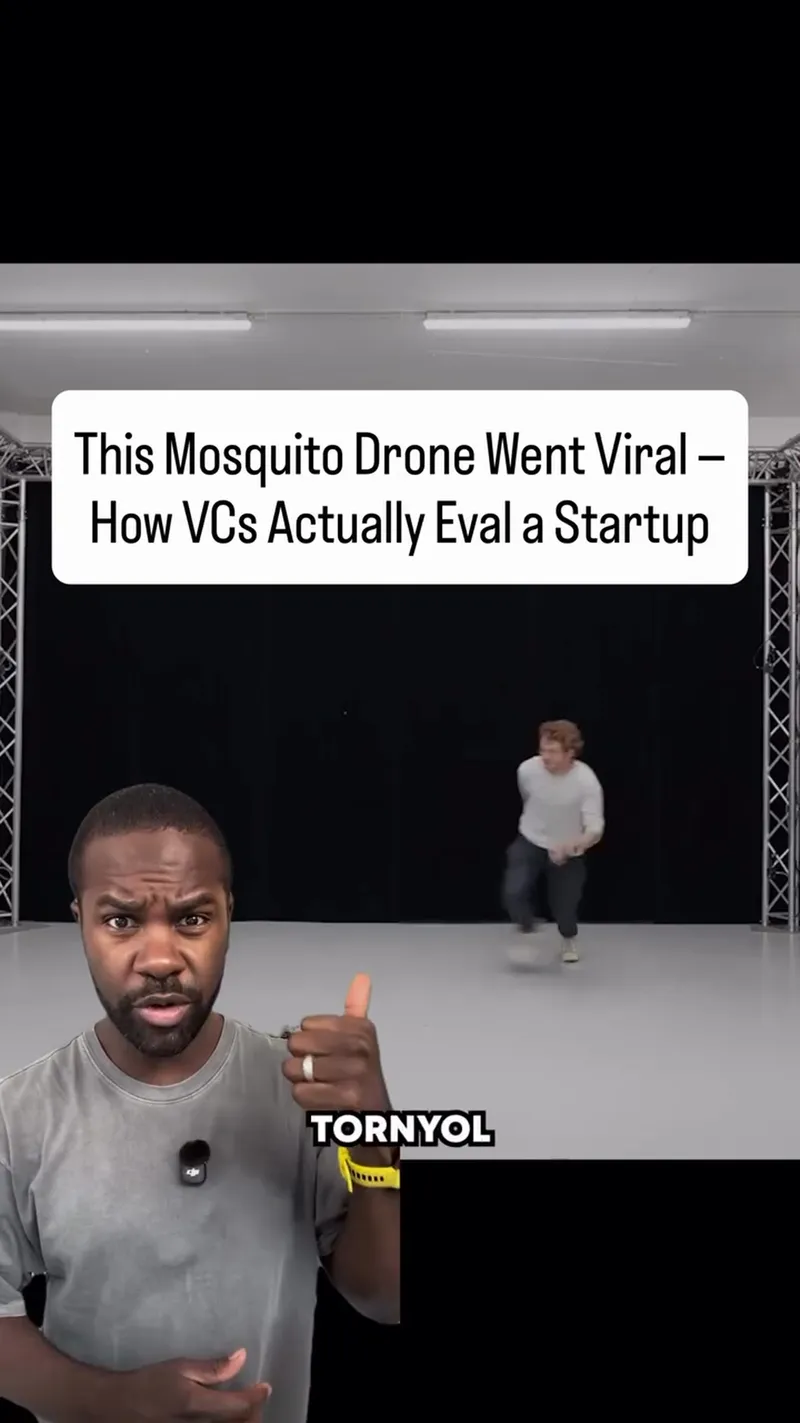
“This Mosquito Drone Went Viral – How VCs Actually Eval a Startup”
- Visual
- Text-led compositionA large, centered headline sits above a full-body background figure on a sparse studio-like set, while a presenter appears as a large cutout in the lower-left foreground. The background figure is gesturing or moving, but the drone is not clearly visible.
- The presenter speaks to camera while sampled clips show a drone demo and a funding document, illustrating his account of the technology and founder.
“Alright, so did you see this YC backed company, Tornyal, just post this video. It shows this small like 40 gram drone autonomously hunting down and then killing this moth in midair. It got over 10 million views. In all the comments, everyone's laughing about this bug zapper that's going to help out summer barbecues. But as a vc, I'm looking at this thing completely differently. So let's use this company as a quick example of how an investor takes a quick eval on a startup. First, let's talk about how it works. The drone's using ultrasonic sonar, which is like echolocation, similar to what a bat has. So it's actually listening for the wing beat of the flying insect and then identifies it by its signature and then intercepts it in midair. So look at where they're starting with a moth, because it's relatively big, it has a slow wing beat, which therefore makes it a lot easier to track. But the goal is mosquitoes. I mean they're smaller, faster, way more erratic in how they move. But then we watch the progress. Moth today, mosquito next. And then here's the thing, if you can autonomously intersect something that's the size of a grain of rice, then tracking like crop pests become pretty easy. Even an enemy drone on a battlefield, even easier than that, because everything bigger and slower is really downhill from that INIT problem. And that's the slope and reading that whole slope, that's really the job of US VCs. Now the second thing I'd look at who's building it and what does maybe their resume or their team tells you about where this might go. Now, the lead engineer and founder on this was Alex Toussaint, and he was also the former engineer at mbda, which is the European missile and defense giant. So that's not just like a fun fact that should really be treated as a diligence signal because then it tells you what problems he's fluent in, what networks he can then call on, and then maybe what markets he can go after and serve without having to retrain. And he even wrote some of this down himself. I then dug into some of his essays and saw that two years ago when he was raising his first $28,000 of non dilutive funding, he explicitly said the control theory that's needed to intercept this type of target is the same as on an air to air missile. So his sonar is the same operating principle as military radar. So while everyone else is asking if this mosquito drone is a real business, that's the wrong question. The right one is, what else can this thing catch again? If you like this sort of thing and want to stay close, join our community, Frontier Link in Bio.”
- 01Viral example and contrarian lens
Sets up the gap between the audience’s surface interpretation and the analysis to come, while promising a quick, structured evaluation.
Introduce a widely viewed demonstration, summarize the common lighthearted reaction, then contrast it with the speaker’s more consequential perspective and announce an evaluation framework.
“Alright, so did you see this YC backed company, Tornyal, just post this video. It shows this small like 40 gram drone autonomously hunting down and then killing this moth in midair. It got over 10 million views. In all the comments, everyone's laughing about this bug zapper that's going to help out summer barbecues. But as a vc, I'm looking at this thing completely differently. So let's use this company as a quick example of how an investor takes a quick eval on a startup.”
- 02Explain the mechanism and its current limit
Provides the technical basis for judging the demonstration and establishes the gap between present performance and the more difficult goal.
Walk through how the system detects and identifies a target, then explain why the demonstrated target is relatively easy and name a more demanding intended target.
“First, let's talk about how it works. The drone's using ultrasonic sonar, which is like echolocation, similar to what a bat has. So it's actually listening for the wing beat of the flying insect and then identifies it by its signature and then intercepts it in midair. So look at where they're starting with a moth, because it's relatively big, it has a slow wing beat, which therefore makes it a lot easier to track. But the goal is mosquitoes. I mean they're smaller, faster, way more erratic in how they move. But then we watch the progress.”
- 03Scale the capability to broader uses
Pays off the capability question by showing why the technical threshold matters beyond the initial use case, while extending the analysis from product to potential applications.
Turn the current-to-future progression into a general capability claim, extrapolate from a very small target to larger applications, and explain that reading this progression is the evaluator’s job.
“Moth today, mosquito next. And then here's the thing, if you can autonomously intersect something that's the size of a grain of rice, then tracking like crop pests become pretty easy. Even an enemy drone on a battlefield, even easier than that, because everything bigger and slower is really downhill from that INIT problem. And that's the slope and reading that whole slope, that's really the job of US VCs.”
- 04Assess the team and its relevant experience
Adds a people-based diligence signal after the technical case, explaining how prior work may indicate which problems and markets the team can pursue.
Introduce the second evaluation criterion, cite the founder’s relevant professional background, and connect that experience to expertise, networks, and possible markets.
“Now the second thing I'd look at who's building it and what does maybe their resume or their team tells you about where this might go. Now, the lead engineer and founder on this was Alex Toussaint, and he was also the former engineer at mbda, which is the European missile and defense giant. So that's not just like a fun fact that should really be treated as a diligence signal because then it tells you what problems he's fluent in, what networks he can then call on, and then maybe what markets he can go after and serve without having to retrain.”
- 05Reinforce the thesis and leave a broader question
Strengthens the capability-based thesis with another piece of background evidence, leaves the audience with an unresolved question about future applications, and ends with a direct invitation.
Add the founder’s prior writing as evidence of relevant technical thinking, connect the operating principle to a consequential domain, reject the obvious business question in favor of a broader capability question, then close with a community invitation.
“And he even wrote some of this down himself. I then dug into some of his essays and saw that two years ago when he was raising his first $28,000 of non dilutive funding, he explicitly said the control theory that's needed to intercept this type of target is the same as on an air to air missile. So his sonar is the same operating principle as military radar. So while everyone else is asking if this mosquito drone is a real business, that's the wrong question. The right one is, what else can this thing catch again? If you like this sort of thing and want to stay close, join our community, Frontier Link in Bio.”