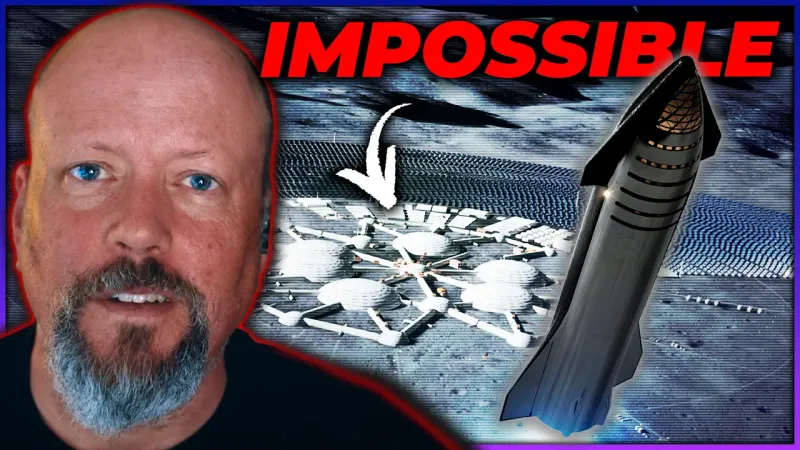
Moon Cities Are Not Happening. Here's Why
Fraser Cain@frasercainMoon Cities Are Not Happening. Here's Why
Fraser Cain opens this Space Bites episode by discussing a paper from Martin Elvis and Jonathan McDowell on why a large, lasting Moon city may be difficult, focusing on lunar water limits. The episode description and opening also preview a new lunar crater, the Roman telescope mission, black holes, and other space news.
- Views
- 238.5K
- Likes
- 4.3K
- Comments
- 929
- Moon city feasibilityLunar water supplySpace news roundupPlanetary science
Analysis
Fraser Cain opens this Space Bites episode by discussing a paper from Martin Elvis and Jonathan McDowell on why a large, lasting Moon city may be difficult, focusing on lunar water limits. The episode description and opening also preview a new lunar crater, the Roman telescope mission, black holes, and other space news.
- News reportExplainerVlog
- Title
- Moon Cities Are Not Happening. Here's Why
“Maybe we won't be living on cities on the moon. Roman's perfect launch adds years to its mission. A fresh new crater on the moon, and it's a biggie. Did the sun eat a planet? And in Space Bites+, Mercury is shrinking faster than we thought. All this and more in this week's Space Bites. Hello from the Cotswolds in the UK. I am currently in a town called Broadway and about to do day two of our hike down through the Cotswolds. Today was a big day, maybe the biggest one of the entire hike. So we're going to take it a little more easy tomorrow, which is good because I need to write my newsletter tomorrow. But anyway, let's get into this week's episode of Space Bites. First up is a story from Evan Goff, and this is reporting on a new paper that has come out from Martin Elvis and Jonathan McDowell. And if those names aren't familiar to you, Jonathan McDowell is a legendary space journalist, writes Jonathan's Space Report, and has just been reporting on the positions of spacecraft and orbits and the deorbiting of spacecraft for longer than I've been doing this job. And the other person is Martin Elvis, who I actually interviewed about a year ago about putting radio telescopes on the far side of the Moon. And he completely convinced me on why we should go to the Moon. But this paper says that trying to build a sustainable long- term presence on the Moon is going to be really tricky. In the paper, they look at two major needs that humanity is going to have on the Moon. One is power. And they looked at renewable power, like solar cells on the Moon, and they looked at maybe the coming age of fusion power. And actually, power is not going to be a problem, that even though the three most important things when you're traveling in space are power, power, and power, there should be enough power falling on the Moon. The second issue is water. According to McDowell and Elvis, this is a big problem. There's actually not a lot of water on the Moon. In fact, they reference a 2007 study that looked at just one crater, and like a big one, one of these South Pole craters that are permanently shadowed. And they found that a 21 kilometer crater had about 1.5 to 4.5 million tons of water ice. Now, I'm sure at this point you're saying, what about recycling water, like the International Space Station recently hit about 98% efficiency in recycling water. And you would assume that a habitation on the Moon would do something very similar. Even if you could reach that 98% efficiency, and you were harvesting all of the water that you could get your hands on on the Moon, you still would find that your city would run out of water in about 100 years or so. Now, if you bring that number of people down to say 100,000 people, now you could last 1,000 years. And they think, well, if you actually bring it down to a Moon village, maybe 1,000 people, something that is equivalent to what we have, say in Antarctica, now you could effectively last forever. And that is the kind of human presence on the Moon. So maybe not an Artemis-style city on the Moon, maybe not a Futurama-style amusement park on the Moon, probably just a small lunar station. Now, if you're interested in that conversation that I had with Martin Elvis, I'll put a link down in the show notes, and I think you'll find it really interesting.”
- 01Raise the possibility and introduce the source
This makes the episode's central feasibility question explicit and signals that the discussion is grounded in a recently published paper.
The speaker questions whether people will live in lunar cities, then identifies the paper and its authors.
“Maybe we won't be living on cities on the moon. Roman's perfect launch adds years to its mission. A fresh new crater on the moon, and it's a biggie. Did the sun eat a planet? And in Space Bites+, Mercury is shrinking faster than we thought. All this and more in this week's Space Bites. Hello from the Cotswolds in the UK. I am currently in a town called Broadway and about to do day two of our hike down through the Cotswolds. Today was a big day, maybe the biggest one of the entire hike. So we're going to take it a little more easy tomorrow, which is good because I need to write my newsletter tomorrow. But anyway, let's get into this week's episode of Space Bites. First up is a story from Evan Goff, and this is reporting on a new paper that has come out from Martin Elvis and Jonathan McDowell.”
- 02Establish relevant experience and frame the paper's claim
Relevant experience establishes context for the sources, while the speaker's earlier positive view of lunar exploration creates a useful contrast with the paper's feasibility concerns.
The speaker explains one author's relevant reporting background, recalls having interviewed the other, and introduces the paper's claim that a sustainable lunar presence will be difficult.
“And if those names aren't familiar to you, Jonathan McDowell is a legendary space journalist, writes Jonathan's Space Report, and has just been reporting on the positions of spacecraft and orbits and the deorbiting of spacecraft for longer than I've been doing this job. And the other person is Martin Elvis, who I actually interviewed about a year ago about putting radio telescopes on the far side of the Moon. And he completely convinced me on why we should go to the Moon. But this paper says that trying to build a sustainable long- term presence on the Moon is going to be really tricky.”
- 03Assess the requirements and narrow the conclusion
The concrete resource discussion develops the feasibility question into an assessment of what scale might be supportable. The ending preserves a distinction between a large imagined city and a smaller lunar presence; the supplied excerpt then turns toward a related prior conversation.
The speaker outlines power and water as needs, qualifies the power concern, gives water estimates and scenarios for settlement size, then concludes that a small station is more plausible than a city or amusement park.
“In the paper, they look at two major needs that humanity is going to have on the Moon. One is power. And they looked at renewable power, like solar cells on the Moon, and they looked at maybe the coming age of fusion power. And actually, power is not going to be a problem, that even though the three most important things when you're traveling in space are power, power, and power, there should be enough power falling on the Moon. The second issue is water. According to McDowell and Elvis, this is a big problem. There's actually not a lot of water on the Moon. In fact, they reference a 2007 study that looked at just one crater, and like a big one, one of these South Pole craters that are permanently shadowed. And they found that a 21 kilometer crater had about 1.5 to 4.5 million tons of water ice. Now, I'm sure at this point you're saying, what about recycling water, like the International Space Station recently hit about 98% efficiency in recycling water. And you would assume that a habitation on the Moon would do something very similar. Even if you could reach that 98% efficiency, and you were harvesting all of the water that you could get your hands on on the Moon, you still would find that your city would run out of water in about 100 years or so. Now, if you bring that number of people down to say 100,000 people, now you could last 1,000 years. And they think, well, if you actually bring it down to a Moon village, maybe 1,000 people, something that is equivalent to what we have, say in Antarctica, now you could effectively last forever. And that is the kind of human presence on the Moon. So maybe not an Artemis-style city on the Moon, maybe not a Futurama-style amusement park on the Moon, probably just a small lunar station. Now, if you're interested in that conversation that I had with Martin Elvis, I'll put a link down in the show notes, and I think you'll find it really interesting.”