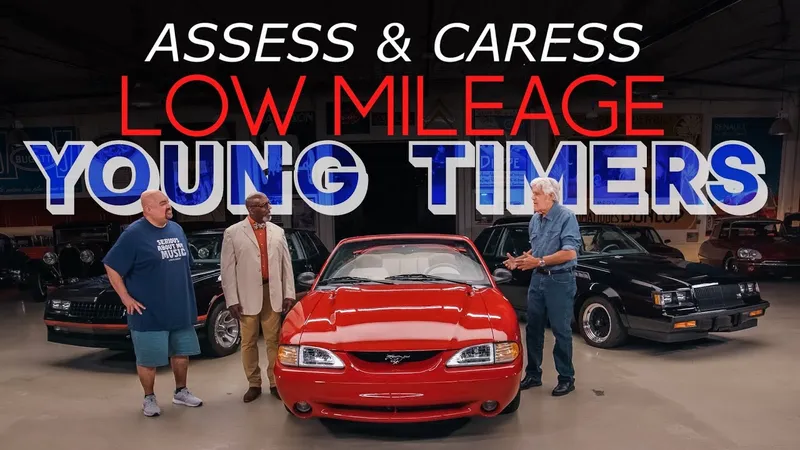
Low Mileage Young-Timers | Assess and Caress with Donald Osborne | Jay Leno's Garage
Jay Leno's Garage@jaylenosgarageLow Mileage Young-Timers | Assess and Caress with Donald Osborne | Jay Leno's Garage
Jay Leno and valuation expert Donald Osborne welcome Gabriel Iglesias to discuss three unusually low-mileage cars from his collection: a 1987 Buick GNX, 1988 Chevrolet Monte Carlo SS, and 1994 Ford Mustang SVT Cobra pace car replica. The opening introduces “youngtimers,” how cars become classics, and the collector-market framing behind the episode.
- Views
- 262.9K
- Likes
- 4.7K
- Comments
- 455
- Low-Mileage YoungtimersCollector car valuesGabriel iglesias carsClassic car collecting
Analysis
Jay Leno and valuation expert Donald Osborne welcome Gabriel Iglesias to discuss three unusually low-mileage cars from his collection: a 1987 Buick GNX, 1988 Chevrolet Monte Carlo SS, and 1994 Ford Mustang SVT Cobra pace car replica. The opening introduces “youngtimers,” how cars become classics, and the collector-market framing behind the episode.
- InterviewReview
- Title
- Low Mileage Young-Timers | Assess and Caress with Donald Osborne | Jay Leno's Garage
“Welcome to the episode of Assassin Crestand Jaylen's Garage. Brought to you by the fabulous Audrain Auto Museum inNewport, Rhode Island. Uh, we get quite a few cars there, but not these three.These three belong to a very discerning collector, a man of impeccable taste, aman when he walks into a room, everything stops.>> They're not your cars. >> And no, these are not my cars. My carsdon't stop. His stop. And these cars are him. This is his childhood, and he'sbrought them here tonight to share with us. Please welcome Gabriel and Glaces.Gabriel, how are you, my friend? >> H doing good. Doing good.>> Yeah. >> Hey there. Great to meet you. [laughter]>> These are astonishing cars that you've uh loaned to us today.>> Yeah. You know, yeah, they're not bad. >> No, but>> they stop. They do stop. >> I'm a generation older than Donald, butstill we have the same taste. Late 60s, early 70s. It's just funny how it alljust keeps moving forward, you know, like you're you're a child of the late80s and 90s. When you were a little kid, these cars from the 80s, this was thecool thing, wasn't it? >> Oh, yeah. Very much so. Very much so.But it wasn't until the 90s that I really had a different appreciation for.>> Right. Right. Yeah. >> Because I was in a position to drivethem. Whereas before, it's like vroom, you know.>> Right. Right. >> Always driving them. But the drivingcharacteristics on carpet and the street are very, very different.>> Very, very different. >> Yeah. Exactly. I find that often it'sthe case. And this segment is actually sort of titled low mileage youngtimers.And young timers is this >> that's like me. [laughter] >> And you actually like original cars aswell, which we'll get into in a moment. The term young-timers comes from Germancar collecting because antique cars were called old-timers. And they said, well,they're these cars that are very interesting and collectible, but they'renot old. So, what do we call them? And so, hence the term youngtimes.>> Very German. >> Very German. Exactly. Young time cuss.And one of the things that Jay just mentioned is the fact that it's so truecollecting is like the universe. It keeps expanding. It doesn't stop at1968, doesn't stop at 1990 because these cars are now old cars. We have to facethat. You know, we seem to remember them in the showroom, but nonetheless, Imean, these cars are uh practically your age.>> Yeah. Well, you know, so what exactly is uh considered a classic? How how olddoes a car have to be for it to be classic?>> That's a great question. And there are different definitions of that. The motorvehicle departments in most states think 25 years old is a classic car.>> Is a classic. Brass era, then vintage, then classic. I think that's how itworks, isn't it? >> That's generally how it works. But theinteresting thing, >> just an old ass car. [laughter]>> Well, that that what what what defines for me a classic is when an old ass carbecomes interesting to people that didn't remember it when it was new. Andthat's one of the things nostalgia is a great thing. Nostalgia is fantastic, butnostalgia only carries us so far. Once the people that like brass era cars, thepeople that remember those cars as kids are long dead and yet they're stillinteresting to people because they're interesting cars. And I think that's theentire point of this. >> Well, Donald, tell us what we have heretoday. >> All right. Well, we have from Gab'swonderful collection a 1987 Buick GNX, a 1988 Chevrolet Monte Carlo SS, and a1994 Ford Mustang SVT Cobra pace car replica.>>”
- 01Show and guest introduction
Establishes the program and introduces the collection and its owner before the hosts connect the cars to the episode’s subject.
Identifies the show, its sponsor, the collection’s owner and his cars, then welcomes him and exchanges greetings.
“Welcome to the episode of Assassin Crestand Jaylen's Garage. Brought to you by the fabulous Audrain Auto Museum inNewport, Rhode Island. Uh, we get quite a few cars there, but not these three.These three belong to a very discerning collector, a man of impeccable taste, aman when he walks into a room, everything stops.>> They're not your cars. >> And no, these are not my cars. My carsdon't stop. His stop. And these cars are him. This is his childhood, and he'sbrought them here tonight to share with us. Please welcome Gabriel and Glaces.Gabriel, how are you, my friend? >> H doing good. Doing good.>> Yeah. >> Hey there. Great to meet you. [laughter]>>”
- 02Personal connection and category
Makes the category personally meaningful before explaining its name, and uses a guest’s recollection to lead naturally into the topic.
The host identifies the items as loaned for the episode; the exchange links their appeal to a shared era and to childhood memories, then introduces the segment’s “low mileage young-timers” label.
“These are astonishing cars that you've uh loaned to us today.>> Yeah. You know, yeah, they're not bad. >> No, but>> they stop. They do stop. >> I'm a generation older than Donald, butstill we have the same taste. Late 60s, early 70s. It's just funny how it alljust keeps moving forward, you know, like you're you're a child of the late80s and 90s. When you were a little kid, these cars from the 80s, this was thecool thing, wasn't it? >> Oh, yeah. Very much so. Very much so.But it wasn't until the 90s that I really had a different appreciation for.>> Right. Right. Yeah. >> Because I was in a position to drivethem. Whereas before, it's like vroom, you know.>> Right. Right. >> Always driving them. But the drivingcharacteristics on carpet and the street are very, very different.>> Very, very different. >> Yeah. Exactly. I find that often it'sthe case. And this segment is actually sort of titled low mileage youngtimers.And young timers is this >> that's like me. [laughter]”
- 03Category origin and classic question
Clarifies the category, then develops the opening’s central question: whether classic status depends on an official age threshold or on a car’s continuing interest to people without firsthand memories of its debut.
The host notes the guest’s interest in original examples, explains the German collecting term “young-timers,” then moves to the expanding age range of collectible cars and asks what qualifies as a classic. The answer distinguishes state definitions from a more personal definition based on whether people remember the car when new.
“>> And you actually like original cars aswell, which we'll get into in a moment. The term young-timers comes from Germancar collecting because antique cars were called old-timers. And they said, well,they're these cars that are very interesting and collectible, but they'renot old. So, what do we call them? And so, hence the term youngtimes.>> Very German. >> Very German. Exactly. Young time cuss.And one of the things that Jay just mentioned is the fact that it's so truecollecting is like the universe. It keeps expanding. It doesn't stop at1968, doesn't stop at 1990 because these cars are now old cars. We have to facethat. You know, we seem to remember them in the showroom, but nonetheless, Imean, these cars are uh practically your age.>> Yeah. Well, you know, so what exactly is uh considered a classic? How how olddoes a car have to be for it to be classic?>> That's a great question. And there are different definitions of that. The motorvehicle departments in most states think 25 years old is a classic car.>> Is a classic. Brass era, then vintage, then classic. I think that's how itworks, isn't it? >> That's generally how it works. But theinteresting thing, >> just an old ass car. [laughter]>> Well, that that what what what defines for me a classic is when an old ass carbecomes interesting to people that didn't remember it when it was new. Andthat's one of the things nostalgia is a great thing. Nostalgia is fantastic, butnostalgia only carries us so far. Once the people that like brass era cars, thepeople that remember those cars as kids are long dead and yet they're stillinteresting to people because they're interesting cars. And I think that's theentire point of this. >> Well, Donald, tell us what we have heretoday. >> All right. Well, we have from Gab'swonderful collection a 1987 Buick GNX, a 1988 Chevrolet Monte Carlo SS, and a1994 Ford Mustang SVT Cobra pace car replica.>>”