The shocking thing about investment returns...
Nischa@nischaThe shocking thing about investment returns...
The video compares long-term stock market returns with cash savings and explains how inflation can reduce purchasing power. Nischa also discusses managing investment behavior, avoiding investing money needed for debt or near-term expenses, and promotes a free workshop on investing and building wealth.
- Views
- 203.9K
- Likes
- 2K
- Comments
- 203
- Long-Term Investing ReturnsInflation and Cash SavingsInvestor Behavior and RiskGetting started investing
Analysis
The video compares long-term stock market returns with cash savings and explains how inflation can reduce purchasing power. Nischa also discusses managing investment behavior, avoiding investing money needed for debt or near-term expenses, and promotes a free workshop on investing and building wealth.
- Explainer
- Title
- The shocking thing about investment returns...
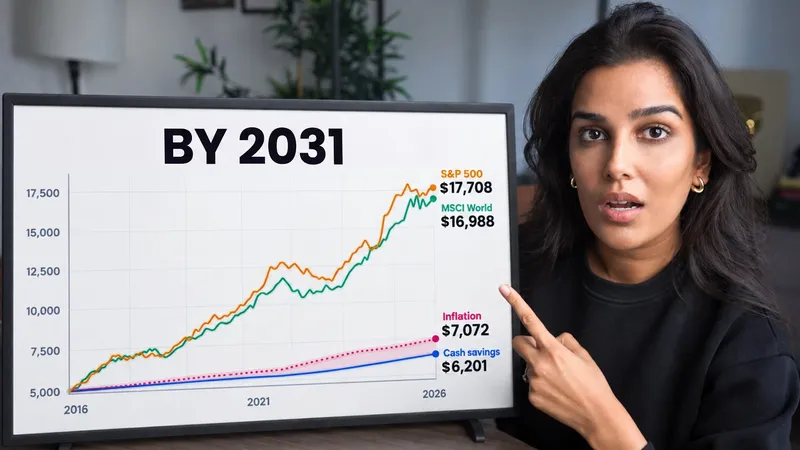
“I want to show you something that really shocked me when I first saw it. Investing, it's volatile. On the screen right now, you can see the annual returns of two stock market indices. The S&P 500, which tracks around 500 of the largest companies in the United States, and a global index, which gives you exposure to companies across different countries around the world. Now, let's compare that with keeping your money in a bank account paying high interest. Your bank balance in comparison looks a lot more stable and it's slowly going up. And here is the really important part. First, one of the biggest mistakes you can do if you're thinking about investing your money is staying logged in. Because you are going to watch your money go up and down. You are going to watch this graph happen daily, weekly, monthly. In fact, being a successful investor has far more to do with your behavior and managing your emotions than how smart you are. Second, you should not be investing any money that you need to pay off high interest rate debt or that you're going to need in the next 5 years. Chartered Accountant, I've spent 9 years working in investment banking and I have seen firsthand what happens when markets don't behave the way people expect. So, with that in mind, let's come back to this graph. This is the returns when you're looking at an annual basis, an annual percent of return. Now, let's zoom out. Let's look at 10 years if you kept your money in a bank account. Because this is where things get really interesting. Let's say you had 5,000 10 years ago. If you had kept that money in cash and you put it all into the best savings account of all time at any point in time. After 10 years, you could have expected your 5,000 savings to have grown to approximately 6,201. At first glance, that sounds pretty good. You've made over a thousand. But, here's the problem. To buy the same stuff that that 5,000 would would got you 10 years ago, you don't need 6,201. You need over 7,000. So, technically, you're actually worse off than you were 10 years ago. You have less purchasing power because of inflation. Now, let's put the same 5,000 into the stock market. So, looking back at the same two indices we spoke about, the S&P 500 and a global index like the MSCI All World, here is what 5,000 would have turned into. Nearly 17,800 for the S&P 500 or nearly 17,000 in the All World. This here shows a pretty high probability that investing is what you need to do to make sure you don't fall behind. And I'm sharing a completely free 45-minute workshop this Sunday, and by the end of that 45 minutes, you'll know exactly how to invest and what to invest in. You can sign up at nisha.me/invest or click the link that is in the description below. It's completely 100 100% free, and we'll also cover how to accelerate your investment returns over time, including the one hack that I haven't mentioned anywhere on my social media that almost everyone misses. We'll also talk about the single biggest mistake new investors make and how to make sure you avoid it. And I'll show you how to calculate exactly what you need to eventually live off your investments so that you can be in full control over your financial life and your financial future. Again, it's 100% free. You can sign up at nisha.me/invest anytime before the doors close or click the link in the description.”
- 01Surprising premise and comparison
This makes investment returns the immediate subject and sets up a comparison between potentially volatile market returns and steadier-looking savings.
The speaker promises to show a personally shocking observation, then introduces investment volatility and compares stock indices with a high-interest bank account.
“I want to show you something that really shocked me when I first saw it. Investing, it's volatile. On the screen right now, you can see the annual returns of two stock market indices. The S&P 500, which tracks around 500 of the largest companies in the United States, and a global index, which gives you exposure to companies across different countries around the world. Now, let's compare that with keeping your money in a bank account paying high interest.”
- 02The reassuring result and its catch
The apparent reassurance is qualified: investors may need to tolerate fluctuations, and the speaker cautions against investing money needed for high-interest debt or within five years.
The bank balance is described as stable and rising, before the speaker introduces important points about investor behavior, managing emotions, and money that should not be invested.
“Your bank balance in comparison looks a lot more stable and it's slowly going up. And here is the really important part. First, one of the biggest mistakes you can do if you're thinking about investing your money is staying logged in. Because you are going to watch your money go up and down. You are going to watch this graph happen daily, weekly, monthly. In fact, being a successful investor has far more to do with your behavior and managing your emotions than how smart you are. Second, you should not be investing any money that you need to pay off high interest rate debt or that you're going to need in the next 5 years.”
- 03Credentials and worked comparison
The credentials contextualize the speaker’s perspective, while the ten-year example supplies the opening’s central reversal: a balance can rise yet still buy less. The index figures then support the speaker’s argument that investing can help avoid falling behind.
The speaker gives professional experience, returns to the graph, and contrasts what $5,000 could become in a savings account with what the same amount could become in two stock indices. The nominal savings gain is then qualified by inflation’s effect on purchasing power.
“Chartered Accountant, I've spent 9 years working in investment banking and I have seen firsthand what happens when markets don't behave the way people expect. So, with that in mind, let's come back to this graph. This is the returns when you're looking at an annual basis, an annual percent of return. Now, let's zoom out. Let's look at 10 years if you kept your money in a bank account. Because this is where things get really interesting. Let's say you had 5,000 10 years ago. If you had kept that money in cash and you put it all into the best savings account of all time at any point in time. After 10 years, you could have expected your 5,000 savings to have grown to approximately 6,201. At first glance, that sounds pretty good. You've made over a thousand. But, here's the problem. To buy the same stuff that that 5,000 would would got you 10 years ago, you don't need 6,201. You need over 7,000. So, technically, you're actually worse off than you were 10 years ago. You have less purchasing power because of inflation. Now, let's put the same 5,000 into the stock market. So, looking back at the same two indices we spoke about, the S&P 500 and a global index like the MSCI All World, here is what 5,000 would have turned into. Nearly 17,800 for the S&P 500 or nearly 17,000 in the All World. This here shows a pretty high probability that investing is what you need to do to make sure you don't fall behind.”
- 04Workshop offer and further promises
This is a promotional close to the identified opening: it states what the workshop promises, gives a time-bound participation opportunity, and expands the offer into further specific topics. The transcript then continues with repeated registration details; the supplied excerpt does not provide a clear transition into the main video content.
The speaker offers a free 45-minute workshop, provides sign-up routes, and previews instruction on investing, returns, a little-known tip, avoiding a major beginner mistake, and estimating what is needed to live off investments.
“And I'm sharing a completely free 45-minute workshop this Sunday, and by the end of that 45 minutes, you'll know exactly how to invest and what to invest in. You can sign up at nisha.me/invest or click the link that is in the description below. It's completely 100 100% free, and we'll also cover how to accelerate your investment returns over time, including the one hack that I haven't mentioned anywhere on my social media that almost everyone misses. We'll also talk about the single biggest mistake new investors make and how to make sure you avoid it. And I'll show you how to calculate exactly what you need to eventually live off your investments so that you can be in full control over your financial life and your financial future. Again, it's 100% free. You can sign up at nisha.me/invest anytime before the doors close or click the link in the description.”