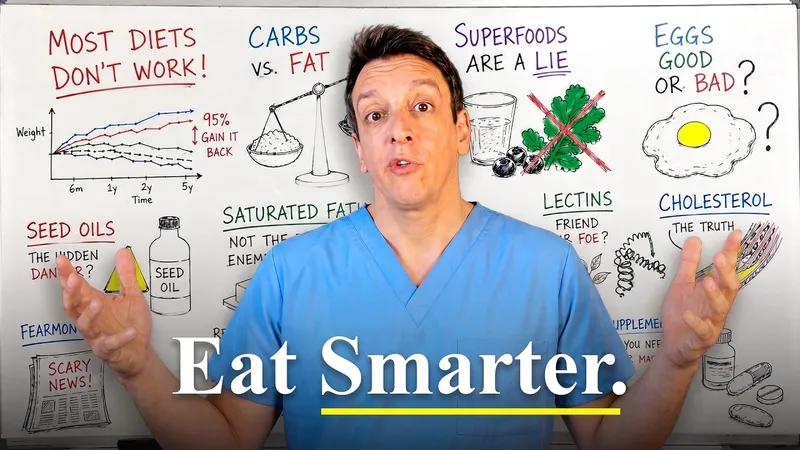
I Studied Nutrition for 30 Years. Here’s What Actually Matters.
I Studied Nutrition for 30 Years. Here’s What Actually Matters.
Gil Carvalho argues that nutrition advice can be confusing when it focuses on isolated nutrients instead of whole foods. He introduces a set of principles, beginning with how foods combine many components, and says the video will address fats, fear of foods, homeostasis, and consistency.
- Views
- 645K
- Likes
- 21.5K
- Comments
- 843
- Nutrition principlesWhole food effectsDietary fatsNutrition misinformation
Analysis
Gil Carvalho argues that nutrition advice can be confusing when it focuses on isolated nutrients instead of whole foods. He introduces a set of principles, beginning with how foods combine many components, and says the video will address fats, fear of foods, homeostasis, and consistency.
- ExplainerTalking head
- Title
- I Studied Nutrition for 30 Years. Here’s What Actually Matters.
“Have you noticed you can watch 10 videos on nutrition and get all kinds of contradictory advice and come away more confused than you went in? And scared of every food and frustrated and you just feel like giving up. Truth is, most nutrition content on social media is not that helpful. It misses the point entirely. What's worse, it trains your mind to ask the wrong questions. And this is really tragic because nutrition applied correctly is unbelievably powerful. Heart disease, cancer, diabetes, even dementia are massively impacted by your diet. So, getting the wrong advice isn't just a complete waste of your time, it also deprives you of life-saving information. I've spent the last 30 years studying medicine, biology, and nutrition. I've published my own scientific studies and I've had the privilege of interviewing some of the top researchers on the planet. And in this video, I'll share with you exactly what my family and I do and eat to achieve and maintain exceptional health. I'll give you every tool you need so you can build delicious, healthy meals for your family and you can also spot bad nutrition advice and you can finally stop wasting time with stuff that just doesn't matter. I was recently writing this long article answering every frequently asked question on nutrition that you guys ask and I'll link that below for you, but I realized it all boils down to five really simple principles. And they're so incredibly powerful because they give you peace of mind and we can cover them in minutes as you'll see and by the end, you'll be able to judge nutrition claims immediately if it's something serious or if it's just fear-mongering. So, here's the first principle.”
- 01Conflicting advice
This establishes the audience problem that motivates the video: not a lack of content, but advice that leaves viewers less certain and may direct their attention to the wrong questions.
The speaker asks whether viewers have noticed that many nutrition videos can leave them with contradictory advice, confusion, fear, and frustration, then says most social-media nutrition content is not helpful and misses the point.
“Have you noticed you can watch 10 videos on nutrition and get all kinds of contradictory advice and come away more confused than you went in? And scared of every food and frustrated and you just feel like giving up. Truth is, most nutrition content on social media is not that helpful. It misses the point entirely. What's worse, it trains your mind to ask the wrong questions.”
- 02Consequences
This explains why the confusion matters beyond inconvenience and frames better guidance as consequential. The health claims are presented as the speaker’s claims, not independently verified evidence.
The speaker says correctly applied nutrition can be powerful, names serious diseases, and claims that wrong advice wastes time and can deprive viewers of life-saving information.
“And this is really tragic because nutrition applied correctly is unbelievably powerful. Heart disease, cancer, diabetes, even dementia are massively impacted by your diet. So, getting the wrong advice isn't just a complete waste of your time, it also deprives you of life-saving information.”
- 03Experience and promised guidance
The experience is offered as a reason to follow the guidance, and the personal-practice promise turns the broad subject into an account of what the speaker says works for their family.
The speaker describes 30 years of study, published scientific work, and interviews with top researchers, then promises to share what the speaker and family do and eat to maintain health.
“I've spent the last 30 years studying medicine, biology, and nutrition. I've published my own scientific studies and I've had the privilege of interviewing some of the top researchers on the planet. And in this video, I'll share with you exactly what my family and I do and eat to achieve and maintain exceptional health.”
- 04Tools and five principles
This makes the viewing payoff specific: a short set of principles intended to support meal decisions and the assessment of claims. The transition into the first principle marks the start of the sustained explanation, so the introduction ends before its details.
The speaker promises tools for making healthy meals, spotting bad advice, and avoiding wasted time. A recent article is said to have distilled frequently asked questions into five simple principles, which the speaker says can provide peace of mind and help viewers judge nutrition claims. The introduction ends as the speaker announces the first principle.
“I'll give you every tool you need so you can build delicious, healthy meals for your family and you can also spot bad nutrition advice and you can finally stop wasting time with stuff that just doesn't matter. I was recently writing this long article answering every frequently asked question on nutrition that you guys ask and I'll link that below for you, but I realized it all boils down to five really simple principles. And they're so incredibly powerful because they give you peace of mind and we can cover them in minutes as you'll see and by the end, you'll be able to judge nutrition claims immediately if it's something serious or if it's just fear-mongering. So, here's the first principle.”