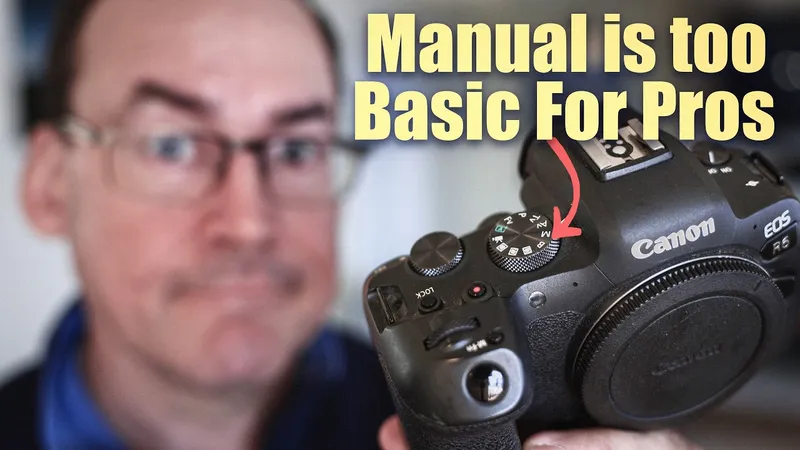
Why 95% of Pros use THIS MODE!
Simon d'Entremont@simon_dentremontWhy 95% of Pros use THIS MODE!
Simon d’Entremont explains why experienced photographers may return to semi-automatic camera modes after learning manual exposure. The opening contrasts control over aperture, shutter speed and ISO, and argues that letting the camera manage settings that matter less can help photographers respond quickly to wildlife moments.
- Views
- 269.3K
- Likes
- 8.5K
- Comments
- 550
- Camera shooting modesManual exposure controlWildlife photographyPhotography exposure settings
Analysis
Simon d’Entremont explains why experienced photographers may return to semi-automatic camera modes after learning manual exposure. The opening contrasts control over aperture, shutter speed and ISO, and argues that letting the camera manage settings that matter less can help photographers respond quickly to wildlife moments.
- ExplainerTutorial
- Title
- Why 95% of Pros use THIS MODE!
“This video is brought to you by Squarespace. If you need a website or domain, go to squarespace.com. Hey everyone, and welcome to a new video. Now, when we learn photography, we're usually taught that there's a progression. You may start in automatic, then maybe graduate to aperture priority or shutter priority or auto ISO, and eventually you reach full manual mode. Manual is supposed to be the final destination, the most advanced mode, and the mode serious photographers use. But, I don't think that's where the progression ends. For the very most skilled photographers, I think there's actually another step after manual. And strangely enough, it takes us right back to some of those automatic and semi-automatic modes we thought we'd graduated from. The difference now is that we're not using automation because we don't know how to control the camera, we're using it because we do. So, in this video, I'm going to show you why many professional and most experienced photographers deliberately go back to semi-automatic modes after having mastered manual. [clears throat] And why doing that can actually give you more control over your photography, not less. My name is Simon d'Entremont, and I'm a professional nature and wildlife photographer living in Eastern Canada. I make weekly videos giving you photo tips or taking you behind the scenes for nature photography. Subscribe if you want to see more.”
- 01Set up the supposed progression
Establishes the expectation that manual is the culmination, giving the coming reversal a clear point of comparison.
The speaker describes a familiar learning path through photography modes, ending with manual as the assumed advanced destination.
“This video is brought to you by Squarespace. If you need a website or domain, go to squarespace.com. Hey everyone, and welcome to a new video. Now, when we learn photography, we're usually taught that there's a progression. You may start in automatic, then maybe graduate to aperture priority or shutter priority or auto ISO, and eventually you reach full manual mode. Manual is supposed to be the final destination, the most advanced mode, and the mode serious photographers use.”
- 02Reverse the expected endpoint
Makes the episode's central counterintuitive premise explicit and promises to explain why returning to automation can bring more control.
The speaker disputes that manual is where progression ends and says highly skilled photographers may return to automatic and semi-automatic modes, this time using automation because they know how to control the camera.
“But, I don't think that's where the progression ends. For the very most skilled photographers, I think there's actually another step after manual. And strangely enough, it takes us right back to some of those automatic and semi-automatic modes we thought we'd graduated from. The difference now is that we're not using automation because we don't know how to control the camera, we're using it because we do. So, in this video, I'm going to show you why many professional and most experienced photographers deliberately go back to semi-automatic modes after having mastered manual. [clears throat] And why doing that can actually give you more control over your photography, not less.”
- 03Establish expertise and channel context
Supports the guide's credibility with relevant professional experience and briefly identifies the channel's continuing subject matter.
The speaker gives his name, professional nature and wildlife photography background, describes the channel's weekly videos, and invites viewers to subscribe.
“My name is Simon d'Entremont, and I'm a professional nature and wildlife photographer living in Eastern Canada. I make weekly videos giving you photo tips or taking you behind the scenes for nature photography. Subscribe if you want to see more.”