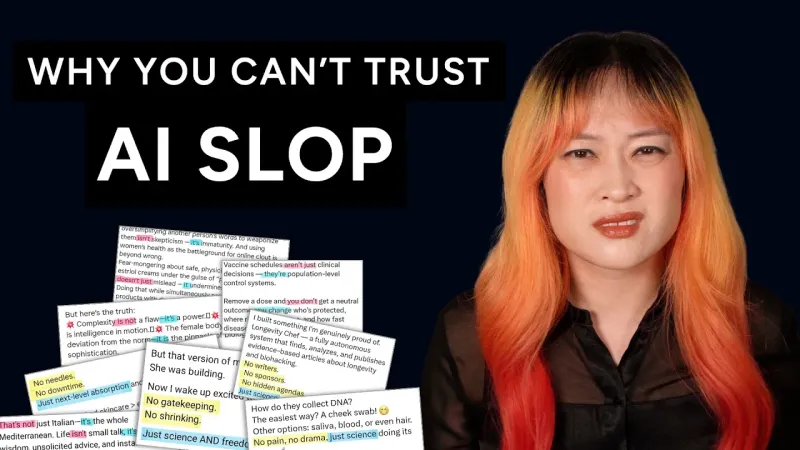
AI slop has hit the science communicators
Lab Muffin Beauty Science@LabMuffinBeautyScienceAI slop has hit the science communicators
Michelle discusses the spread of AI-generated science content and why she says chatbots such as ChatGPT, Claude and Gemini should not be trusted for accuracy or fact-checking. She introduces common signs of AI slop and promises tips for spotting it, while raising concerns about its effects on science communication and critical thinking.
- Views
- 323.7K
- Likes
- 17.9K
- Comments
- 2.1K
- AI-Generated Science ContentAI chatbot accuracySpotting science misinformationCritical thinking
Analysis
Michelle discusses the spread of AI-generated science content and why she says chatbots such as ChatGPT, Claude and Gemini should not be trusted for accuracy or fact-checking. She introduces common signs of AI slop and promises tips for spotting it, while raising concerns about its effects on science communication and critical thinking.
- ExplainerRant
- Title
- AI slop has hit the science communicators
AI slop has hit the science creators. I cannot go on social media without AI science slop being poured into my eyes. This isn't just beauty science. This is all of science and facts. And it's made me really worried about critical thinking and just what are we doing as a species? By AI slop, I'm talking about stuff that is obviously mostly AI - things like ChatGPT, Claude, and Gemini. And a lot of people don't seem to know why it's a problem or how to spot it, including science creators. So today we're going through why you can't trust AI science slop and how to spot it. We're going slopspotting. And once you start seeing the slop, it is really hard to unsee. I think the AI slop infographics are the most obvious. There's also the writing. "It's not X, it's Y." "No A, no B, just C." This is in posts and captions. People are saying it in videos. It sounds kind of smart, but it isn't if you take a second to look at it properly. And there's mistakes that no human adult would make. Like this post has a list of references and only one of them actually exists. And getting really basic facts wrong, like these cosmetic chemists managed to talk about a study for 15 minutes over two podcasts while missing basic stuff that's even mentioned in the abstract. Scientists are messing things up like how long a study took, how many people were in the study. And a lot of people were telling on themselves with these caricatures, asking ChatGPT to include what they knew about their job. I saw so many from medical doctors and there's topics that they post about in the background like skincare tips. Now, a lot of this slop is from people who never cared about accuracy in the first place. They just want to make low effort content and look like an expert, push their brand, get sponsorships. And honestly? There was a lot of human slop before AI slop. Stealing content has always been a huge problem. It's not like the plagiarism machine is going to magically make people more ethical. But it is less effort to make slop now, so Brandolini's law is much worse. This is the BS asymmetry principle. The amount of energy to refute BS is a heck of a lot bigger than the energy you need to make it. So those of us who want to get real science from experts and science creators, we need to learn how to spot AI slop. And I'll be going through some tips. But what really disturbs me is seeing people who used to put in effort now just posting AI slop. This guy is one of Australia's top epidemiologists. I followed him in 2020. His feed is now mostly slop and he has given ChatGPT a name. Sorry, ChatGPT has told him its name. Columbia Public Health - this is an Ivy League college - they are also posting slop. Why are they doing this? I think some science creators are scared they'll fall behind. Social media platforms punish you if you don't post enough. And there's also all that "AI is here to stay" marketing. Some of them might not see the problem. They genuinely think AI content is accurate and better than their own content. I have seen so many science creators say things that show they do not understand AI tools. Like this chemist from the podcast, he's been using ChatGPT heavily for 2 years. His hobby is making AI music, but he still doesn't seem to realise that you can't rely on ChatGPT to summarise things correctly or fact check podcasts because AI chatbots aren't accurate.
- 01State the concern
This puts the central concern up front and establishes why the issue matters beyond a single niche.
The speaker says AI slop has reached science creators, describes repeated exposure to it, broadens the concern beyond beauty science, and says it has made them worried about critical thinking.
“AI slop has hit the science creators. I cannot go on social media without AI science slop being poured into my eyes. This isn't just beauty science. This is all of science and facts. And it's made me really worried about critical thinking and just what are we doing as a species?”
- 02Define the problem and promise a guide
The definition clarifies the episode’s subject, while the stated knowledge gap and direct promise establish the questions the episode will address.
The speaker defines what they mean by AI slop, says people including science creators may not recognize why it is a problem, and promises to explain why not to trust it and how to spot it.
“By AI slop, I'm talking about stuff that is obviously mostly AI - things like ChatGPT, Claude, and Gemini. And a lot of people don't seem to know why it's a problem or how to spot it, including science creators. So today we're going through why you can't trust AI science slop and how to spot it. We're going slopspotting. And once you start seeing the slop, it is really hard to unsee.”
- 03Preview recognizable warning signs
These examples begin to make the promised recognition guide concrete and give viewers reasons to keep listening for how the signs are identified.
The speaker names AI slop infographics and recurring writing patterns, then describes errors in references and basic facts, including mistakes about research details.
I think the AI slop infographics are the most obvious. There's also the writing. "It's not X, it's Y." "No A, no B, just C." This is in posts and captions. People are saying it in videos. It sounds kind of smart, but it isn't if you take a second to look at it properly. And there's mistakes that no human adult would make. Like this post has a list of references and only one of them actually exists. And getting really basic facts wrong, like these cosmetic chemists managed to talk about a study for 15 minutes over two podcasts while missing basic stuff that's even mentioned in the abstract. Scientists are messing things up like how long a study took, how many people were in the study.
- 04Explain the incentives and larger context
This moves from identifying examples to explaining why the content spreads and why responding to it can be difficult.
The speaker gives examples of AI-generated professional caricatures and low-effort content, then distinguishes AI slop from older human slop and says easier production worsens the effort imbalance involved in refuting false claims.
“And a lot of people were telling on themselves with these caricatures, asking ChatGPT to include what they knew about their job. I saw so many from medical doctors and there's topics that they post about in the background like skincare tips. Now, a lot of this slop is from people who never cared about accuracy in the first place. They just want to make low effort content and look like an expert, push their brand, get sponsorships. And honestly? There was a lot of human slop before AI slop. Stealing content has always been a huge problem. It's not like the plagiarism machine is going to magically make people more ethical. But it is less effort to make slop now, so Brandolini's law is much worse. This is the BS asymmetry principle. The amount of energy to refute BS is a heck of a lot bigger than the energy you need to make it.”
- 05Make the audience need explicit
This connects the problem to the audience’s interest in reliable science and shifts toward a specific concern the coming discussion will examine.
The speaker says people seeking real science from experts and science creators need to learn to spot AI slop, promises tips, and introduces concern about established creators now posting it.
“So those of us who want to get real science from experts and science creators, we need to learn how to spot AI slop. And I'll be going through some tips. But what really disturbs me is seeing people who used to put in effort now just posting AI slop.”
- 06Raise the question of why creators use it
The examples make the concern more specific, while the unanswered question about creators’ reasons opens a further line of explanation.
The speaker describes an epidemiologist whose feed is now mostly slop and a public-health institution posting slop, then asks why. They suggest platform pressure, AI marketing, and creators’ beliefs about its accuracy as possible explanations.
This guy is one of Australia's top epidemiologists. I followed him in 2020. His feed is now mostly slop and he has given ChatGPT a name. Sorry, ChatGPT has told him its name. Columbia Public Health - this is an Ivy League college - they are also posting slop. Why are they doing this? I think some science creators are scared they'll fall behind. Social media platforms punish you if you don't post enough. And there's also all that "AI is here to stay" marketing. Some of them might not see the problem. They genuinely think AI content is accurate and better than their own content.
- 07Give a final example of misplaced trust
This continues the opening’s examples and qualifications about trust, ending with a concrete claim about a tool limitation. The supplied excerpt ends here, so the boundary of the introduction cannot be confirmed beyond this point.
The speaker says science creators sometimes reveal misunderstandings of AI tools and cites a chemist who uses ChatGPT heavily but, in the speaker’s account, still appears not to understand its limits for summarizing and fact-checking podcasts.
“I have seen so many science creators say things that show they do not understand AI tools. Like this chemist from the podcast, he's been using ChatGPT heavily for 2 years. His hobby is making AI music, but he still doesn't seem to realise that you can't rely on ChatGPT to summarise things correctly or fact check podcasts because AI chatbots aren't accurate.”