The Multiple Choice Question That Breaks Your Brain
MindYourDecisions@MindYourDecisionsThe Multiple Choice Question That Breaks Your Brain
Presto Walker examines a viral multiple-choice question asking the odds of randomly choosing its correct answer, where 25%, 50%, and 0% are among the options. He traces how each proposed answer conflicts with the number of correct choices and calls the question paradoxical and not well posed. The description says the same question has gone viral before.
- Views
- 1.1M
- Likes
- 14.5K
- Comments
- 2.8K
- Self-Referential Probability PuzzleMultiple-Choice LogicParadoxical questions
Analysis
Presto Walker examines a viral multiple-choice question asking the odds of randomly choosing its correct answer, where 25%, 50%, and 0% are among the options. He traces how each proposed answer conflicts with the number of correct choices and calls the question paradoxical and not well posed. The description says the same question has gone viral before.
- Explainer
- Title
- The Multiple Choice Question That Breaks Your Brain
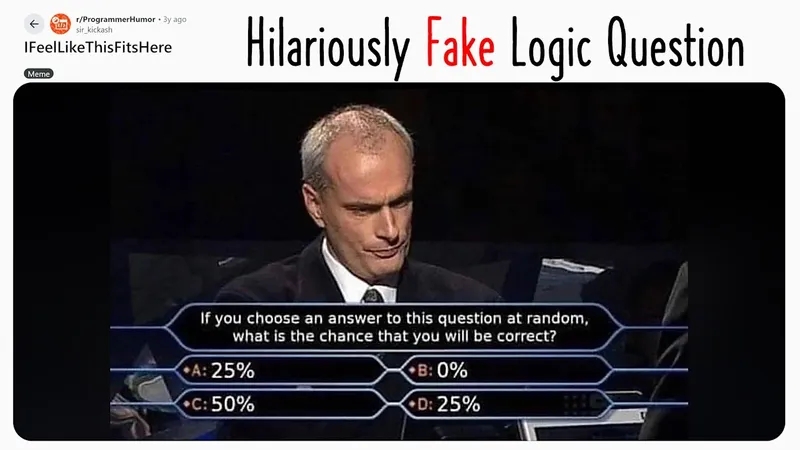
“Hey, this is Presto Walker. The image of a supposed test question was posted on X by the user @math_files. It has gone viral with over 13 million views and people arguing about what the correct answer is. I received multiple requests to cover this topic and I thank everyone who suggested the question to me. So, what's the correct answer? Let's go through this question in detail. If you pick the answer of this question at random, what is the chance that you will be correct? The choices are A, 25%, B, 50%, C, 0%, or D, 25%. At first glance, this question appears to be about probability. If you pick the answer of this question at random, what is the chance that you will be correct? In common language, when we say you pick something at random, that means all of the options will be equally likely. So, here we have four multiple-choice options, so each of the four options will be equally likely, so there's a one out of four or 25% chance that you will pick any of the options. But, if you were to just say that 25% is the correct answer, would that actually make any logical sense? So, this question is actually not about probability at all. It is actually about logic. So, let's go ahead and suppose that 25% is the correct answer and you select option A. Well, if 25% is the correct answer, that is also present in option D. So, that would mean that A and D would both have to be the correct answer to the question. But now, we would have two of the four choices are correct. And if you're picking at random, picking two out of four would be a 50% chance. So, we can't have the answer be 25% because if we pick 25%, then necessarily the answer would have to be 50%. So, we eliminate these choices and we go ahead and consider option B, 50%. But if this is the correct answer choice, only one of the four answer choices is correct. So, that puts us back at a 25% chance of selecting the correct answer. So, 50% cannot be the correct answer. So, we go ahead and we reanalyze selecting 25% as the correct answer, but that again would give us two answer choices that are correct, which will again lead us to 50% chance of selecting the correct answer. So, we eliminate these options and we again consider 50% as the correct answer, which again leads us to only one of the four answer choices being correct. So, we end up in a vicious circle where we cannot have 50% be the correct answer, we cannot have 25% be the correct answer. So, by the process of elimination, the correct answer must be C, that there is a 0% chance that we will select the correct answer. But now, this will be one of the four options, which would give a 25% chance of selecting the correct answer. So, of course, we can't have 25% be the correct answer, we can't have 0% be the correct answer, we can't have 50% be the correct answer. The question itself cannot have a correct answer as stated. None of these options will logically work. It is a paradoxical question. An alternate way of saying this is that the question itself is not well posed. There is no way to select a correct answer given the framing of the question.”
- 01Viral setup and question
This establishes why the example is being addressed and raises the answer viewers will follow the explanation to resolve.
The speaker introduces the named example, notes its reach and the disagreement around its answer, acknowledges requests, then poses the central question and offers to examine it.
“Hey, this is Presto Walker. The image of a supposed test question was posted on X by the user @math_files. It has gone viral with over 13 million views and people arguing about what the correct answer is. I received multiple requests to cover this topic and I thank everyone who suggested the question to me. So, what's the correct answer? Let's go through this question in detail.”
- 02Question and answer choices
Restating the puzzle precisely lets viewers consider its terms before the explanation begins.
The speaker repeats the random-choice question and enumerates the four percentage options.
“If you pick the answer of this question at random, what is the chance that you will be correct? The choices are A, 25%, B, 50%, C, 0%, or D, 25%.”
- 03From probability to a logical contradiction
The reasoning develops the apparent paradox rather than merely announcing a verdict; following the competing assumptions clarifies why the choices cannot settle into one consistent answer.
The speaker starts with the probability interpretation, observes that four equally likely choices imply a 25% chance of selecting any one, and asks whether 25% can consistently be the correct answer. The speaker reframes the puzzle as a logic problem, tests 25% and 50%, and shows how each assumption leads back to the other.
“At first glance, this question appears to be about probability. If you pick the answer of this question at random, what is the chance that you will be correct? In common language, when we say you pick something at random, that means all of the options will be equally likely. So, here we have four multiple-choice options, so each of the four options will be equally likely, so there's a one out of four or 25% chance that you will pick any of the options. But, if you were to just say that 25% is the correct answer, would that actually make any logical sense? So, this question is actually not about probability at all. It is actually about logic. So, let's go ahead and suppose that 25% is the correct answer and you select option A. Well, if 25% is the correct answer, that is also present in option D. So, that would mean that A and D would both have to be the correct answer to the question. But now, we would have two of the four choices are correct. And if you're picking at random, picking two out of four would be a 50% chance. So, we can't have the answer be 25% because if we pick 25%, then necessarily the answer would have to be 50%. So, we eliminate these choices and we go ahead and consider option B, 50%. But if this is the correct answer choice, only one of the four answer choices is correct. So, that puts us back at a 25% chance of selecting the correct answer. So, 50% cannot be the correct answer. So, we go ahead and we reanalyze selecting 25% as the correct answer, but that again would give us two answer choices that are correct, which will again lead us to 50% chance of selecting the correct answer. So, we eliminate these options and we again consider 50% as the correct answer, which again leads us to only one of the four answer choices being correct. So, we end up in a vicious circle where we cannot have 50% be the correct answer, we cannot have 25% be the correct answer.”
- 04Conclusion and qualification
This gives the opening's answer while explaining its limits: the problem is not that one listed option secretly wins, but that the question's framing does not yield a logically workable choice.
The speaker eliminates the remaining possibilities, concludes that no listed choice works, and qualifies the puzzle as paradoxical and not well posed.
“So, by the process of elimination, the correct answer must be C, that there is a 0% chance that we will select the correct answer. But now, this will be one of the four options, which would give a 25% chance of selecting the correct answer. So, of course, we can't have 25% be the correct answer, we can't have 0% be the correct answer, we can't have 50% be the correct answer. The question itself cannot have a correct answer as stated. None of these options will logically work. It is a paradoxical question. An alternate way of saying this is that the question itself is not well posed. There is no way to select a correct answer given the framing of the question.”