Dyno Testing a Tesla Valve. Will it Run?
Dyno Testing a Tesla Valve. Will it Run?
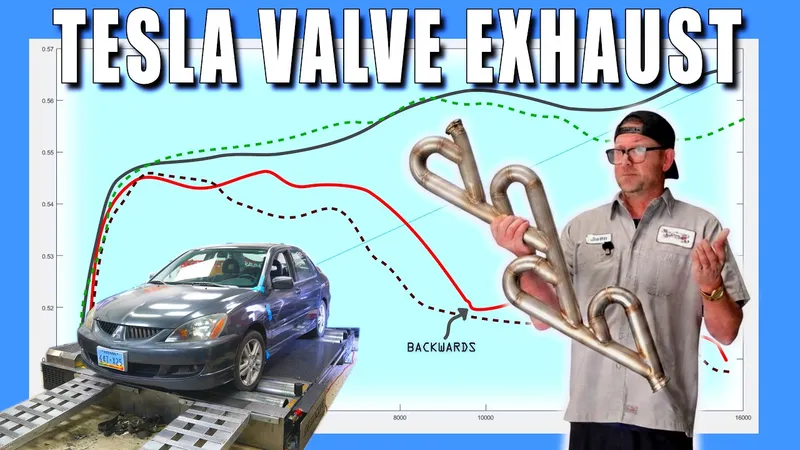
The video tests whether a Tesla valve—a one-way flow device with no moving parts—can work in a car’s exhaust without choking the engine. The opening lays out dyno pulls with stock exhaust and the valve in both directions, and begins reporting baseline results; the title promises unexpected results, but the excerpt does not reveal the full outcome.
- Views
- 1.4M
- Likes
- 30.6K
- Comments
- 1.4K
- Tesla valve exhaust testCar dyno testingAutomotive fabrication
Analysis
The video tests whether a Tesla valve—a one-way flow device with no moving parts—can work in a car’s exhaust without choking the engine. The opening lays out dyno pulls with stock exhaust and the valve in both directions, and begins reporting baseline results; the title promises unexpected results, but the excerpt does not reveal the full outcome.
- ExperimentDemonstration

- Title
- Dyno Testing a Tesla Valve. Will it Run?
“This is a Tesla valve, a one-way flow control device with no mechanical or moving parts inside. How it works is when you take something and flow it through in one direction, everything happily goes through. But, if we flip it upside down, Oh, terrific. I've lost my marbles. Now, Tesla valves are usually reserved for liquids, not necessarily marbles or gases for that matter. But, the question is, if we stick this on the exhaust of a car, what's going to happen? And what are we going to do with that information? >> [music] >> All right, so here's what I'm thinking. Stock exhaust is on there. All the mandrel bent 2-in just like we did before. That's on there right now. Three pulls, baseline. Tesla valve in the correct direction, three pulls. Tesla valve in the wrong direction, three pulls. >> As if it runs. >> If it runs. >> Yeah. >> If valid point. And then, back to the stock exhaust for whatever reason, because we need to prove that the stock exhaust was the stock exhaust. >> Right. >> That'll make the comments happy.”
- 01Introduce and explain the subject
Establish the central subject and enough of its claimed operation for the later reversal and test to make sense.
Names the device, defines its function, and describes the expected behavior in one direction.
“This is a Tesla valve, a one-way flow control device with no mechanical or moving parts inside. How it works is when you take something and flow it through in one direction, everything happily goes through.”
- 02Illustrate the reversal and pose the test
The reversal makes the operating principle memorable, while the unanswered application question sets up the episode's experiment.
Contrasts the expected behavior with a humorous reversed example, qualifies the usual application, and asks what will happen in a new application and what the test will reveal.
“But, if we flip it upside down, Oh, terrific. I've lost my marbles. Now, Tesla valves are usually reserved for liquids, not necessarily marbles or gases for that matter. But, the question is, if we stick this on the exhaust of a car, what's going to happen? And what are we going to do with that information?”
- 03Set out the comparison
Turns the opening question into a specific experiment and gives viewers a reason to follow the results across the planned conditions.
The speaker lists the baseline and two test configurations, gives each the same number of attempts, and explains that the baseline will be repeated to verify the comparison.
“>> [music] >> All right, so here's what I'm thinking. Stock exhaust is on there. All the mandrel bent 2-in just like we did before. That's on there right now. Three pulls, baseline. Tesla valve in the correct direction, three pulls. Tesla valve in the wrong direction, three pulls. >> As if it runs. >> If it runs. >> Yeah. >> If valid point. And then, back to the stock exhaust for whatever reason, because we need to prove that the stock exhaust was the stock exhaust. >> Right. >> That'll make the comments happy.”