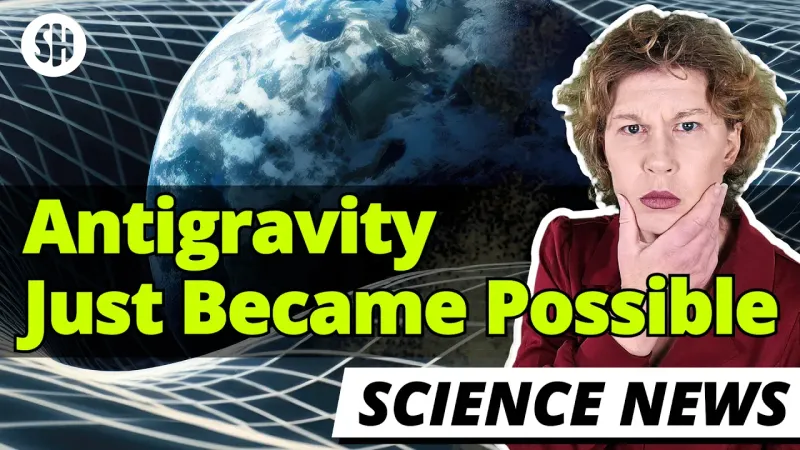
Scientists Have Figured Out How to Make Antigravity
Sabine Hossenfelder@SabineHossenfelderScientists Have Figured Out How to Make Antigravity
The video discusses a paper proposing that quantum mechanics could allow two attractive gravitational pulls to combine into an effective repulsion. It explains how this idea relates to general relativity and the unresolved question of whether gravity has quantum properties, while noting that the proposal comes with caveats.
- Views
- 1.3M
- Likes
- 41.3K
- Comments
- 4.4K
- Quantum antigravityGeneral relativityQuantum gravity
Analysis
The video discusses a paper proposing that quantum mechanics could allow two attractive gravitational pulls to combine into an effective repulsion. It explains how this idea relates to general relativity and the unresolved question of whether gravity has quantum properties, while noting that the proposal comes with caveats.
- ExplainerNews analysis
- Title
- Scientists Have Figured Out How to Make Antigravity
“Scientists have figured out how to make Scientists have figured out how to make Scientists have figured out how to make anti-gravity. Sounds crazy, yet I think anti-gravity. Sounds crazy, yet I think anti-gravity. Sounds crazy, yet I think it might actually work. But before you it might actually work. But before you it might actually work. But before you go and buy ceiling furniture, let's have go and buy ceiling furniture, let's have go and buy ceiling furniture, let's have a look at the ifs and buts. In a look at the ifs and buts. In a look at the ifs and buts. In Einstein's theory of general relativity, Einstein's theory of general relativity, Einstein's theory of general relativity, gravity's always attractive. The gravity's always attractive. The gravity's always attractive. The reason's quite simple. In gravity, reason's quite simple. In gravity, reason's quite simple. In gravity, energy plays the role that electric energy plays the role that electric energy plays the role that electric charges play in electromagnetism. It charges play in electromagnetism. It charges play in electromagnetism. It just that since gravity's mediated by just that since gravity's mediated by just that since gravity's mediated by spin-2 field, like charges attract and spin-2 field, like charges attract and spin-2 field, like charges attract and unlike charges repel. And since there unlike charges repel. And since there unlike charges repel. And since there are only positive masses and only are only positive masses and only are only positive masses and only positive energies, they all attract each positive energies, they all attract each positive energies, they all attract each other. But according to the new paper, other. But according to the new paper, other. But according to the new paper, quantum mechanics offers a loophole. quantum mechanics offers a loophole. quantum mechanics offers a loophole. Under the right conditions, two Under the right conditions, two Under the right conditions, two attractive gravitational pulls can attractive gravitational pulls can attractive gravitational pulls can combine into an effective repulsion. combine into an effective repulsion. combine into an effective repulsion. That's a startling conclusion they That's a startling conclusion they That's a startling conclusion they arrived at by studying an entirely arrived at by studying an entirely arrived at by studying an entirely different question, namely how to find different question, namely how to find different question, namely how to find out whether gravity itself is quantum. out whether gravity itself is quantum. out whether gravity itself is quantum. This one of the biggest unsolved This one of the biggest unsolved This one of the biggest unsolved problems in physics. We have quantum problems in physics. We have quantum problems in physics. We have quantum mechanics, which describes atoms and mechanics, which describes atoms and mechanics, which describes atoms and elementary particles through quantum elementary particles through quantum elementary particles through quantum fields. And we have general relativity, fields. And we have general relativity, fields. And we have general relativity, which describes gravity as the curvature which describes gravity as the curvature which describes gravity as the curvature of space-time. Both theories work of space-time. Both theories work of space-time. Both theories work extremely well. Unfortunately, they extremely well. Unfortunately, they extremely well. Unfortunately, they don't fit together. It's like having two don't fit together. It's like having two don't fit together. It's like having two instruction manuals for the universe. instruction manuals for the universe. instruction manuals for the universe. One that says assemble with screws, and One that says assemble with screws, and One that says assemble with screws, and the other says there are no screws.”
- 01Claim and qualification
Establish the episode’s striking premise, while the speaker’s uncertainty leaves room to examine whether the claim holds up.
The speaker repeats the claim that scientists have figured out how to make antigravity, calls it crazy-sounding, and says it might work.
“Scientists have figured out how to make Scientists have figured out how to make Scientists have figured out how to make anti-gravity. Sounds crazy, yet I think anti-gravity. Sounds crazy, yet I think anti-gravity. Sounds crazy, yet I think it might actually work.”
- 02Caution and scope
Keep the bold premise from sounding settled and promise a look at its limitations before proceeding.
The speaker jokes about buying ceiling furniture, then proposes examining the claim’s qualifications.
“But before you it might actually work. But before you it might actually work. But before you go and buy ceiling furniture, let's have go and buy ceiling furniture, let's have go and buy ceiling furniture, let's have a look at the ifs and buts.”
- 03Proposed explanation
Give the audience the proposed mechanism behind the headline claim, while attributing it to the paper rather than presenting it as established fact.
The speaker states that gravity is always attractive under general relativity, outlines an analogy to electromagnetism, and says a new paper proposes that quantum mechanics offers a loophole: attractive gravitational pulls could combine into effective repulsion.
“In a look at the ifs and buts. In a look at the ifs and buts. In Einstein's theory of general relativity, Einstein's theory of general relativity, Einstein's theory of general relativity, gravity's always attractive. The gravity's always attractive. The gravity's always attractive. The reason's quite simple. In gravity, reason's quite simple. In gravity, reason's quite simple. In gravity, energy plays the role that electric energy plays the role that electric energy plays the role that electric charges play in electromagnetism. It charges play in electromagnetism. It charges play in electromagnetism. It just that since gravity's mediated by just that since gravity's mediated by just that since gravity's mediated by spin-2 field, like charges attract and spin-2 field, like charges attract and spin-2 field, like charges attract and unlike charges repel. And since there unlike charges repel. And since there unlike charges repel. And since there are only positive masses and only are only positive masses and only are only positive masses and only positive energies, they all attract each positive energies, they all attract each positive energies, they all attract each other. But according to the new paper, other. But according to the new paper, other. But according to the new paper, quantum mechanics offers a loophole. quantum mechanics offers a loophole. quantum mechanics offers a loophole. Under the right conditions, two Under the right conditions, two Under the right conditions, two attractive gravitational pulls can attractive gravitational pulls can attractive gravitational pulls can combine into an effective repulsion. combine into an effective repulsion. combine into an effective repulsion.”
- 04Broader physics problem
Widen the premise from a possible antigravity mechanism to the unresolved tension that motivates the research. The supplied excerpt cuts off during the analogy, before the introduction’s eventual boundary can be confirmed.
The speaker calls the proposed conclusion startling and says it came from studying whether gravity itself is quantum, one of physics’ biggest unsolved problems. They then contrast quantum mechanics, which describes atoms and elementary particles through quantum fields, with general relativity, which describes gravity as the curvature of space-time. Both theories work extremely well, but do not fit together; the excerpt ends with an analogy to conflicting instruction manuals.
“That's a startling conclusion they That's a startling conclusion they That's a startling conclusion they arrived at by studying an entirely arrived at by studying an entirely arrived at by studying an entirely different question, namely how to find different question, namely how to find different question, namely how to find out whether gravity itself is quantum. out whether gravity itself is quantum. out whether gravity itself is quantum. This one of the biggest unsolved This one of the biggest unsolved This one of the biggest unsolved problems in physics. We have quantum problems in physics. We have quantum problems in physics. We have quantum mechanics, which describes atoms and mechanics, which describes atoms and mechanics, which describes atoms and elementary particles through quantum elementary particles through quantum elementary particles through quantum fields. And we have general relativity, fields. And we have general relativity, fields. And we have general relativity, which describes gravity as the curvature which describes gravity as the curvature which describes gravity as the curvature of space-time. Both theories work of space-time. Both theories work of space-time. Both theories work extremely well. Unfortunately, they extremely well. Unfortunately, they extremely well. Unfortunately, they don't fit together. It's like having two don't fit together. It's like having two don't fit together. It's like having two instruction manuals for the universe. instruction manuals for the universe. instruction manuals for the universe. One that says assemble with screws, and One that says assemble with screws, and One that says assemble with screws, and the other says there are no screws.”