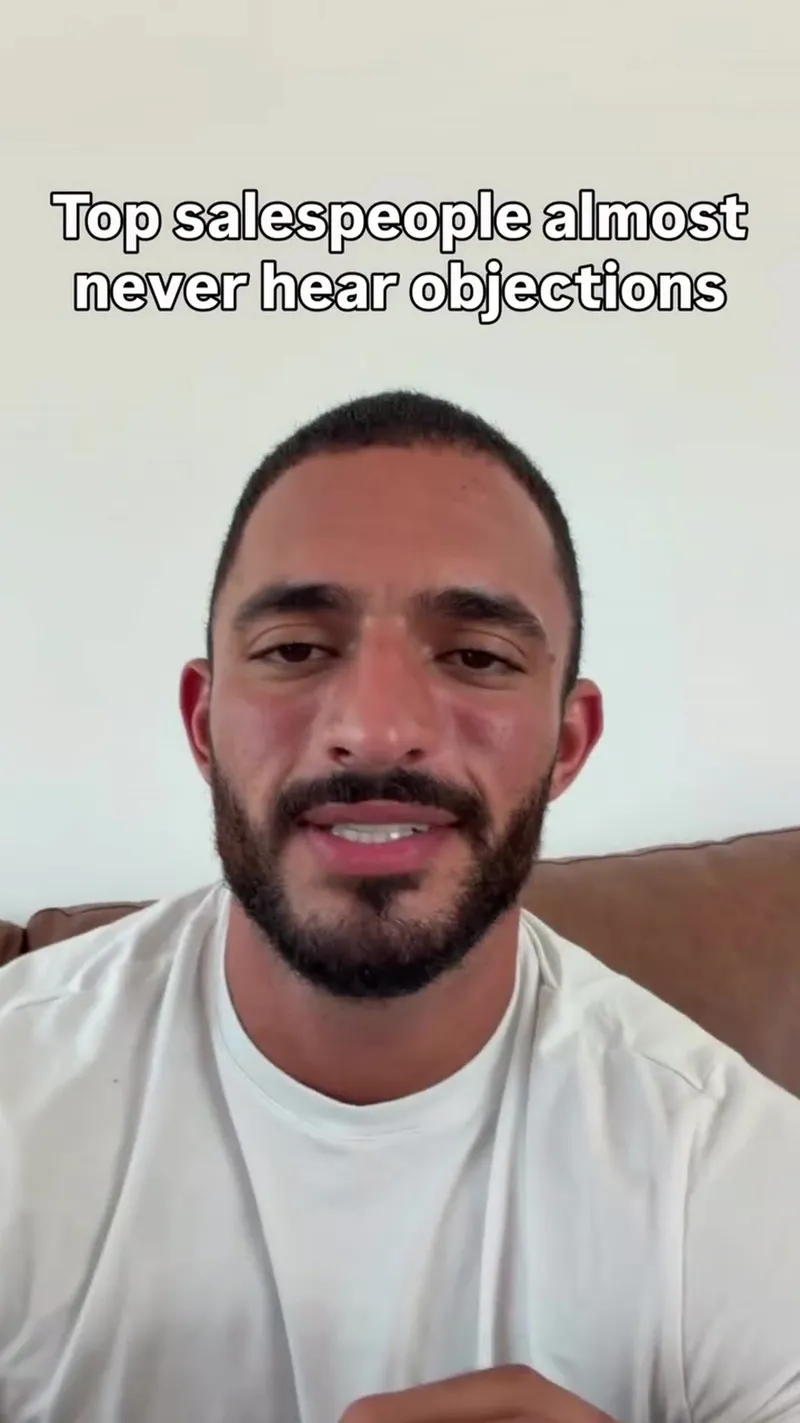
This video explains how to stop reacting to sales objections and start preventing them by addressing concerns before they are ever spoken. The creator provides specific examples for handling price, trust, and decision pressure throughout a presentation. He concludes by demonstrating these exact techniques on the viewer to prove how effective they are.
Stop Handling Objections and Start Preventing Them
This video explains how to stop reacting to sales objections and start preventing them by addressing concerns before they are ever spoken. The creator provides specific examples for handling price, trust, and decision pressure throughout a presentation. He concludes by demonstrating these exact techniques on the viewer to prove how effective they are.
- Views
- 131K
- Likes
- 8.1K
- Comments
- 104
- Topics
Analysis
Give me two minutes and I'll change the way you look at sales forever. The best salespeople almost never hear any objections.
Give me two minutes and I'll change the way you look at sales forever. The best salespeople almost never hear any objections. And that's exactly why they're the best. After spending years in commission based sales and leading teams of hundreds and hundreds of reps, one lesson completely changed the way I sold forever. The best objection handler is the one who never has to handle objections in the first place. If you're handling objections, you're probably already too late. Think about it. If you know someone is going to say this is too expensive, why would you wait till the end? Instead, address it before they ever have a chance. Example. I know we're not the cheapest option and honestly, that's intentional. Let me show you why the people who chose us are happy paying more. Now you frame the objection before price ever became one. Another one. If you know they're going to wonder, how do I know this actually works? Don't wait. Say, look. Before we go any further, I want to show you a couple people who are in the exact same position you're in today. Now, trust isn't an objection. It's already been established. If you know they're worried about, let's say, making the wrong decision, don't wait for the I need to think about it because it's coming. Instead, say by the end of today, you'll know whether this is the right fit or not. And if I don't think it is, I'll be the first person to tell you you just removed all the pressure before they ever felt it. This principle never changes because objection prevention isn't memorizing scripts. It's about understanding human psychology. Average salespeople will react. Elite salespeople anticipate. And here's the biggest mistake I see. Most reps think objections happen at the close and that's furthest from the truth. Objections are created throughout the presentation. A weak presentation will create objections. A strong presentation will prevent them. Remember this, the sale isn't won when they say yes. It's won when there's nothing left to say no to. So the next time you're giving a presentation, ask what objections can I eliminate before they're ever spoken. Master that. And closing becomes the easiest part of the conversation. I'll give you a little bit more. Here's the interesting part. Some of you have probably already decided you're gonna save this video. Not because I asked you to, but because I gave you a reason why it would benefit you. Some of you have probably already decided you're gonna follow me. Not because I told you to, but because I explained that I break down sales psychology like this every single week, and some others who were skeptical, most likely when this video started, probably aren't anymore. Not because I argued with you. Because I established credibility before you ever had the chance to question it. Do you see what just happened? I wasn't just teaching objection prevention, I was demonstrating it. I removed all of the reasons you would have said no before you had the chance to thank them. That's the difference between average salespeople and elite ones. Now, I want you to do one thing. Go back and watch the last minute of this video again. I promise you'll catch at least three objections I handled before you even realized you had them. Then come back here and comment the first one you noticed. Once you start seeing objection prevention, you'll never sell the same way again.
- 01The Time-Locked Hook
State a specific, short amount of time and promise a permanent change in perspective.
- 02The Paradoxical Claim
Claim that the best people in the field don't actually do what everyone thinks they do.
- 03Authority and Origin
Establish your credibility by mentioning your experience and the specific lesson you learned.
- 04The Core Philosophy
State your main counter-intuitive thesis or mantra.
- 05Example 1: Reframing [Barrier 1]
Identify a common barrier and show how to address it before it becomes a problem.
- 06Example 2: Reframing [Barrier 2]
Identify a second common barrier and provide an proactive dialogue fix.
- 07Example 3: Reframing [Barrier 3]
Identify a third barrier (usually emotional) and show how to remove the pressure.
- 08Theory and Contrast
Contrast the elite approach with the average approach to reinforce the value of the lesson.
- 09The Meta Reveal
Point out how the viewer's own behavior during the video proves the lesson was just performed on them.
- 10The Re-watch Challenge CTA
Challenge the viewer to re-watch the video to find 'hidden' applications of the lesson, driving engagement.