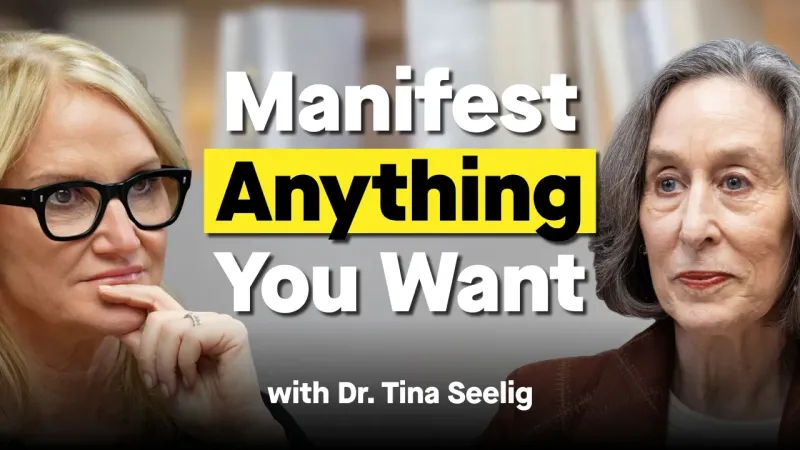
Stanford Luck Researcher: How to Manifest the Life You Want
Mel Robbins@melrobbinsStanford Luck Researcher: How to Manifest the Life You Want
Mel Robbins interviews Dr. Tina Seelig about her work on luck and the idea that people can influence how lucky they become. They distinguish fortune—what happens to you—from luck, which Seelig describes as something you can help create. The episode promises practical strategies, a framework for creating opportunities, and a discussion of risk.

- Views
- 5.4M
- Likes
- 74.8K
- Comments
- 2.4K
- Creating your own luckFortune versus luckRisk and OpportunityPersonal agency
Analysis
Mel Robbins interviews Dr. Tina Seelig about her work on luck and the idea that people can influence how lucky they become. They distinguish fortune—what happens to you—from luck, which Seelig describes as something you can help create. The episode promises practical strategies, a framework for creating opportunities, and a discussion of risk.
- InterviewPodcast episode

- Title
- Stanford Luck Researcher: How to Manifest the Life You Want
Have you ever looked at someone else's life and thought, "How did they get so lucky?" If you could turn your luck around, wouldn't you? Today's guest is Dr. Tina Seelig. Her work is all about the science of luck. You can learn how to become a luckier person. >> [music] >> Dr. Seelig earned her PhD in neuroscience at Stanford Medical School. She's also the author of 18 books. >> Luck is success or failure apparently caused by chance. >> Success or failure apparently? What What is the apparently in there for? >> the point. I mean, this is really important. It looks on the surface as if it's chance, but really underneath, there are things that you have done to tempt good luck your way. There's something very, very important to keep in mind. Fortune is the things that happen to you. Luck is what you control. >> You know, if somebody feels really unlucky right now, what's the first thing they should do this week? >> I would say, if you were going to pick one thing, >> Hey, it's Mel. And before we get into this episode, my team was showing me 57% of you who watch the Mel Robbins podcast here on YouTube are not subscribed yet. Could you do me a quick favor? Just hit subscribe so that you don't miss any of the episodes that we post here on YouTube. It lets me know you're enjoying the guests and the content that we're bringing you because I want to make sure you don't miss a thing. And I'm so glad you're here for this episode cuz this is a really good one. All right, let's dive in. Dr. Tina Seelig, welcome to the Mel Robbins podcast. >> not be more delighted. Thank you so much for having me. >> I am thrilled about the topic that we're going to talk about. I love your research and thank you for taking time out of your schedule to come and share all of this research around luck and how we can use it to improve our lives. And I think that's where I want to start. So, could you talk to me and the person that's here with us right now and just tell us what might change about our lives if we really apply everything you're about to teach us today? >> I couldn't be more delighted to share this information because when people understand that they have more agency in their lives, they realize that they have levers they can use every single day to make themselves luckier. >> When you talk about luck, Dr. Seelig, what are you talking about? What does that mean? >> Uh first of all, please call me Tina. Uh the definition of luck is success or failure apparently caused by chance. >> Success or failure apparently? >> Apparently, exactly. >> Wait, wait, what is the apparently in there for? >> And that's the point. I mean, this is really important. The word apparently, it looks on the surface as if it's chance, but really underneath, there are things that you have done to tempt good luck your way. >> Oh, okay. So, I want to make sure that I am tracking and I want to make sure that as the person who's with us is listening, we got that cuz I think that there is a little treasure buried beneath that, which is often times the things that we attribute to luck, are you saying that once we understand everything you're about to teach us, that those things we once just attributed to luck, bad luck or good luck, we could trace back and say, "Actually, there was something that I set in motion that I'm not giving myself credit for that made this chance thing happen."
- 01Recognizable wish
This relatable question establishes the personal appeal of the topic and invites viewers to consider whether luck can change.
The host asks viewers to recall envying another person’s apparent luck, then imagines turning their own luck around.
Have you ever looked at someone else's life and thought, "How did they get so lucky?" If you could turn your luck around, wouldn't you?
- 02Guest and promise
The guest’s relevant background gives context for the coming account, while the host’s statement makes the episode’s intended learning promise explicit.
The host introduces Dr. Tina Seelig, describes her work on the science of luck, and says viewers can learn to become luckier. A music cue and the guest’s Stanford and book credentials follow.
“Today's guest is Dr. Tina Seelig. Her work is all about the science of luck. You can learn how to become a luckier person. >> [music] >> Dr. Seelig earned her PhD in neuroscience at Stanford Medical School. She's also the author of 18 books.”
- 03A different definition
The exchange turns the topic into a question about whether luck is truly chance or partly influenced by what people do, setting up the guest’s explanation.
The guest gives a definition of luck as success or failure apparently caused by chance. The host questions the word “apparently,” and the guest begins contrasting surface appearances with actions that may invite good luck.
“>> Luck is success or failure apparently caused by chance. >> Success or failure apparently? What What is the apparently in there for? >> the point. I mean, this is really important. It looks on the surface as if it's chance, but really underneath, there are things that you have done to tempt good luck your way. There's something very, very important to keep in mind. Fortune is the things that happen to you. Luck is what you control. >> You know, if somebody feels really unlucky right now, what's the first thing they should do this week? >> I would say, if you were going to pick one thing,”
- 04Subscription request and show welcome
This is a channel promotion and show-identification interlude before the interview resumes; it is part of the supplied opening even though it pauses the topic.
The host interrupts the guest’s unfinished answer to ask viewers to subscribe, citing an audience subscription statistic and explaining the request. She then welcomes the guest to the podcast, and the guest thanks her.
“>> Hey, it's Mel. And before we get into this episode, my team was showing me 57% of you who watch the Mel Robbins podcast here on YouTube are not subscribed yet. Could you do me a quick favor? Just hit subscribe so that you don't miss any of the episodes that we post here on YouTube. It lets me know you're enjoying the guests and the content that we're bringing you because I want to make sure you don't miss a thing. And I'm so glad you're here for this episode cuz this is a really good one. All right, let's dive in. Dr. Tina Seelig, welcome to the Mel Robbins podcast. >> not be more delighted. Thank you so much for having me. >>”
- 05Frame the interview’s purpose
This exchange restates the subject and asks for a practical account of its implications. The guest’s answer supplies a small initial answer while inviting further explanation of those levers.
The host says she is excited about the topic and the guest’s research, then asks what applying the guest’s teaching could change in viewers’ lives. The guest responds that understanding their agency can reveal daily levers for becoming luckier.
“I am thrilled about the topic that we're going to talk about. I love your research and thank you for taking time out of your schedule to come and share all of this research around luck and how we can use it to improve our lives. And I think that's where I want to start. So, could you talk to me and the person that's here with us right now and just tell us what might change about our lives if we really apply everything you're about to teach us today? >> I couldn't be more delighted to share this information because when people understand that they have more agency in their lives, they realize that they have levers they can use every single day to make themselves luckier. >>”
- 06Define and challenge the term
The host’s follow-up develops the central distinction between chance and agency. The guest gives an initial explanation, but the opening ends while the host is checking her understanding, before the discussion moves into its sustained explanation.
The host asks what Seelig means by luck. After she defines it as success or failure apparently caused by chance, the host presses on “apparently”; Seelig explains that people may do things that tempt good luck their way.
When you talk about luck, Dr. Seelig, what are you talking about? What does that mean? >> Uh first of all, please call me Tina. Uh the definition of luck is success or failure apparently caused by chance. >> Success or failure apparently? >> Apparently, exactly. >> Wait, wait, what is the apparently in there for? >> And that's the point. I mean, this is really important. The word apparently, it looks on the surface as if it's chance, but really underneath, there are things that you have done to tempt good luck your way. >> Oh, okay. So, I want to make sure that I am tracking and I want to make sure that as the person who's with us is listening, we got that cuz I think that there is a little treasure buried beneath that, which is often times the things that we attribute to luck, are you saying that once we understand everything you're about to teach us, that those things we once just attributed to luck, bad luck or good luck, we could trace back and say, "Actually, there was something that I set in motion that I'm not giving myself credit for that made this chance thing happen."