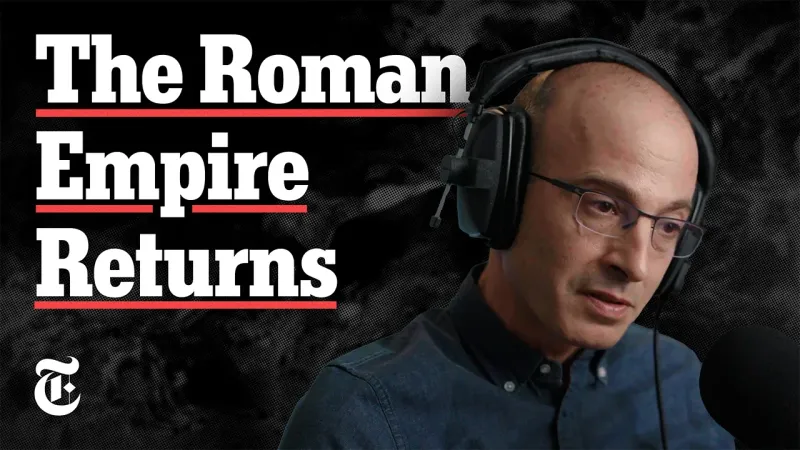
Yuval Noah Harari on Donald Trump’s Core Delusion | The Ezra Klein Show
The Ezra Klein Show@EzraKleinShowYuval Noah Harari on Donald Trump’s Core Delusion | The Ezra Klein Show
Ezra Klein interviews historian Yuval Noah Harari about whether cooperation or power has driven human history, and how political stories shape ideas of national greatness. Their discussion is framed around liberalism, Trumpism, Israel, social media and AI; the opening also raises how stories can unite people or deepen divisions.
- Views
- 812.7K
- Likes
- 13.9K
- Comments
- 1.9K
- Cooperation and PowerLiberalism and PopulismStories in HistorySocial Media and AI
Analysis
Ezra Klein interviews historian Yuval Noah Harari about whether cooperation or power has driven human history, and how political stories shape ideas of national greatness. Their discussion is framed around liberalism, Trumpism, Israel, social media and AI; the opening also raises how stories can unite people or deepen divisions.
- InterviewPodcast episode
- Title
- Yuval Noah Harari on Donald Trump’s Core Delusion | The Ezra Klein Show
“I think if you look across his mega-bestselling books like Sapiens and Homo Deus, Yuval Noah Harari really has one major topic. That topic is cooperation. Cooperation and the ability to cooperate across scale, across time, as being the fundamental engine of human progress. Cooperation as the way we go from being this creature that absolutely cannot beat a bear or a lion in a fight to being able to create and command the societies we have now. I think right now there's something interestingly challenging about Harari's work because we live in this moment of Trumpism, of right-wing populism, and one of the messages of those movements is that this emphasis on cooperation, on positive-sum relationships, >> [music] >> is a lie. That humanity, that society, is driven not so much by these like soft questions of cooperation as by power, hierarchy, dominance, about winning the transaction with the other, about coming out ahead in the conflict, in the trade. That all these like niceties of liberalism, they were a lie. And that really humanity runs on power. And that to forget that is to forget the engine of our progress. So I've been wanting to talk to Harari about this. I think there's a an interesting debate to put him in conversation with. He's a new book for kids called Unstoppable Us, volume three. It is also about cooperation and how enemies turn into friends, but this conversation is bigger than that. It's about liberalism, it's about Israel, Harari is Israeli, it's about AI and what it's going to do to us and what it's going to do to language as the way we work with and fail to work with each other. It is, as we say in the podcast biz, a wide-ranging conversation and all the better for it. As always, my email is ezrakleinshow@nytimes.com. Yuval Noah Harari, welcome to the show. Thank you. It's good to be here. I wanted to begin with a clip of Stephen Miller, uh Donald Trump's deputy chief of staff, that I began thinking about as I was reading some of your recent work. I'm going to play it here. You can talk all you want about international niceties and everything else, but we live in a world, in the real world, Jack, that is governed by strength, that is governed by force, that is governed by power. These are the iron laws of the world that exist since the beginning of time. >> do you think when you hear that? That the whole of the of uh the history of philosophy and spirituality is uh in argument with exactly that point of view. That the only reality is power. The only reality is force. And from the viewpoint of a historian, it's clear that this is not the case. If the only human reality was brute force, we would still be living in tiny hunter-gatherer bands in the African savanna. Because the whole of human history is about how do you get more people to cooperate and to trust each other. And you cannot do that only with brute force. I I want to spend some time here on this tension between visions of cooperation as a driving force in human history and visions of power as a driving force in human history. Because I think if I'm trying to steel man the vision that emerges out of the Trump administration and some other uh political figures like them right now, they would say that the conditions for cooperation have been a mixture of shared national and religious stories Mhm.”
- 01Establish the thinker’s central subject
This establishes the discussion’s starting premise and gives the guest’s later disagreement a clear point of reference.
The host identifies a recurring idea across the guest’s work and explains why cooperation matters to human progress.
“I think if you look across his mega-bestselling books like Sapiens and Homo Deus, Yuval Noah Harari really has one major topic. That topic is cooperation. Cooperation and the ability to cooperate across scale, across time, as being the fundamental engine of human progress. Cooperation as the way we go from being this creature that absolutely cannot beat a bear or a lion in a fight to being able to create and command the societies we have now.”
- 02Set the idea against a current opposing claim
The opposition makes the abstract idea consequential in the present and sets up the question the guest will address.
The host connects the guest’s work to current political movements and states their contrary view of cooperation and power.
“I think right now there's something interestingly challenging about Harari's work because we live in this moment of Trumpism, of right-wing populism, and one of the messages of those movements is that this emphasis on cooperation, on positive-sum relationships, >> [music] >> is a lie. That humanity, that society, is driven not so much by these like soft questions of cooperation as by power, hierarchy, dominance, about winning the transaction with the other, about coming out ahead in the conflict, in the trade. That all these like niceties of liberalism, they were a lie. And that really humanity runs on power. And that to forget that is to forget the engine of our progress.”
- 03Explain the planned conversation
This links the initial disagreement to the episode while setting expectations for a wide-ranging discussion, rather than promising a single narrow answer.
The host says why they wanted to speak with the guest, gives brief book context, and previews the conversation’s broader subjects and scope.
“So I've been wanting to talk to Harari about this. I think there's a an interesting debate to put him in conversation with. He's a new book for kids called Unstoppable Us, volume three. It is also about cooperation and how enemies turn into friends, but this conversation is bigger than that. It's about liberalism, it's about Israel, Harari is Israeli, it's about AI and what it's going to do to us and what it's going to do to language as the way we work with and fail to work with each other. It is, as we say in the podcast biz, a wide-ranging conversation and all the better for it. As always, my email is ezrakleinshow@nytimes.com.”
- 04Welcome the guest and introduce the opening material
The welcome establishes the interview setting; the clip introduction moves from the host’s framing to the specific argument the guest is asked to assess.
The host welcomes the guest, then explains that a clip from a political figure prompted the question and that the host will play it.
“Yuval Noah Harari, welcome to the show. Thank you. It's good to be here. I wanted to begin with a clip of Stephen Miller, uh Donald Trump's deputy chief of staff, that I began thinking about as I was reading some of your recent work. I'm going to play it here.”
- 05Present the claim and pose the central question
The clip supplies the concrete opposing claim, and the host’s question invites the guest to test its broad premise.
The clip asserts that the world is governed by strength and power. The host asks whether history, philosophy, and spirituality are in argument with that view.
“You can talk all you want about international niceties and everything else, but we live in a world, in the real world, Jack, that is governed by strength, that is governed by force, that is governed by power. These are the iron laws of the world that exist since the beginning of time. >> do you think when you hear that? That the whole of the of uh the history of philosophy and spirituality is uh in argument with exactly that point of view. That the only reality is power. The only reality is force.”
- 06Answer with a historical counterargument
The guest provides an initial answer and a concrete historical counterclaim, while the host’s follow-up identifies the tension the conversation will explore.
Speaking from the viewpoint of a historian, the guest rejects the claim and argues that human history depends on cooperation and trust, not brute force alone.
“And from the viewpoint of a historian, it's clear that this is not the case. If the only human reality was brute force, we would still be living in tiny hunter-gatherer bands in the African savanna. Because the whole of human history is about how do you get more people to cooperate and to trust each other. And you cannot do that only with brute force. I I want to spend some time here on this tension between visions of cooperation as a driving force in human history and visions of power as a driving force in human history. Because I think if I'm trying to steel man the vision that emerges out of the Trump administration and some other uh political figures like them right now, they would say that the conditions for cooperation have been a mixture of shared national and religious stories Mhm.”