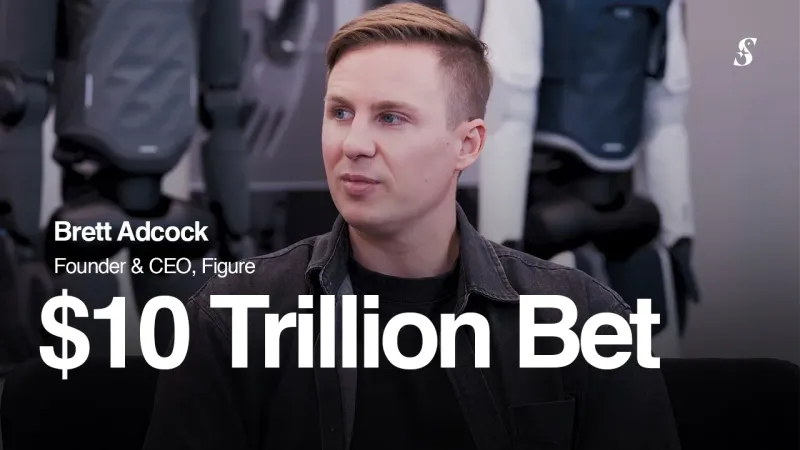
The $10 Trillion Bet on Humanoid Robots | Figure Founder Brett Adcock
Sourcery with Molly O'Shea@SourceryVCThe $10 Trillion Bet on Humanoid Robots | Figure Founder Brett Adcock
Sourcery interviews Figure founder and CEO Brett Adcock about building general-purpose humanoid robots, their use in factories and homes, and the challenge of making them work autonomously. He discusses Figure’s production ambitions, the OpenAI partnership breakup, and the capital and business risks behind his vision for a large robotics market.

- Views
- 242K
- Likes
- 1.3K
- Comments
- 162
- Humanoid roboticsPhysical AIRobot production plansRobotics business risks
Analysis
Sourcery interviews Figure founder and CEO Brett Adcock about building general-purpose humanoid robots, their use in factories and homes, and the challenge of making them work autonomously. He discusses Figure’s production ambitions, the OpenAI partnership breakup, and the capital and business risks behind his vision for a large robotics market.
- InterviewPodcast episode
- Title
- The $10 Trillion Bet on Humanoid Robots | Figure Founder Brett Adcock
The meta problem in robotics is to be able to solve a humanoid robot. If you can solve this, it'll build the biggest business in the world by a large factor. We'll own over half the world's GDP as human labor. >> You recently went viral for comments on your OpenAI partnership with Finger. What happened there? >> So, OpenAI led our series B a couple years ago. They brought in Satya and Microsoft. It got to the point where our team internally that was designing these models were running circles around OpenAI. We were just way better at this, so I fired them. I self-funded the whole company up front. You know, we got to a million a month of burn in 4 months. Getting the robots to do the things we showed you today has almost killed me. We had record production in March, and we're going to try to 3x that by May. We want to be able to get to a million units a year. >> You've raised nearly $2 billion publicly stated at $39 billion. Do you see capital as a risk or a constraint or the valuation as a risk? >> We'll just build like enormous of tens of trillions of revenue. We'll build something massive. I mean, what do most companies trade at? Tech companies trade at 10 or 20 times revenue. You're in like $10 trillion or, you know, whatever, $100 billion to $20 million in revs. Like, this is going to be a huge business. >> Brett, welcome to Sourcery. >> Thanks for having me. >> I don't know if this is going to be part one or part two, but this is a series now. >> Okay. Great. >> We did the entire tour, and now we're going to do a sit-down interview. I figured uh we recently went viral for a lot of these hot takes at Hill and Valley. And so, I think it would be great if we just start there. So, what is your hottest take right now? >> On in robotics? >> Yeah. >> My hot take. Um I think one thing that we spend a lot of time on is doing things with like fully autonomous and end-to-end. And you asked us a few questions uh here when we walked in of like, "Is this like teleoperated?" We're not teleoperating this stuff. I think our hot take for robotics is just it's like it's kind of really difficult to see what's really happening in the space without coming on site and really seeing stuff. So, I hope I I hope you had a good experience here today seeing everything we're doing. Um I think my and I think the hottest take I have is like we just want humanoid robots to work and like they're working now. And it's pretty simple. Like we're seeing robots um to do everyday things like we saw it clean up a living room, do commercial work. Like it's just it's cool to see it. Like it's cool to see that this going to happen next few years. >> This is a very hotly contested space and it's becoming more and more competitive as It was funny cuz we did this interview with Skydio and he was talking about Adam was talking about the drone cycles. There are drone cycles where there's hype cycles and that kind of thing. But humanoid robots are certainly at a different scale and pace than before. So, how does this feel with the competition? >> Um I think like the Listen, our internal goal is like how do we get these things to do real stuff and get paid for it?
- 01Scale-setting claim
A striking scale claim establishes the opportunity that gives the interview its stakes and invites scrutiny of what solving the problem would mean.
The guest frames the central robotics challenge as a chance to build an exceptionally large business, then makes a claim about its share of world GDP.
“The meta problem in robotics is to be able to solve a humanoid robot. If you can solve this, it'll build the biggest business in the world by a large factor. We'll own over half the world's GDP as human labor.”
- 02Partnership question and account
The question turns the broad opportunity into a specific business episode. The guest's account provides concrete context and raises questions about the partnership decision and the demands of building the company.
The interviewer asks about the guest's viral comments on the OpenAI partnership. The guest describes the investment, an internal assessment of the team's relative capability, firing the team, self-funding, and the financial and personal strain of developing the robots.
“>> You recently went viral for comments on your OpenAI partnership with Finger. What happened there? >> So, OpenAI led our series B a couple years ago. They brought in Satya and Microsoft. It got to the point where our team internally that was designing these models were running circles around OpenAI. We were just way better at this, so I fired them. I self-funded the whole company up front. You know, we got to a million a month of burn in 4 months. Getting the robots to do the things we showed you today has almost killed me. We had record production in March, and we're going to try to 3x that by May. We want to be able to get to a million units a year.”
- 03Valuation and scale comparison
This exchange develops the opening's scale claim through valuation and revenue, while keeping the financial figures and the guest's forecast distinct from proof of a $10 trillion bet.
The interviewer cites publicly stated fundraising and valuation figures, then asks whether capital or valuation is a risk or constraint. The guest responds with a speculative comparison between possible revenue and technology-company revenue multiples, concluding that the business could be huge.
“>> You've raised nearly $2 billion publicly stated at $39 billion. Do you see capital as a risk or a constraint or the valuation as a risk? >> We'll just build like enormous of tens of trillions of revenue. We'll build something massive. I mean, what do most companies trade at? Tech companies trade at 10 or 20 times revenue. You're in like $10 trillion or, you know, whatever, $100 billion to $20 million in revs. Like, this is going to be a huge business.”
- 04Interview setup and first topic
This establishes the recurring show and interview context, then steers the conversation from the business history toward the guest's views on robotics.
The host welcomes Brett to Sourcery, mentions that the series may have one or two parts, and explains that the conversation follows a tour. The host proposes starting with the guest's recent hot takes and asks for his hottest current take; the guest clarifies the topic is robotics.
“>> Brett, welcome to Sourcery. >> Thanks for having me. >> I don't know if this is going to be part one or part two, but this is a series now. >> Okay. Great. >> We did the entire tour, and now we're going to do a sit-down interview. I figured uh we recently went viral for a lot of these hot takes at Hill and Valley. And so, I think it would be great if we just start there. So, what is your hottest take right now? >> On in robotics? >> Yeah.”
- 05Guest's robotics take
This supplies the guest's direct perspective on the technology after the earlier business and partnership material, framing the near-term promise in terms of practical work rather than only company scale.
The guest says the team works on fully autonomous, end-to-end systems, rejects the suggestion that the work is teleoperated, and argues that understanding the field is difficult without visiting a site. He then gives his main take: he wants humanoid robots to work at everyday tasks and says their progress and near-future potential are exciting.
>> My hot take. Um I think one thing that we spend a lot of time on is doing things with like fully autonomous and end-to-end. And you asked us a few questions uh here when we walked in of like, "Is this like teleoperated?" We're not teleoperating this stuff. I think our hot take for robotics is just it's like it's kind of really difficult to see what's really happening in the space without coming on site and really seeing stuff. So, I hope I I hope you had a good experience here today seeing everything we're doing. Um I think my and I think the hottest take I have is like we just want humanoid robots to work and like they're working now. And it's pretty simple. Like we're seeing robots um to do everyday things like we saw it clean up a living room, do commercial work. Like it's just it's cool to see it. Like it's cool to see that this going to happen next few years.
- 06Competition question
The question opens the next interview topic and returns attention to the competitive context around the opportunity. The excerpt ends during the guest's response, so the answer and the introduction's transition into the fuller discussion are not supplied.
The interviewer describes the field as increasingly competitive, compares the pace and scale of humanoid robotics with earlier drone cycles, and asks how the guest feels about competition.
“>> This is a very hotly contested space and it's becoming more and more competitive as It was funny cuz we did this interview with Skydio and he was talking about Adam was talking about the drone cycles. There are drone cycles where there's hype cycles and that kind of thing. But humanoid robots are certainly at a different scale and pace than before. So, how does this feel with the competition? >> Um I think like the Listen, our internal goal is like how do we get these things to do real stuff and get paid for it?”