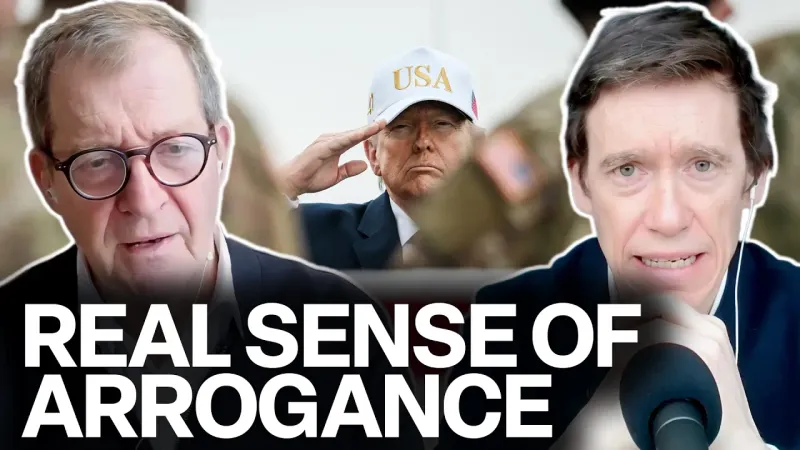
“Blank Incomprehension” - Is America Alone in How It Sees the Iran War?
The Rest Is Politics@restispolitics“Blank Incomprehension” - Is America Alone in How It Sees the Iran War?
Rory Stewart and Alastair Campbell discuss muted opposition to the Iran war in the US and how American views differ from those in the UK. The episode also raises US war costs, betting on the conflict, foreign influence in British politics, and a proposal to ban political donations, among other topics.
- Views
- 584.2K
- Likes
- 10.9K
- Comments
- 3.2K
- Iran war oppositionUS public opinionAmerican foreign policyBritish political donationsForeign political influence
Analysis
Rory Stewart and Alastair Campbell discuss muted opposition to the Iran war in the US and how American views differ from those in the UK. The episode also raises US war costs, betting on the conflict, foreign influence in British politics, and a proposal to ban political donations, among other topics.
- Podcast episodeCo hosted conversationNews analysis

- Title
- “Blank Incomprehension” - Is America Alone in How It Sees the Iran War?
“Trump's gone after Iran. Nobody fully expected him to do so, and now they're creating justifications behind it. But, they don't add up. It's a war that feels like the risk is taken by the US, the costs are borne elsewhere. This is decades of American arrogance coming to a head in the form of this guy. Why was Iran considered a more important threat than Russia? They have spent colossal sums of money, which could have gone to Ukraine in this Iran intervention. It's just madness that we're dealing with at the moment. I I honestly think this is a form of madness. Welcome to The Rest Is Politics with me, Alistair Campbell. And me, uh Rory Stewart. And Rory, we're going to talk about Iran, inevitably. We're going to talk about what's going on, but also talk about this business of betting on the war. We'll do that in the second half, alongside a very interesting report that came out last week by former civil servant Philip Rycroft about trying to clean up the financing of British politics and deal with foreign interference. But, on Iran, there is so much to get through. So, where should Where do you want to start? >> Let me start with the fact that I'm in the US. So, I'm speaking to you from Yale, and I have found myself in the last week very aware that I'm in a completely different United States. I arrived here, of course, sharing many of your views on Trump and on Iran, and I continue to have those views, but I've walked into a United States in which I'm facing blank incomprehension from a huge range of people. Students, uh people who are Democrats, moderate Republicans, colonels in the military, academics, they are thinking in a completely different way, talking a totally different language. They don't feel anything like the level of outrage, shock, and disgust that we feel about this war. I was here for example when there were the no kings demonstration going on on here in the streets of New Haven. But the sense it's totally different. I suppose just to sort of sum up totally different from my experience. I was in the US during the Afghan and Iraq wars and again at a university at Harvard and now at Yale. Then people were deeply interested in the legal justifications the war, the moral justification the war. They were very interested in deep conversations about what was going on on the ground, different theories of military strategy and threat assessment. It doesn't feel like that at all. This is a war where the level of discussion and argumentation is very very limited. And maybe I'll I'll hand back to you on this that I was talking to somebody who's a real really dislikes Trump, is a big Democrat funder. And I said to her, you know, how shocked I was by the Iran war. And she said, I know, you're you're right, right? And and look what he's doing to the universities. And that was about all the all the conversation I got out of it. >> That sort of goes against how it feels from reading the polls. I mean the polls here at the moment is unpopular as any president this stage of his term, any president in history. The war itself, the Iran war is polling with 41% support. World War II had 97% Afghanistan 92. Even the Iraq war against which millions of people marched had 76% support. So it's really it's really interesting that you're getting that sense.”
- 01Judgment and stakes
This is the cold open’s strong opinion and establishes the central issue: whether the intervention’s reasoning and allocation of costs make sense. The pointed question gives the discussion a specific line of inquiry.
The speaker says a leader acted against expectations, criticizes the justifications, and frames the war as placing risk and costs on different parties. They attribute it to longstanding arrogance and ask why one perceived threat outranked another.
“Trump's gone after Iran. Nobody fully expected him to do so, and now they're creating justifications behind it. But, they don't add up. It's a war that feels like the risk is taken by the US, the costs are borne elsewhere. This is decades of American arrogance coming to a head in the form of this guy. Why was Iran considered a more important threat than Russia? They have spent colossal sums of money, which could have gone to Ukraine in this Iran intervention. It's just madness that we're dealing with at the moment. I I honestly think this is a form of madness.”
- 02Show identification and roadmap
The show identification establishes the recurring format after the cold open. The roadmap clarifies that the episode will move beyond the initial critique, while the exchange hands the discussion to Rory.
The hosts welcome viewers to the show, identify themselves, and preview discussion of Iran, the war, betting on the war, and a report on British politics and foreign interference. They note the amount to cover and invite a starting point.
“Welcome to The Rest Is Politics with me, Alistair Campbell. And me, uh Rory Stewart. And Rory, we're going to talk about Iran, inevitably. We're going to talk about what's going on, but also talk about this business of betting on the war. We'll do that in the second half, alongside a very interesting report that came out last week by former civil servant Philip Rycroft about trying to clean up the financing of British politics and deal with foreign interference. But, on Iran, there is so much to get through. So, where should Where do you want to start?”
- 03Rory’s account of the perspective gap
The guest answers the handoff with a personal account that makes the title’s perspective question concrete. The comparison with his earlier experience explains what feels different to him and leaves open why the present discussion differs.
Rory says he is speaking from Yale and has found himself in a different United States. He describes people across several groups who think and speak differently and do not share the same outrage, shock, or disgust. He contrasts this with his earlier experience of American discussion during the Afghan and Iraq wars, when people engaged with legal and moral justifications, events on the ground, and military strategy. He concludes that discussion and argument about this war seem limited.
“>> Let me start with the fact that I'm in the US. So, I'm speaking to you from Yale, and I have found myself in the last week very aware that I'm in a completely different United States. I arrived here, of course, sharing many of your views on Trump and on Iran, and I continue to have those views, but I've walked into a United States in which I'm facing blank incomprehension from a huge range of people. Students, uh people who are Democrats, moderate Republicans, colonels in the military, academics, they are thinking in a completely different way, talking a totally different language. They don't feel anything like the level of outrage, shock, and disgust that we feel about this war. I was here for example when there were the no kings demonstration going on on here in the streets of New Haven. But the sense it's totally different. I suppose just to sort of sum up totally different from my experience. I was in the US during the Afghan and Iraq wars and again at a university at Harvard and now at Yale. Then people were deeply interested in the legal justifications the war, the moral justification the war. They were very interested in deep conversations about what was going on on the ground, different theories of military strategy and threat assessment. It doesn't feel like that at all. This is a war where the level of discussion and argumentation is very very limited.”
- 04Personal example and polling counterpoint
The personal example qualifies Rory’s account with a specific interaction, and the host’s polling comparison complicates it with reported public-opinion figures. This develops the unresolved question of how the lived impressions relate to broader views. The supplied excerpt ends during this discussion, so the introduction boundary may extend beyond it.
Rory starts to hand back and recounts a conversation with a strong Democratic donor who dislikes Trump. She describes that conversation as focused mainly on Trump's actions toward universities. The other host counters that polls make the reaction seem different, cites support figures for the Iran war and earlier wars, and says the two impressions are interesting.
“And maybe I'll I'll hand back to you on this that I was talking to somebody who's a real really dislikes Trump, is a big Democrat funder. And I said to her, you know, how shocked I was by the Iran war. And she said, I know, you're you're right, right? And and look what he's doing to the universities. And that was about all the all the conversation I got out of it. >> That sort of goes against how it feels from reading the polls. I mean the polls here at the moment is unpopular as any president this stage of his term, any president in history. The war itself, the Iran war is polling with 41% support. World War II had 97% Afghanistan 92. Even the Iraq war against which millions of people marched had 76% support. So it's really it's really interesting that you're getting that sense.”