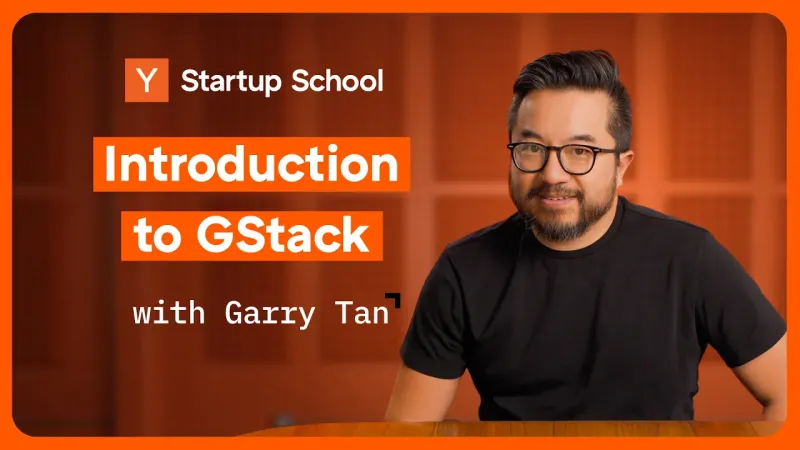
How to Make Claude Code Your AI Engineering Team
Y Combinator@ycombinatorHow to Make Claude Code Your AI Engineering Team
Garry Tan introduces GStack, an open-source toolkit that organizes AI coding agents into specialist roles, including office hours, design, code review, and QA. The opening demo uses its Office Hours skill to pressure-test an idea for an app that finds tax forms in Gmail before moving into planning and testing.

- Views
- 267.5K
- Likes
- 6.5K
- Comments
- 291
- AI coding agentsGStack ToolkitStartup idea reviewAutomated app testing
Analysis
Garry Tan introduces GStack, an open-source toolkit that organizes AI coding agents into specialist roles, including office hours, design, code review, and QA. The opening demo uses its Office Hours skill to pressure-test an idea for an app that finds tax forms in Gmail before moving into planning and testing.
- TutorialDemonstration
- Title
- How to Make Claude Code Your AI Engineering Team
“Hi, I'm Gary, president and CEO of Y Combinator. I'm also an engineer who spent the first decade of my career building software full-time. I studied computer systems engineering at Stanford, then was employee number 10 at Palunteer, where I was an engineer, designer, and product manager all at once. I co-founded Posterous, a micro blogging platform that sold to Twitter, and I also built the first version of Bookface, YC's internal social platform and knowledge base. Basically, I've written a lot of code in my career, and I'm here to tell you we are in a completely new era of building software, the agent era. It turns out the way to get agents to do real work is the same way humans have always done it as a team with roles with process with review. I built GStack to encode this 3 weeks ago and now it has more GitHub stars than Ruby on Rails. In this video I want to explain how it can help you build with agents. I've coded more in the past two months than I did in all of 2013, which is the last time I worked really, really hard as an engineer. I started playing with Claude Code back in January after hearing people like Andre Karpathy and Boris Churnney say they weren't manually writing any code anymore. And I got completely hooked. Along the way, I've essentially built all of Posterus, which took 2 years to build with a co-founder and a team of 10 engineers. I've essentially built all of my startup Posterus, which took 2 years, $10 million, and 10 engineers to build. Out of the box, the model wanders. It doesn't know your data well. So, it guesses. And guessing at that scale is how you get plausible looking code that silently breaks. The bottleneck here is not the model's intelligence. As long as you set the models upright, they are already smart enough to do extraordinary work on your codebase. This is backwards. The scaffolding should be trivially thin. GStack is my implementation of the thin harness fat skills approach. It's an open-source repo that I built that turns clawed code into an AI engineering team for you. skills that act like a team of specialists. Office hours is one of those skills. It's actually modeled exactly after what we go through at YC as a partner doing office hours with startups. It starts by asking six forcing questions for you to reframe your product before you start building. Let me show you how it works.”
- 01Establish relevant experience
This background gives context for the speaker's coming perspective on software development, rather than relying on confident assertion alone.
The speaker introduces a leadership role and summarizes engineering education and software-building credentials.
“Hi, I'm Gary, president and CEO of Y Combinator. I'm also an engineer who spent the first decade of my career building software full-time. I studied computer systems engineering at Stanford, then was employee number 10 at Palunteer, where I was an engineer, designer, and product manager all at once. I co-founded Posterous, a micro blogging platform that sold to Twitter, and I also built the first version of Bookface, YC's internal social platform and knowledge base.”
- 02State the field shift and central idea
This introduces the video's main premise and the organizing principle behind the approach, setting up why a different way of working may matter.
The speaker condenses his experience into a claim that a new era of building software has begun, then describes the team structure he says lets agents do real work.
“Basically, I've written a lot of code in my career, and I'm here to tell you we are in a completely new era of building software, the agent era. It turns out the way to get agents to do real work is the same way humans have always done it as a team with roles with process with review.”
- 03Introduce the tool and promise
The tool makes the premise concrete; the adoption comparison supports its relevance, while the explicit explanation promise sets the viewing expectation.
The speaker names GStack, says when he built it and cites its GitHub-star comparison, then promises to explain how it can help viewers build with agents.
“I built GStack to encode this 3 weeks ago and now it has more GitHub stars than Ruby on Rails. In this video I want to explain how it can help you build with agents.”
- 04Personal example and problem framing
The personal comparison illustrates the claimed change in work, while the failure mode and proposed alternative explain why the tool's structure matters. This leads into the coming explanation without yet beginning its concrete walkthrough.
The speaker says he has coded more recently than in a prior intensive period, recounts trying Claude Code after hearing about others' changed coding practices, and describes being drawn into it. He contrasts the model's tendency to guess and silently break code with the claim that intelligence is not the bottleneck, then argues for thin scaffolding and introduces GStack's approach.
“I've coded more in the past two months than I did in all of 2013, which is the last time I worked really, really hard as an engineer. I started playing with Claude Code back in January after hearing people like Andre Karpathy and Boris Churnney say they weren't manually writing any code anymore. And I got completely hooked. Along the way, I've essentially built all of Posterus, which took 2 years to build with a co-founder and a team of 10 engineers. I've essentially built all of my startup Posterus, which took 2 years, $10 million, and 10 engineers to build. Out of the box, the model wanders. It doesn't know your data well. So, it guesses. And guessing at that scale is how you get plausible looking code that silently breaks. The bottleneck here is not the model's intelligence. As long as you set the models upright, they are already smart enough to do extraordinary work on your codebase. This is backwards. The scaffolding should be trivially thin. GStack is my implementation of the thin harness fat skills approach.”
- 05Define the tool's role and promise an explanation
This states the practical role of the tool and carries the opening promise into the next section, where the explanation can begin.
The speaker describes the tool as an open-source repository that turns agent-based coding into an AI engineering team, adds that its skills act like specialist teammates, and promises to show how it works.
“It's an open-source repo that I built that turns clawed code into an AI engineering team for you. skills that act like a team of specialists. Office hours is one of those skills. It's actually modeled exactly after what we go through at YC as a partner doing office hours with startups. It starts by asking six forcing questions for you to reframe your product before you start building. Let me show you how it works.”