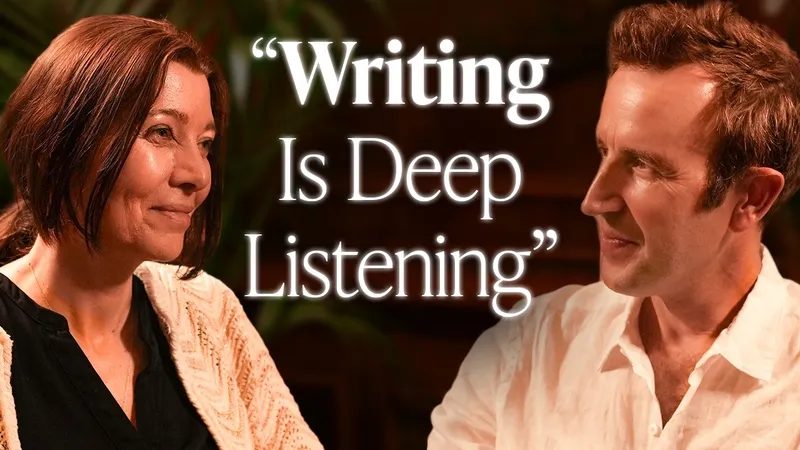
The Deepest Conversation You’ll Ever Watch About Writing (Shafak & Macfarlane Interview)
David Perell@DavidPerellChannelThe Deepest Conversation You’ll Ever Watch About Writing (Shafak & Macfarlane Interview)
Host David Perell brings writers Elif Shafak and Robert Macfarlane together for a relaxed conversation about writing. They discuss turning emotion into language, their writing practices, nature, and how listening, rhythm, and observation can shape words.

- Views
- 1.2M
- Likes
- 10.4K
- Comments
- 457
- Writing and EmotionWriting practiceNature writingLanguage and Rhythm
Analysis
Host David Perell brings writers Elif Shafak and Robert Macfarlane together for a relaxed conversation about writing. They discuss turning emotion into language, their writing practices, nature, and how listening, rhythm, and observation can shape words.
- InterviewPodcast episode

- Title
- The Deepest Conversation You’ll Ever Watch About Writing (Shafak & Macfarlane Interview)
Alif Shafak and Robert McFarland are two of the most dreamy and articulate writers I know. Alif has written 21 books, 13 of which have been novels, and she's the president of the Royal Society of Literature. Robert McFarland, he writes about the natural world, birds, rivers, trees, mountains, and he does so in such a poetic and enchanted way. His writing is just infused with wonder. I've had both of them on the show individually, but what I said is, "Hey, I know you're really good friends. Let's all get together for one conversation. And what I want to do is I want to hear the kind of conversation that you would have over a cup of coffee, over lunch. And so here I'm like you, a fly on the wall for a conversation with two really interesting writers. All right, let's start with you. So when you're with a mountain with a river and you're moved by awe and you think about translating those emotions into language, how is it that you go about doing that? First of all, you accept failure. Language will always be late for light. It will never meet water, river, rock, mountain. That moment of encounter which is a moment in time and a moment in space when countless streams of of being and presence and sensation are all convened in a moment that we call or we speak of ourselves as aruck, wonderuck, astonished language will never catch them. And I think the question is how well language fails. And it's actually in the the the shattering of language as it falls to pieces around the untouchable moment that for me the beauty the beauty comes how how the pieces fall, what they're made of >> and what happens when you're out in the field and what happens when you're at home at the desk. >> Yeah, that's a I mean I I'm extremely interested in the technologies of writing. So I I write across a lot of forms. Some of those forms I I absolutely have to write in notebook and that's typically song lyrics and short poems. I I really don't like writing them on the screen. I like working them out on paper. I have different size notebooks for different lengths. I have tiny A6 ones, bigger A5 ones, and depending on, you know, whether I how much of it I need to see, I'll I'll choose that notebook. Can I choose a pen that that that works as well? I have a fountain pen that has ink which carries the water of now 110 rivers in it. So if I want to write something very flowing, I'll I'll reach for the river pen. >>
- 01Establish the guests
This supplies context for the guests’ relevance before the host explains why they have brought them together.
The host praises the two writers and outlines their work, accomplishments, and connection to the show.
“Alif Shafak and Robert McFarland are two of the most dreamy and articulate writers I know. Alif has written 21 books, 13 of which have been novels, and she's the president of the Royal Society of Literature. Robert McFarland, he writes about the natural world, birds, rivers, trees, mountains, and he does so in such a poetic and enchanted way. His writing is just infused with wonder.”
- 02Explain the conversation premise
This makes the intended format and reason for the joint conversation clear, setting up the question that begins it.
The host says both guests have appeared separately, then explains the idea of bringing them together for an informal conversation that viewers can observe.
I've had both of them on the show individually, but what I said is, "Hey, I know you're really good friends. Let's all get together for one conversation. And what I want to do is I want to hear the kind of conversation that you would have over a cup of coffee, over lunch. And so here I'm like you, a fly on the wall for a conversation with two really interesting writers.
- 03Pose the opening question
The specific question initiates the discussion and gives the guest a concrete experience to consider.
The host turns to one guest and asks how an encounter with a natural feature and a feeling of awe might be translated into language.
“All right, let's start with you. So when you're with a mountain with a river and you're moved by awe and you think about translating those emotions into language, how is it that you go about doing that?”
- 04Answer through language’s limits
This offers a nuanced initial answer while keeping the central tension open: if language cannot capture the experience, what can its failure express, and how does writing practice shape that effort?
The guest says to accept failure: language cannot catch up with light or fully meet the natural world and the moment of encounter. The answer proposes that the question is how well language fails, finding beauty in the pieces as language falls around an untouchable moment, and contrasts being in the field with being at a desk.
“First of all, you accept failure. Language will always be late for light. It will never meet water, river, rock, mountain. That moment of encounter which is a moment in time and a moment in space when countless streams of of being and presence and sensation are all convened in a moment that we call or we speak of ourselves as aruck, wonderuck, astonished language will never catch them. And I think the question is how well language fails. And it's actually in the the the shattering of language as it falls to pieces around the untouchable moment that for me the beauty the beauty comes how how the pieces fall, what they're made of >> and what happens when you're out in the field and what happens when you're at home at the desk. >>”
- 05Shift to writing technologies
This moves from the opening question’s abstract tension to a practical discussion of writing choices, while continuing the broader conversation about how writing happens.
The other guest responds with interest in the technologies of writing and describes choosing between notebooks, paper, pens, and a screen according to the form and work involved.
“Yeah, that's a I mean I I'm extremely interested in the technologies of writing. So I I write across a lot of forms. Some of those forms I I absolutely have to write in notebook and that's typically song lyrics and short poems. I I really don't like writing them on the screen. I like working them out on paper. I have different size notebooks for different lengths. I have tiny A6 ones, bigger A5 ones, and depending on, you know, whether I how much of it I need to see, I'll I'll choose that notebook. Can I choose a pen that that that works as well? I have a fountain pen that has ink which carries the water of now 110 rivers in it. So if I want to write something very flowing, I'll I'll reach for the river pen. >>”