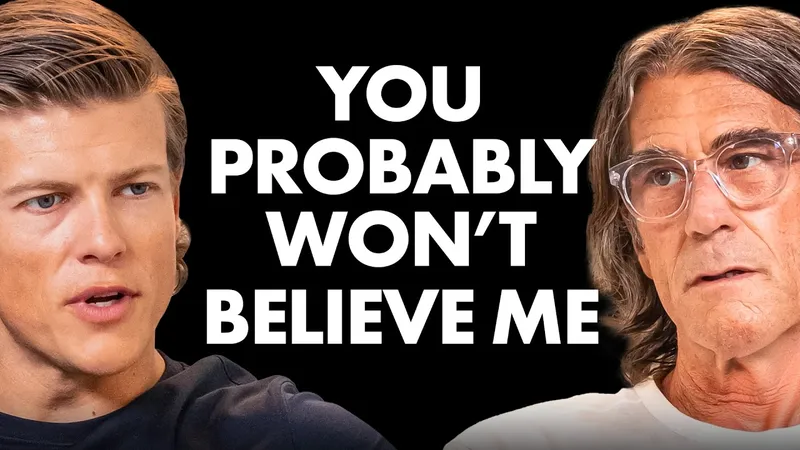
The World’s Greatest Winter Olympian Shares What Makes Him the Best
Rich Roll@richrollThe World’s Greatest Winter Olympian Shares What Makes Him the Best
Rich Roll interviews Norwegian cross-country skier Johannes Klæbo about his viral uphill-skiing moment, training, competitive mindset, and Norway’s approach to developing athletes. The episode also discusses technique, recovery, and the sport’s health and endurance benefits.
- Views
- 206.5K
- Likes
- 2.6K
- Comments
- 315
- Cross-Country SkiingOlympic trainingChampion mindsetNorwegian youth sports
Analysis
Rich Roll interviews Norwegian cross-country skier Johannes Klæbo about his viral uphill-skiing moment, training, competitive mindset, and Norway’s approach to developing athletes. The episode also discusses technique, recovery, and the sport’s health and endurance benefits.
- InterviewPodcast episode

- Title
- The World’s Greatest Winter Olympian Shares What Makes Him the Best
There goes Klæbo. Let me >> The amount of energy expenditure that is required for you to do that has to be insane. >> I saw the video myself and I was like That looks pretty good. >> hot. >> [laughter] >> Johannes Klæbo >> 13 time Olympic medalist, 11 gold medals, the most gold medals won at a single Winter Olympics, >> [music] >> most career gold medals won by any Winter Olympic athlete. Like it's insane what you've accomplished. >> I always had this mindset where I hate to lose. The feeling of winning a race is amazing. The feeling of becoming second is so much worse. It is a mental game. You are saying that, "Okay, we just go over the next hill, the next hill." And then you just continue to trick your head to just move a little bit more. >> So, 1,000 hours of training, what does it look like? >> 2 and 1/2 hours of >>
- 01Performance reaction
Opens on an already-underway exchange and quickly establishes the performance as notable, inviting interest in the person behind it.
A brief exchange reacts to a named person’s performance, with one speaker remarking on the effort and another saying the result looks good.
“There goes Klæbo. Let me >> The amount of energy expenditure that is required for you to do that has to be insane. >> I saw the video myself and I was like That looks pretty good. >> hot. >> [laughter] >>”
- 02Credentials and mindset
Establishes why the guest is a relevant source, then moves from external achievements to the personal competitive mindset behind them.
The speaker is introduced with a record of achievements, followed by praise and a first-person account of the mindset that makes losing especially difficult.
“Johannes Klæbo >> 13 time Olympic medalist, 11 gold medals, the most gold medals won at a single Winter Olympics, >> [music] >> most career gold medals won by any Winter Olympic athlete. Like it's insane what you've accomplished. >> I always had this mindset where I hate to lose. The feeling of winning a race is amazing. The feeling of becoming second is so much worse. It is a mental game.”
- 03Pushing onward
Makes the mental approach concrete through a repeatable image of continuing one step at a time, extending the opening’s account of the athlete’s mindset.
The guest describes narrowing the challenge to the next obstacle and persuading himself to move a little farther.
You are saying that, "Okay, we just go over the next hill, the next hill." And then you just continue to trick your head to just move a little bit more.
- 04Training question and cut-off answer
Turns the mindset discussion toward a concrete training example. The bounded excerpt cuts off during the response, so the introduction’s endpoint and the example’s full meaning cannot be established here.
The interviewer asks what a stated volume of training looks like. The reply begins with a duration, but the excerpt ends before the answer is complete.
“>> So, 1,000 hours of training, what does it look like? >> 2 and 1/2 hours of >>”