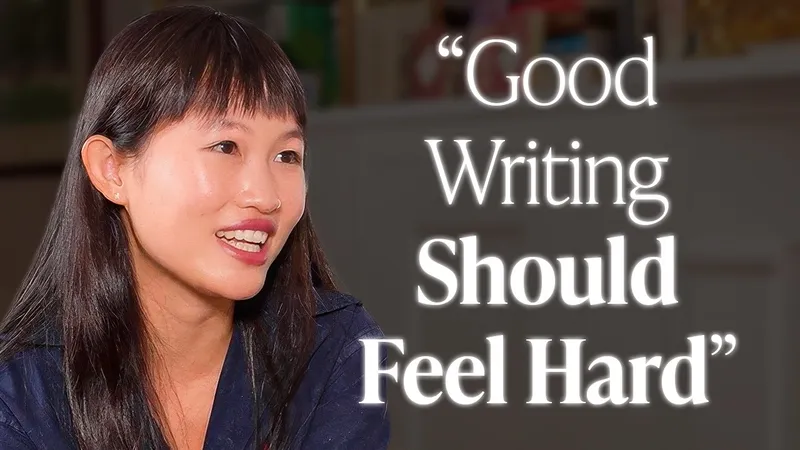
Meet The Writer Who Sold Millions of Books Before 30 (R.F. Kuang Interview)
David Perell@DavidPerellChannelMeet The Writer Who Sold Millions of Books Before 30 (R.F. Kuang Interview)
Writer R.F. Kuang discusses how she draws on emotion and physical sensations to make characters’ feelings vivid on the page. The interview also frames questions about developing different literary voices and living like a writer; the supplied opening focuses on turning emotional experience into narrative.

- Views
- 361.5K
- Likes
- 6.4K
- Comments
- 235
- Writing craftEmotional writingLiterary voiceR.F. Kuang Interview
Analysis
Writer R.F. Kuang discusses how she draws on emotion and physical sensations to make characters’ feelings vivid on the page. The interview also frames questions about developing different literary voices and living like a writer; the supplied opening focuses on turning emotional experience into narrative.
- Interview

- Title
- Meet The Writer Who Sold Millions of Books Before 30 (R.F. Kuang Interview)
“RF Guang came on the show to talk about her love for language and what it means to live like a writer. She's written seven books, won the Nebula Award for best novel, and trained at some of the world's top universities, Cambridge, Oxford, Yale. What stands out is her ability to write in so many different voices, the economical, the poetic, the minimalist, the maximalist. How do you cultivate that dexterity as a writer? It's rare to meet somebody who writes so well and also can explain their process with such joy and precision. So, you just taught a class on writing about intense emotions. So, let's start there. >> Sure. Um, well, sort of to preface, I let my emotions drive a lot of my writing because I treat writing as therapy. Every time I am going through something really hard, something really heavy, um, something that feels like I won't be able to recover from this. Um, one of the first things I do to try to get a grasp on uh all the negativity is sort of to like split my psyche into two parts. And then there's the part that is living through the the grief or the panic or fear or what have you. And then there's the other part that is floating around on the outside that's just like sort of detached and curiously observing. And I'm asking myself questions like, what is my body doing right now? What is the rhythm of my crying? What's happening to my breathing? How are all these thoughts and feelings like sitting on my chest? And then I'll try to document them. And it it doesn't make the the sadness go away, but I think trying to articulate how it's functioning helps me get a grasp on it and makes me legible to myself. So to get to the brass tax of like how you actually turn that into narrative, how you turn that into interesting writing, um I was talking to my students about how feelings aren't abstract. Emotions are not these abstract concepts that are applied to the body like love, hatred, anger, etc. It's not like you think like oh like this is what I'm going through right now. This is love. but rather all feelings start with a physiological response. All feelings are is how your body is reacting to some piece of information. So we we started not from theorizing like how would you describe like like say you're you're writing about triumph, right? You could reach for words like um elation, victory, but that tells the reader like nothing material about what's going on with the character. Um, so we did this exercise where I passed out these like kindergarten level like silhouette diagrams of the human body and I was like without reaching for any abstractions tell me how like joyous triumph like suppose you just got a call and you got a promotion like tell me where that sits in the body like describe only what is happening >> on a physical level and people were saying like oh an elevated heart rate like palpitations butterflies one girl was like I feel joy in my toes like my toes start to tingle and I was like that's weird. But when when you start on the physical level that allows you to do really interesting lateral slides to emotions that are confusing and contradictory and that gets you into the second level of the complex ways in which we feel things because we never feel things in like a one-dimensional flat way, right?”
- 01Guest credentials and distinctive strength
Establishes why this guest’s perspective is relevant and gives the audience a concrete craft question to follow.
The host introduces the guest, summarizes relevant achievements and training, and identifies a distinctive ability across different writing voices.
“RF Guang came on the show to talk about her love for language and what it means to live like a writer. She's written seven books, won the Nebula Award for best novel, and trained at some of the world's top universities, Cambridge, Oxford, Yale. What stands out is her ability to write in so many different voices, the economical, the poetic, the minimalist, the maximalist. How do you cultivate that dexterity as a writer? It's rare to meet somebody who writes so well and also can explain their process with such joy and precision.”
- 02Bridge into the guest’s process
Moves from credentials to a focused craft topic, setting up a personal account rather than leaving the introduction at biography.
The host links the guest’s recent teaching on intense emotions to the opening question, invites her to begin there, and she starts her answer.
“So, you just taught a class on writing about intense emotions. So, let's start there. >> Sure. Um, well, sort of to preface, I let my emotions drive a lot of my writing because I treat writing as therapy.”
- 03Personal account and method of observing
Offers a specific account of the process behind the guest’s claim and develops the question of how intense emotion can become usable material for writing.
The guest describes writing through difficult experiences, separating the part living through the feelings from the part observing them, and asking bodily, sensory questions before documenting the experience.
“Every time I am going through something really hard, something really heavy, um, something that feels like I won't be able to recover from this. Um, one of the first things I do to try to get a grasp on uh all the negativity is sort of to like split my psyche into two parts. And then there's the part that is living through the the grief or the panic or fear or what have you. And then there's the other part that is floating around on the outside that's just like sort of detached and curiously observing. And I'm asking myself questions like, what is my body doing right now? What is the rhythm of my crying? What's happening to my breathing? How are all these thoughts and feelings like sitting on my chest? And then I'll try to document them.”
- 04What articulation does—and does not—do
Provides a modest answer without overstating the effect, then opens the next craft problem: converting experience into compelling writing.
The guest qualifies that documenting feelings does not remove sadness, but says articulating how it works helps her grasp it and become more legible to herself. She then turns to the question of making that experience into narrative.
“And it it doesn't make the the sadness go away, but I think trying to articulate how it's functioning helps me get a grasp on it and makes me legible to myself. So to get to the brass tax of like how you actually turn that into narrative, how you turn that into interesting writing, um I was talking to my students about how feelings aren't abstract.”
- 05Teaching principle and classroom exercise
Begins a concrete teaching example that advances the craft discussion from the guest’s personal process to a method for making emotion more specific on the page.
The guest argues that feelings begin with physiological responses rather than abstract labels, then describes asking students to map a feeling such as triumph onto bodily experience instead of relying on general words.
“Emotions are not these abstract concepts that are applied to the body like love, hatred, anger, etc. It's not like you think like oh like this is what I'm going through right now. This is love. but rather all feelings start with a physiological response. All feelings are is how your body is reacting to some piece of information. So we we started not from theorizing like how would you describe like like say you're you're writing about triumph, right? You could reach for words like um elation, victory, but that tells the reader like nothing material about what's going on with the character. Um, so we did this exercise where I passed out these like kindergarten level like silhouette diagrams of the human body and I was like without reaching for any abstractions tell me how like joyous triumph like suppose you just got a call and you got a promotion like tell me where that sits in the body like describe only what is happening >> on a physical level and people were saying like oh an elevated heart rate like palpitations butterflies one girl was like I feel joy in my toes like my toes start to tingle and I was like that's weird. But when when you start on the physical level that allows you to do really interesting lateral slides to emotions that are confusing and contradictory and that gets you into the second level of the complex ways in which we feel things because we never feel things in like a one-dimensional flat way, right?”