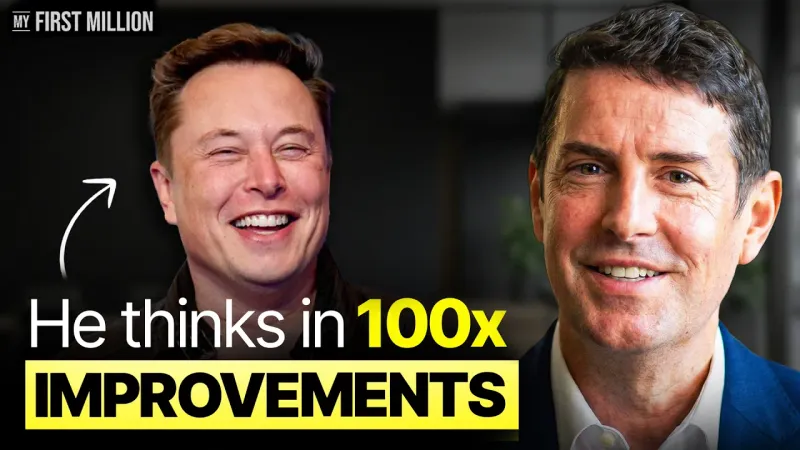
Ex-Tesla President reveals EVERYTHING Elon does to win
My First Million@MyFirstMillionPodEx-Tesla President reveals EVERYTHING Elon does to win
Jon McNeill discusses his time leading Tesla and working with Elon Musk, including Musk’s intense, problem-focused approach to interviewing and setting ambitious improvement targets. The episode also promises lessons on sales, talent, noticing opportunities, concise emails, and AI.

- Views
- 307.7K
- Likes
- 6.2K
- Comments
- 250
- Elon Musk's LeadershipTesla digital salesHiring and TalentStartup problem solving
Analysis
Jon McNeill discusses his time leading Tesla and working with Elon Musk, including Musk’s intense, problem-focused approach to interviewing and setting ambitious improvement targets. The episode also promises lessons on sales, talent, noticing opportunities, concise emails, and AI.
- InterviewPodcast episode

- Title
- Ex-Tesla President reveals EVERYTHING Elon does to win
Part of the secret to Elon's secret sauce is he sets these order of magnitude improvement goals. So 10x 100x. He came to me and said, "Hey, look, we got to figure out how to sell cars online." Cuz nobody was buying $120,000 things sight unseen online. And so he turns to me. He says, "This is your goal. Improve digital sales by 20x." So now it's like, "Oh crap, I got to think way differently about this." All right. So, I guess to start, I mean, I almost want to rename the podcast How Lucky Are We. It's like, oh, we get to sit here with with a guy who was the president of one of the most important companies of our time, Tesla, for years. You got to work with one of the greatest entrepreneurs ever, Elon. You yourself have this crazy entrepreneurial track record. You've built and sold, >> you know, five, six different startups. You're like the Force Gump of the tech industry, just going into different spaces. and you go into, you know, uh, auto repair and cyber insurance and all these different spaces. And so I'm pretty fascinated that we get to talk today and I got a bunch of questions for you, but I want to start with less of a tactical question and more of a a movie scene. So, um, you go into a job interview with Elon Musk. It might not have even felt like it was a formal job interview, but your first conversation with him. Uh, what's that like? >> All right. So, uh, the setup to the scene is we're introduced by a mutual friend and he is intense, uh, and the nicities were about two sentences and then he said, "Hey, I got this problem in manufacturing. Have you ever seen it before?" And then we were right into it and 2 hours flew by cuz I had had that experience in manufacturing. I'd seen that problem. We started to break it down together and then we started to move deeper and deeper and deeper into the problem and uh, we looked up in two hours he was like, "Oh man, like I I got let out of this. I got to go. Uh I'm going to go down to the factory floor and do what we just talked about. >> So that's the first that's the first combo. >> He's uh So you're problem solving together. He skips a small talk and then is he testing you or he's just genuinely trying to solve the problem right now? Like did you get any sense of he was poking around to see kind of where your capacity was or he was literally just >> Oh yeah, that's No, that's exactly what he was up to. So his hiring method is he wants to determine whether or not you can do world class work and his method is to interrogate a particular problem and go super deep on it. And uh it's better if he tries to skew it to a problem that he knows, >> right? >> So that he can bullshitting. >> Exactly. and he can take you do super deep because he's in it and he he just likes to know like almost like a video game like how many layers can this player get through before they're stumped and so that's exactly what was going on. We were getting to know each other but 90% of it was he was evaluating >> later when you worked there and you're the president. Did he try to teach you kind of the the method or say like hey here's what I'm doing when I'm interviewing?
- 01State the approach
This direct claim supplies the opening’s central idea and concrete scale. The target figures make the approach specific and invite the viewer to hear what it means in practice.
The speaker identifies a subject’s “secret sauce” as setting order-of-magnitude improvement goals, then gives examples of targets and a digital-sales assignment.
Part of the secret to Elon's secret sauce is he sets these order of magnitude improvement goals. So 10x 100x. He came to me and said, "Hey, look, we got to figure out how to sell cars online." Cuz nobody was buying $120,000 things sight unseen online. And so he turns to me. He says, "This is your goal. Improve digital sales by 20x." So now it's like, "Oh crap, I got to think way differently about this." All right.
- 02Establish the guest’s relevance
This host-led context explains why the guest can speak to the opening claim and establishes the interview’s subject before the first question.
The host welcomes the conversation, frames the guest’s Tesla leadership and work with Elon, and summarizes the guest’s entrepreneurial history across several industries.
“So, I guess to start, I mean, I almost want to rename the podcast How Lucky Are We. It's like, oh, we get to sit here with with a guy who was the president of one of the most important companies of our time, Tesla, for years. You got to work with one of the greatest entrepreneurs ever, Elon. You yourself have this crazy entrepreneurial track record. You've built and sold, >> you know, five, six different startups. You're like the Force Gump of the tech industry, just going into different spaces. and you go into, you know, uh, auto repair and cyber insurance and all these different spaces. And so I'm pretty fascinated that we get to talk today and I got a bunch of questions for you, but I want to start with less of a tactical question and more of a a movie scene.”
- 03Ask for the first encounter
The question shifts from credentials to a firsthand story. The reported problem and the guest’s experience with manufacturing set up an account of how the encounter unfolded.
The host imagines the guest’s first conversation with Elon as a movie scene and asks what it was like; the guest starts recounting their introduction and an immediate manufacturing problem.
So, um, you go into a job interview with Elon Musk. It might not have even felt like it was a formal job interview, but your first conversation with him. Uh, what's that like? >> All right. So, uh, the setup to the scene is we're introduced by a mutual friend and he is intense, uh, and the nicities were about two sentences and then he said, "Hey, I got this problem in manufacturing. Have you ever seen it before?" And then we were right into it and 2 hours flew by cuz I had had that experience in manufacturing. I'd seen that problem. We started to break it down together and then we started to move deeper and deeper and deeper into the problem and uh, we looked up in two hours he was like, "Oh man, like I I got let out of this. I got to go. Uh I'm going to go down to the factory floor and do what we just talked about. >>
- 04Interpret the problem-solving exchange
The exchange turns the anecdote into a proposed explanation of how Elon evaluates people. The host’s question and the guest’s answer make the method, rather than the scene alone, the focus of the coming conversation.
The host characterizes the encounter as problem-solving together, asks whether Elon was testing the guest or genuinely solving the problem, and the guest explains the hiring method as a deep interrogation of a specific problem.
“So that's the first that's the first combo. >> He's uh So you're problem solving together. He skips a small talk and then is he testing you or he's just genuinely trying to solve the problem right now? Like did you get any sense of he was poking around to see kind of where your capacity was or he was literally just >> Oh yeah, that's No, that's exactly what he was up to. So his hiring method is he wants to determine whether or not you can do world class work and his method is to interrogate a particular problem and go super deep on it. And uh it's better if he tries to skew it to a problem that he knows, >> right? >> So that he can bullshitting. >> Exactly. and he can take you do super deep because he's in it and he he just likes to know like almost like a video game like how many layers can this player get through before they're stumped and so that's exactly what was going on. We were getting to know each other but 90% of it was he was evaluating >>”
- 05Continue the interview inquiry
This is a natural handoff to the next discussion point, but the supplied opening ends mid-interview, so the introduction’s full boundary cannot be confirmed from this excerpt.
A further host question asks whether Elon tried to teach the guest his interviewing method or explain what he was doing.
“later when you worked there and you're the president. Did he try to teach you kind of the the method or say like hey here's what I'm doing when I'm interviewing?”