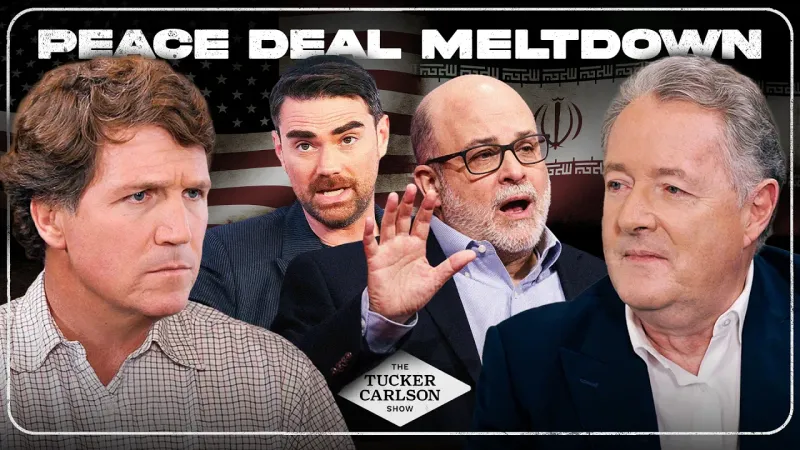
Trump Finally Puts Bibi in His Place & Neocons Cry Over Peace in Iran. Tucker & Piers Morgan React.
Tucker Carlson@TuckerCarlsonTrump Finally Puts Bibi in His Place & Neocons Cry Over Peace in Iran. Tucker & Piers Morgan React.
Tucker Carlson argues that a reported 14-point U.S.-Iran memorandum could end military operations and alter the balance of power, while explaining why neoconservatives oppose it. The listed chapters also indicate discussion of Piers Morgan’s disputes with Mark Levin, Israel’s position, and possible accountability over Gaza; the excerpt does not establish the deal’s outcome.
- Views
- 1.8M
- Likes
- 55.1K
- Comments
- 11K
- Iran peace dealU.S.-Iran RelationsIsrael and GazaNeoconservative politics
Analysis
Tucker Carlson argues that a reported 14-point U.S.-Iran memorandum could end military operations and alter the balance of power, while explaining why neoconservatives oppose it. The listed chapters also indicate discussion of Piers Morgan’s disputes with Mark Levin, Israel’s position, and possible accountability over Gaza; the excerpt does not establish the deal’s outcome.
- MonologueCommentary
- Title
- Trump Finally Puts Bibi in His Place & Neocons Cry Over Peace in Iran. Tucker & Piers Morgan React.
In your mind's eye, you imagine the American Empire ending someday, probably in like a confilgration, in some sort of conflict with another great power. And if you had to pick one, you would imagine the end might come in a dispute over Taiwan, formerly Formosa, the island off mainland China that might China considers part of its country. There's been a dispute about this for almost 80 years and the United States has sort of informally suggested that it would defend Taiwan's sovereignty and periodically that part of the world, South China Sea, pops into the news and you think, "Wow, that could be a big deal if you know we actually had a war with China because every year they get stronger. They now have a bigger economy than ours." You can kind of imagine some reckless American leader destroying American power over Taiwan. But you probably never imagined that the end of American Empire would come in a little over a 100 day conflict with a little rogue state on the Persian Gulf that has the 34th largest economy in the world, a country called Iran, which generations of Americans have been raised to believe is crazy and dangerous, but basically irrelevant and certainly not civilized and in no way capable of affecting America's place in the global hierarchy. You just couldn't imagine that would happen. But something like that apparently has happened and we know because we now have the text of theou the memorandum of understanding between the United States and Iran that unless something happens is going to be signed in 2 days this Friday in Switzerland by both countries. Now, versions of this have been circulating for the past 3 days. And earlier today, apparently on background, members of the Trump administration read the 14 points in theou to a bunch of different reporters at a bunch of different news organizations. They im immediately appeared online and you read this and you think that can't really be real. And then within the last hour, sources in Iran released their version of theou and it turns out to be identical to the one that members of the administration, these unnamed officials gave to American reporters. So both countries releasing the same text of the agreement. Therefore, you can't be certain really of anything, but you can be highly persuaded. You can consider it overwhelmingly likely that this document is real. At least as of right now, thisou is real. 14 points to be signed on Friday. It's pretty short and it's worth reading at least in part because it tells you everything, not just about how this war might end. It's not ended yet, but how it could end, but it tells you even more about the relative place of the United States and Iran in the global order going forward. And it's really kind of an amazing document. And to get right to the point, you can see why neocons are upset. I mean, they have cause to be upset. Not taking their side, but just being honest here. Wow. Here's part of what it says. Paragraph one.
- 01Expected source of change
This gives the audience a recognizable expectation about where the danger might come from, preparing the opening’s reversal.
The speaker imagines a major power’s decline coming through conflict with another great power and names a familiar potential flashpoint.
In your mind's eye, you imagine the American Empire ending someday, probably in like a confilgration, in some sort of conflict with another great power. And if you had to pick one, you would imagine the end might come in a dispute over Taiwan, formerly Formosa, the island off mainland China that might China considers part of its country. There's been a dispute about this for almost 80 years and the United States has sort of informally suggested that it would defend Taiwan's sovereignty and periodically that part of the world, South China Sea, pops into the news and you think, "Wow, that could be a big deal if you know we actually had a war with China because every year they get stronger. They now have a bigger economy than ours." You can kind of imagine some reckless American leader destroying American power over Taiwan.
- 02Unexpected alternative
The reversal makes the opening’s central proposition distinctive and invites the viewer to hear why the speaker thinks this less expected scenario matters.
The speaker pivots from the expected great-power conflict to the claimed possibility of a short conflict with Iran changing American power.
“But you probably never imagined that the end of American Empire would come in a little over a 100 day conflict with a little rogue state on the Persian Gulf that has the 34th largest economy in the world, a country called Iran, which generations of Americans have been raised to believe is crazy and dangerous, but basically irrelevant and certainly not civilized and in no way capable of affecting America's place in the global hierarchy. You just couldn't imagine that would happen. But something like that apparently has happened and we know because we now have the text of theou the memorandum of understanding between the United States and Iran that unless something happens is going to be signed in 2 days this Friday in Switzerland by both countries.”
- 03Document and evidence qualification
The document provides a stated evidentiary basis for the opening claim, while the uncertainty qualification keeps the claim properly attributed and leaves room to examine the text.
The speaker recounts the circulation of versions of the memorandum, says Iranian and U.S.-shared texts match, and qualifies the conclusion as highly likely rather than certain.
“Now, versions of this have been circulating for the past 3 days. And earlier today, apparently on background, members of the Trump administration read the 14 points in theou to a bunch of different reporters at a bunch of different news organizations. They im immediately appeared online and you read this and you think that can't really be real. And then within the last hour, sources in Iran released their version of theou and it turns out to be identical to the one that members of the administration, these unnamed officials gave to American reporters. So both countries releasing the same text of the agreement. Therefore, you can't be certain really of anything, but you can be highly persuaded. You can consider it overwhelmingly likely that this document is real. At least as of right now, thisou is real. 14 points to be signed on Friday. ”
- 04Meaning and transition to the text
This previews the document’s proposed significance and gives a reason to examine its wording. The introduction ends when the speaker begins the sustained quotation and discussion of its terms.
The speaker says the short document could explain how the war might end and reveal the countries’ relative places in the global order, then identifies neoconservative opposition before beginning to quote paragraph one.
“It's pretty short and it's worth reading at least in part because it tells you everything, not just about how this war might end. It's not ended yet, but how it could end, but it tells you even more about the relative place of the United States and Iran in the global order going forward. And it's really kind of an amazing document. And to get right to the point, you can see why neocons are upset. I mean, they have cause to be upset. Not taking their side, but just being honest here. Wow. Here's part of what it says. Paragraph one. ”