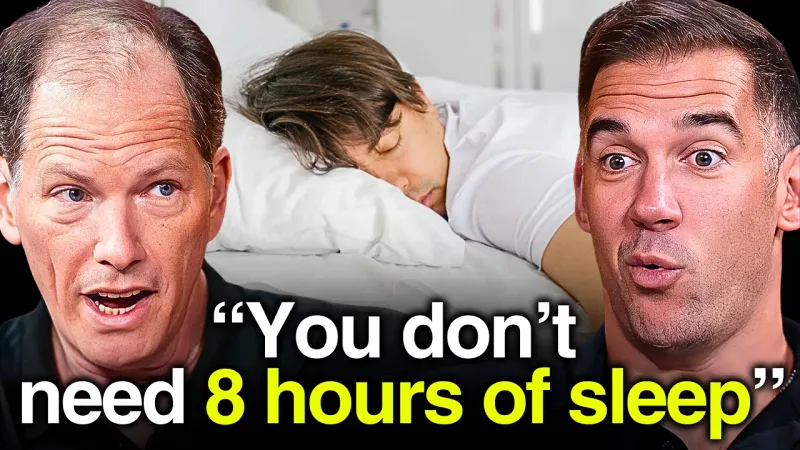
Sleep Doctor: “8 Hours of Sleep” Is a Lie (Here's What You Actually Need) | Dr. Michael Breus
Lewis Howes@lewishowesSleep Doctor: “8 Hours of Sleep” Is a Lie (Here's What You Actually Need) | Dr. Michael Breus
In this School of Greatness interview, sleep specialist Dr. Michael Breus discusses why sleep needs may not follow a universal eight-hour rule and how daily habits and circadian rhythms affect rest. The episode covers nighttime waking, breathing techniques, chronotypes, sleep trackers, melatonin and other sleep-related topics.
- Views
- 136.7K
- Likes
- 2.5K
- Comments
- 195
- Sleep quality and durationCircadian rhythm and chronotypesInsomnia and nighttime wakingSleep habits and treatments
Analysis
In this School of Greatness interview, sleep specialist Dr. Michael Breus discusses why sleep needs may not follow a universal eight-hour rule and how daily habits and circadian rhythms affect rest. The episode covers nighttime waking, breathing techniques, chronotypes, sleep trackers, melatonin and other sleep-related topics.
- InterviewPodcast episode
- Title
- Sleep Doctor: “8 Hours of Sleep” Is a Lie (Here's What You Actually Need) | Dr. Michael Breus
This is the most powerful drug in the world. And if you can figure out how to use that to your advantage, now we're talking. If you were a patient of mine and you walked in, and let's say you were taking 10 mg of Ambien, I could utter one sentence looking at your medical chart, and I could make that Ambien not work. I could just turn to you and say, "You have cancer." Boom, you ain't sleeping that night. His research has changed the way top CEOs, elite athletes, and millions of people think about sleep, energy, and performance. A best-selling author and one of the most >> trusted sleep experts in the world, Dr. Michael Breus, thanks for being here. I think sleep is kind of like the volume knob for greatness. When your volume is low, nobody can hear you. You can't hear you. You can't perform at the levels that you want to perform. Sleep affects every organ system and every disease state. Literally, everything you do, you do better with a good night's sleep. What ruminates in the mind that causes us not to sleep? That is literally the number one question that I'm asked is, "What do I do if I wake up in the middle of the night, somewhere between 1:00 and 3:00, and I can't get back to sleep?" What do you do? So, I've got a whole routine, and I tell people all the time about it. So, first of all, You said there's a difference between sleep experts and sleep doctors. What is that difference? >> Yeah, so it's not just a nuance, it's a whole different kind of area. So, a sleep expert, and and by the way, I love sleep experts. They really help me do my job really well. Sleep experts are folks who are a lot of times academicians, right? So, they're running research, they're looking at things. But when when you do a research study, it's in a very controlled environment, right? And and you get these interesting results, and you can talk about them and and tell people all these interesting things. That's what a sleep expert does. They kind of create an overwhelming theory of based on all their research and try to explain a problem. I'm a sleep doctor. I take care of people's sleep. I take care of people's apnea, narcolepsy, insomnia. I look at these things called chronotypes, which I know we're going to get into, but I pressure test all of their ideas in the real world, and then I manipulate them so that they work. So, a lot of times it works in the research lab, but it might just not work in your bedroom. >> Yeah, yeah. What's interesting because before we started, you were talking about how you have two French bulldogs that sleep in bed with you. Yes, I do. >> a You have a, you know, a 60-in big screen TV, blasting TV, that's bright lights on the whole time. And right away, I was like, that's everything that sleep experts say not to do. >> Right. >> to have it, you know, 50° or something, you know, 60-something degrees is the perfect temperature. Blackout shades, snake plants, like they have all these like cooling temperature sheets, like they have the perfect environment, which I actually love the idea of having the perfect environment to allow yourself to sleep. But it sounds like as one of the top sleep doctors, you don't do that. >> Nope. And I've also heard sleep experts say like, don't sleep with your partner because like any movement is going to disrupt your sleep.
- 01Broad framing and consequence
A forceful, broad premise gives the conversation a clear starting point and suggests why the subject matters.
The speaker opens with an emphatic claim about the subject and says that learning to use it well could be advantageous.
“This is the most powerful drug in the world. And if you can figure out how to use that to your advantage, now we're talking.”
- 02Illustrative clinical example
A concrete, high-stakes example makes the opening claim vivid, though it does not establish that the described exchange occurred.
The speaker describes how a doctor could disrupt a patient’s sleep with a frightening statement, illustrating the subject’s power.
If you were a patient of mine and you walked in, and let's say you were taking 10 mg of Ambien, I could utter one sentence looking at your medical chart, and I could make that Ambien not work. I could just turn to you and say, "You have cancer." Boom, you ain't sleeping that night.
- 03Guest introduction and credentials
The introduction identifies the guest and offers reasons to hear his perspective. The claims are attributed to the host rather than independently verified here.
The host introduces the guest through claims about his research, influence, publishing, and standing as a sleep expert, then welcomes him.
“His research has changed the way top CEOs, elite athletes, and millions of people think about sleep, energy, and performance. A best-selling author and one of the most >> trusted sleep experts in the world, Dr. Michael Breus, thanks for being here.”
- 04Sleep’s importance
This supplies the host’s reason for making sleep central to the conversation and links the topic to broader functioning.
The host compares sleep to a volume control for achievement and says that sleep affects bodily systems and everyday performance.
“I think sleep is kind of like the volume knob for greatness. When your volume is low, nobody can hear you. You can't hear you. You can't perform at the levels that you want to perform. Sleep affects every organ system and every disease state. Literally, everything you do, you do better with a good night's sleep.”
- 05A common concern and a routine question
The exchange moves from sleep’s general importance to a recognizable practical concern, setting up a more detailed answer.
The host asks what thoughts keep people from sleeping; the guest identifies a frequently asked question about waking during the night and asks what to do.
What ruminates in the mind that causes us not to sleep? That is literally the number one question that I'm asked is, "What do I do if I wake up in the middle of the night, somewhere between 1:00 and 3:00, and I can't get back to sleep?" What do you do?
- 06Routine introduced; question changes
The routine signals a practical answer may follow, while the host’s new question redirects the conversation to the guest’s professional distinction.
The guest says he has a routine he often shares. The host shifts to asking how sleep experts differ from sleep doctors.
“So, I've got a whole routine, and I tell people all the time about it. So, first of all, You said there's a difference between sleep experts and sleep doctors. What is that difference?”
- 07Research expertise versus clinical work
This establishes the guest’s stated role and the opening’s central distinction: research findings may not translate directly to an individual’s bedroom.
The guest describes sleep experts as often academic researchers working in controlled environments, then contrasts that role with his clinical care and real-world testing of research ideas.
“>> Yeah, so it's not just a nuance, it's a whole different kind of area. So, a sleep expert, and and by the way, I love sleep experts. They really help me do my job really well. Sleep experts are folks who are a lot of times academicians, right? So, they're running research, they're looking at things. But when when you do a research study, it's in a very controlled environment, right? And and you get these interesting results, and you can talk about them and and tell people all these interesting things. That's what a sleep expert does. They kind of create an overwhelming theory of based on all their research and try to explain a problem. I'm a sleep doctor. I take care of people's sleep. I take care of people's apnea, narcolepsy, insomnia. I look at these things called chronotypes, which I know we're going to get into, but I pressure test all of their ideas in the real world, and then I manipulate them so that they work. So, a lot of times it works in the research lab, but it might just not work in your bedroom.”
- 08Everyday bedroom example
The conversation applies the research-versus-real-life contrast to familiar sleep conditions, inviting the guest to respond to the apparent mismatch. The excerpt ends during this opening exchange, before a sustained main explanation or the package’s eight-hour question.
The host recalls the guest’s dogs sleeping in bed with him, then lists bedroom conditions that seem at odds with common sleep advice. The guest and host discuss temperature and sleep-environment suggestions, and the host observes that the guest does not follow all of them.
“>> Yeah, yeah. What's interesting because before we started, you were talking about how you have two French bulldogs that sleep in bed with you. Yes, I do. >> a You have a, you know, a 60-in big screen TV, blasting TV, that's bright lights on the whole time. And right away, I was like, that's everything that sleep experts say not to do. >> Right. >> to have it, you know, 50° or something, you know, 60-something degrees is the perfect temperature. Blackout shades, snake plants, like they have all these like cooling temperature sheets, like they have the perfect environment, which I actually love the idea of having the perfect environment to allow yourself to sleep. But it sounds like as one of the top sleep doctors, you don't do that. >> Nope. And I've also heard sleep experts say like, don't sleep with your partner because like any movement is going to disrupt your sleep.”