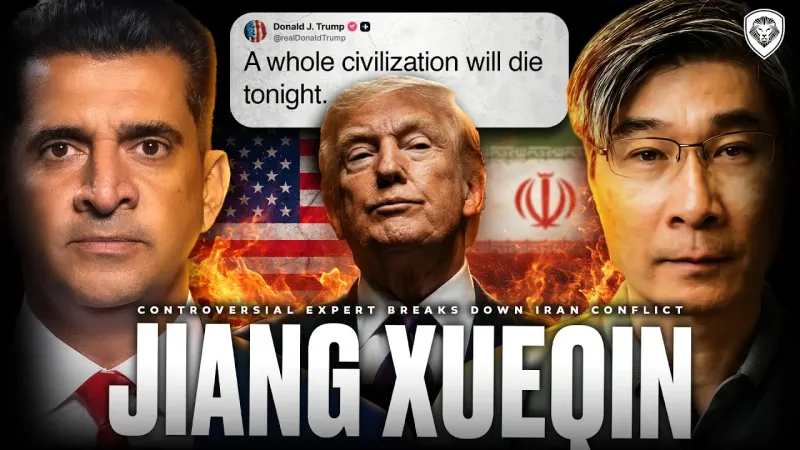
Jiang Xueqin Finally Breaks His Silence With PBD | PBD #772
PBD Podcast@PBDPodcastJiang Xueqin Finally Breaks His Silence With PBD | PBD #772
Patrick Bet-David interviews Jiang Xueqin about his predictions that Trump would return to power and that a U.S.–Iran war could end in an American loss. They begin discussing the reasoning behind those predictions, alongside Jiang’s perspective on global power and geopolitical strategy.
- Views
- 966.9K
- Likes
- 27.4K
- Comments
- 9.6K
- Trump’s ReturnU.S.–Iran ConflictGeopolitical predictionsGlobal power structures
Analysis
Patrick Bet-David interviews Jiang Xueqin about his predictions that Trump would return to power and that a U.S.–Iran war could end in an American loss. They begin discussing the reasoning behind those predictions, alongside Jiang’s perspective on global power and geopolitical strategy.
- Interview

- Title
- Jiang Xueqin Finally Breaks His Silence With PBD | PBD #772
Adam, what's your point? The future looks bright. My handshake is better than anything I ever signed. It's right here. >> [music] >> You are a one-on-one? My son's right about you. I don't think I've I've ever said this before. So, my guest today is Yang Xiyu Chuan and I did my best to pronounce the last name. I've been looking forward to uh the conversation with you for quite some time. The day the interview came out with you and uh I believe it was Osage and Crystal, which I thought it was fascinating how a man uh in July of 2024 can predict that Trump's going to win, then he's going to go to war against Iran, and then Iran's going to win, which was your prediction. And I said, "I want to talk to him." And then so, let's get the nasty stuff out of the way cuz I actually want to have a civil conversation with you. I'm actually very curious about why you think the way you think. Uh one, uh at the beginning when we had that, uh our team reached out to you uh to get on the podcast and I think on a podcast you said you thought it was going to be a hit piece interview. What gave you the impression I was going to do a hit piece on you? Well, it was just a timing because the day you got in touch, um there was a coordinated smear campaign against me on Twitter, meaning that there were some influencers who were using the same talking points against me. Um just saying that I just mix stuff um up and uh it seemed very similar, so I was very afraid. Also, at that time I was I was under a lot of stress. So, I didn't want to put myself in a situation where um I would be asked hard questions and I didn't think I would be able to respond properly to um to hard questions. And I I watch your show. I'm a huge fan of yours, Patrick, so I I I know I know you're very good You ask very good questions. I I appreciate that and and that's a fair assessment. And then again, the other part I want to get out of the way on Medhi Hasan when you were on there and professor not professor, we've all seen that viral stuff that's been out. So, if you're comfortable, I'm going to call you Ziyang if that's okay with you as we're going through it. >> That's perfect. That's perfect. Yeah. >> Beautiful. Yeah, absolutely. So, so so I appreciate that. Uh question for you. So, when you said again, I've seen the entire interview and I've seen a lot of your stuff because what I like is seeing what the market is saying and why, right? Some people have certain patterns and your experience is a very interesting one because you went to Yale College, you've lived in Canada, you're now in uh Hong Kong if I'm not mistaken. >> No, no, no, no, Beijing. I'm in Beijing. >> my apologies. You're in Beijing right now. And so, you have a very interesting perspective of these three different worlds and there's a lot of things to talk about. What what uh what analysis or what patterns did you notice for you to say, you know, not the first one that Trump was going to win cuz let's set that one aside, but the one that US is going to go to war with Iran and then we're going to lose.
- 01Cold-open fragments
The snippets begin with interview content before the host introduces the episode, creating a brief preview without resolving what the fragments refer to.
A question and brief replies open the excerpt, followed by a short exchange whose context is not yet clear.
“Adam, what's your point? The future looks bright. My handshake is better than anything I ever signed. It's right here. >> [music] >> You are a one-on-one? My son's right about you. I don't think I've I've ever said this before.”
- 02Guest introduction and prediction context
The host establishes the conversation's context and introduces a consequential, attributed prediction that leads into the interview.
The host identifies the guest, notes the effort to pronounce his name, and recounts the guest's earlier prediction about Trump's election, a war with Iran, and Iran winning.
So, my guest today is Yang Xiyu Chuan and I did my best to pronounce the last name. I've been looking forward to uh the conversation with you for quite some time. The day the interview came out with you and uh I believe it was Osage and Crystal, which I thought it was fascinating how a man uh in July of 2024 can predict that Trump's going to win, then he's going to go to war against Iran, and then Iran's going to win, which was your prediction. And I said, "I want to talk to him."
- 03Host's stated approach and first question
The host frames the exchange as an inquiry into the guest's perspective and raises the question that prompts the guest's explanation.
The host says he wants a civil conversation, expresses curiosity about the guest's reasoning, and asks why the guest expected a hit-piece interview.
“And then so, let's get the nasty stuff out of the way cuz I actually want to have a civil conversation with you. I'm actually very curious about why you think the way you think. Uh one, uh at the beginning when we had that, uh our team reached out to you uh to get on the podcast and I think on a podcast you said you thought it was going to be a hit piece interview. What gave you the impression I was going to do a hit piece on you?”
- 04Guest explains his hesitation
The guest's account answers the first question with personal context, while his praise and the naming exchange help establish the interview's conversational footing.
The guest attributes his concern to a perceived coordinated smear campaign, says he was stressed and afraid, and explains that he feared being unable to respond properly to difficult questions. He also praises the host's questions and asks to use a different name.
“Well, it was just a timing because the day you got in touch, um there was a coordinated smear campaign against me on Twitter, meaning that there were some influencers who were using the same talking points against me. Um just saying that I just mix stuff um up and uh it seemed very similar, so I was very afraid. Also, at that time I was I was under a lot of stress. So, I didn't want to put myself in a situation where um I would be asked hard questions and I didn't think I would be able to respond properly to um to hard questions. And I I watch your show. I'm a huge fan of yours, Patrick, so I I I know I know you're very good You ask very good questions. I I appreciate that and and that's a fair assessment. And then again, the other part I want to get out of the way on Medhi Hasan when you were on there and professor not professor, we've all seen that viral stuff that's been out. So, if you're comfortable, I'm going to call you Ziyang if that's okay with you as we're going through it. >> That's perfect. That's perfect. Yeah. >> Beautiful. Yeah, absolutely. So, so so I appreciate that.”
- 05Shift to the prediction question
The host uses the guest's experience to frame the next question and sets up the coming discussion of the Iran-war prediction. The supplied excerpt ends before the guest answers or the introduction's transition to sustained discussion is clear.
The host says he has watched the interview and the guest's other work, describes the guest's experience across several places, corrects his assumption about the guest's current location, and begins asking what patterns informed the prediction about war with Iran and a possible loss.
“Uh question for you. So, when you said again, I've seen the entire interview and I've seen a lot of your stuff because what I like is seeing what the market is saying and why, right? Some people have certain patterns and your experience is a very interesting one because you went to Yale College, you've lived in Canada, you're now in uh Hong Kong if I'm not mistaken. >> No, no, no, no, Beijing. I'm in Beijing. >> my apologies. You're in Beijing right now. And so, you have a very interesting perspective of these three different worlds and there's a lot of things to talk about. What what uh what analysis or what patterns did you notice for you to say, you know, not the first one that Trump was going to win cuz let's set that one aside, but the one that US is going to go to war with Iran and then we're going to lose.”