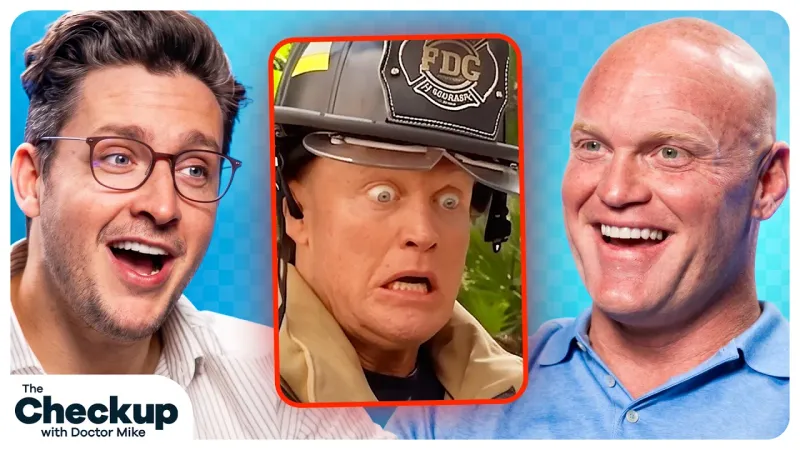
Everything Hollywood Gets Wrong About Firefighters | Fire Department Chronicles
Doctor Mike@DoctorMikeEverything Hollywood Gets Wrong About Firefighters | Fire Department Chronicles
Doctor Mike talks with firefighter and first responder Jason Patton of Fire Department Chronicles about firefighter training, fire safety, emergency response, career advice, and myths in firefighter shows. The opening includes discussion of escaping a house fire and correcting common safety misconceptions; the episode description lists additional topics including firefighter pay, private firefighting, and unusual calls.

- Views
- 4M
- Likes
- 86.9K
- Comments
- 4.3K
- Firefighter Training and SafetyFirefighter Myths in HollywoodEmergency response experiencesFirefighter career advice
Analysis
Doctor Mike talks with firefighter and first responder Jason Patton of Fire Department Chronicles about firefighter training, fire safety, emergency response, career advice, and myths in firefighter shows. The opening includes discussion of escaping a house fire and correcting common safety misconceptions; the episode description lists additional topics including firefighter pay, private firefighting, and unusual calls.
- InterviewPodcast episode
- Title
- Everything Hollywood Gets Wrong About Firefighters | Fire Department Chronicles
“We've had people escape from fires and then go back in to grab books and they perish in the fire. Yeah, books or or personal items. Yeah. >> Oh, yeah. >> So, you're never running back in. >> Don't run back in the house. No, once you're out >> So, what if your child's in there? >> Look, when we say touch the door, if you touch the door and it is scalding your hands, like it is so hot you can see flames coming out from underneath the door, when you open up that door, you're going to die. Like there's no way you're going to make it out to that hallway if flames are that bad. >> Wet towels, putting them at the door jamb, covering yourself with them, all that's useless. >> No. Smoke inhalation is that that big issue. When you go out there, those those fumes are extremely toxic. You're inhaling all the polyesters, all the whatever lithium stuff is on fire. >> I have two air purifiers in my room. Bad idea to turn them on? >> I mean >> Because they would suck air into the room, but they would also be cleaning the smoke. >> They would be. >> They would. So, I don't know what is the strategy there. >> You're going to die. >> [laughter] >> That's >> Welcome back to the Checkup podcast, where today I'm speaking to Jason Patton, otherwise known as Fire Department Chronicles. He's the most followed firefighter in the world and for good reason. You probably know Jason's viral and hilarious videos recapping bizarre encounters he's had out in the field as a first responder or from his series on YouTube where he green screens himself into firefighter shows and calls them out for their BS face-to-face. He's easily one of the most charismatic people we've had on the show, but also rich in substance. He's not just some comedy influencer, he's an actual multi-year veteran of fighting fires and treating patients on the front lines with an incredible amount of insight into the profession. We touched on juicy topics like how much firefighters actually get paid, how to stay safe during a fire, controversial topics like private firefighters for celebrities, and even silly topics like the pain of sliding down the fire pole. Oh, and of course, the basics. Just to set the ground rules straight off the jump, if I catch on fire mid-episode, is it stop, drop, and roll or are there different strategies now? >> Stop, drop, and roll, but I mean, how long do you want me to let you stay on fire? >> No, no, minimal cuz I don't have the fire suit on. So, yeah. >> Oh, okay. Okay. I didn't know if this would end an epic video. >> [laughter] >> Dude, I still think about the training that I got when I was in middle school in Brooklyn of D.A.R.E. Stop, drop, and roll. Has any of these things been upgraded or is it still the same tried and true? Cuz I think about it from a chest compression CPR standpoint. Is there anything new that folks need to know about personal safety? >> No, but stop, drop, and roll is great cuz you're you're doing the basic things. You're you're rolling on top of the fire, so you're hopefully able to remove the oxygen from it. It's funny because you're right, in the medical field things tend to change constantly. Every 4 years they're they're finding out something new. Writing one extra compression in now. >> [laughter] >> But, firefighting at a constant basis we're trying to make things as efficient as possible, save as many lives as possible.”
- 01Incident and immediate warning
The concrete fatal consequence makes the safety issue matter immediately and sets up the practical question of how to recognize a fire that is too dangerous to re-enter.
The host describes people who escaped a fire, returned for belongings, and died; the exchange turns that account into a direct warning not to go back inside.
“We've had people escape from fires and then go back in to grab books and they perish in the fire. Yeah, books or or personal items. Yeah. >> Oh, yeah. >> So, you're never running back in. >> Don't run back in the house. No, once you're out >>”
- 02Challenge and blunt correction
The emotionally difficult hypothetical tests the warning, while specific danger signs and corrections develop what the viewer needs to understand about re-entry and smoke.
A question about a child inside leads to a description of a dangerously hot door and the likelihood of dying if it is opened; the speakers then dismiss wet towels as protection against smoke inhalation and toxic fumes.
“So, what if your child's in there? >> Look, when we say touch the door, if you touch the door and it is scalding your hands, like it is so hot you can see flames coming out from underneath the door, when you open up that door, you're going to die. Like there's no way you're going to make it out to that hallway if flames are that bad. >> Wet towels, putting them at the door jamb, covering yourself with them, all that's useless. >> No. Smoke inhalation is that that big issue. When you go out there, those those fumes are extremely toxic. You're inhaling all the polyesters, all the whatever lithium stuff is on fire. >>”
- 03Air purifier exchange and comic button
The exchange continues the practical discussion through another safety question, while its deadpan repetition and laughter provide a comic beat before the show introduction.
A speaker asks whether running air purifiers during a fire is a bad idea; the reply questions the strategy, repeats the danger bluntly, and ends with laughter.
“I have two air purifiers in my room. Bad idea to turn them on? >> I mean >> Because they would suck air into the room, but they would also be cleaning the smoke. >> They would be. >> They would. So, I don't know what is the strategy there. >> You're going to die. >> [laughter] >> That's >>”
- 04Show, guest, and topic identification
After the cold open, this establishes the recurring show, gives a relevant reason to hear the guest's account, and sets expectations for a broad conversation that includes the title's Hollywood-and-firefighter subject.
The host welcomes listeners to the podcast, names the guest and his firefighter identity, describes his popular videos and field work, establishes his experience treating patients, and previews topics ranging from firefighter pay and safety to celebrity firefighters, the fire pole, and basic fire advice.
“Welcome back to the Checkup podcast, where today I'm speaking to Jason Patton, otherwise known as Fire Department Chronicles. He's the most followed firefighter in the world and for good reason. You probably know Jason's viral and hilarious videos recapping bizarre encounters he's had out in the field as a first responder or from his series on YouTube where he green screens himself into firefighter shows and calls them out for their BS face-to-face. He's easily one of the most charismatic people we've had on the show, but also rich in substance. He's not just some comedy influencer, he's an actual multi-year veteran of fighting fires and treating patients on the front lines with an incredible amount of insight into the profession. We touched on juicy topics like how much firefighters actually get paid, how to stay safe during a fire, controversial topics like private firefighters for celebrities, and even silly topics like the pain of sliding down the fire pole. Oh, and of course, the basics. Just to set the ground rules straight off the jump, if I catch on fire mid-episode, is it stop, drop, and roll or are there different strategies now? >>”
- 05Initial answer and follow-up setup
The answer partially addresses the first question and keeps the exchange light, while the personal memory leads naturally to a broader question about whether basic safety guidance has been updated.
The guest answers with the familiar advice and jokes about how long the host can stay on fire; the host clarifies that he lacks protective gear. The host then recalls school training and asks whether safety advice has changed, including CPR and personal safety.
“Stop, drop, and roll, but I mean, how long do you want me to let you stay on fire? >> No, no, minimal cuz I don't have the fire suit on. So, yeah. >> Oh, okay. Okay. I didn't know if this would end an epic video. >> [laughter] >> Dude, I still think about the training that I got when I was in middle school in Brooklyn of D.A.R.E. Stop, drop, and roll. Has any of these things been upgraded or is it still the same tried and true? Cuz I think about it from a chest compression CPR standpoint. Is there anything new that folks need to know about personal safety? >>”
- 06Brief answer and excerpt boundary
The short answer provides an initial response and opens a comparison between changing medical guidance and firefighting practice. The supplied excerpt ends during this answer, before a clear transition to the main conversation, so the introduction boundary cannot be confirmed beyond this point.
The guest says the familiar advice remains useful and explains its basic rationale. The host observes that medical guidance changes, and the guest begins contrasting that with firefighting practices; the excerpt cuts off mid-thought.
“No, but stop, drop, and roll is great cuz you're you're doing the basic things. You're you're rolling on top of the fire, so you're hopefully able to remove the oxygen from it. It's funny because you're right, in the medical field things tend to change constantly. Every 4 years they're they're finding out something new. Writing one extra compression in now. >> [laughter] >> But, firefighting at a constant basis we're trying to make things as efficient as possible, save as many lives as possible.”