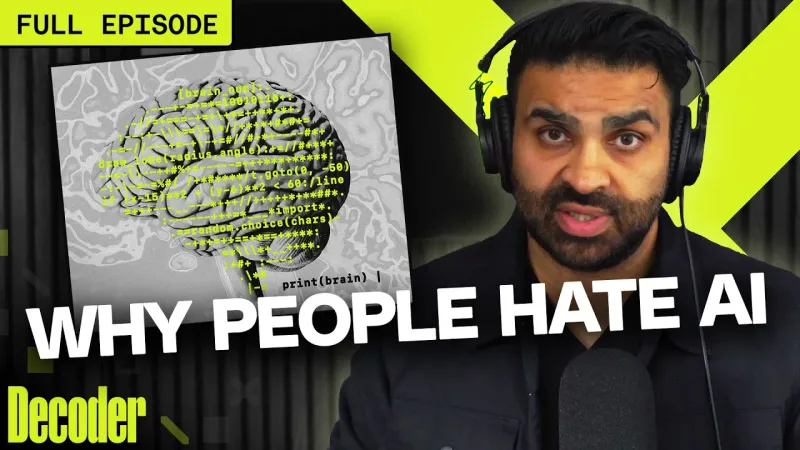
THE PEOPLE DO NOT YEARN FOR AUTOMATION | Decoder
Decoder with Nilay Patel@DecoderPodTHE PEOPLE DO NOT YEARN FOR AUTOMATION | Decoder
Nilay Patel introduces “software brain,” a way of seeing the world through algorithms, databases and loops, and argues that AI has intensified its influence. He points to polling and public opposition to AI, then frames the gap between tech-industry enthusiasm and public sentiment as a question of automation’s limits and social acceptance.

- Views
- 88.1K
- Likes
- 4.4K
- Comments
- 404
- AI public opinionSoftware thinkingAutomation and societyAI industry backlash
Analysis
Nilay Patel introduces “software brain,” a way of seeing the world through algorithms, databases and loops, and argues that AI has intensified its influence. He points to polling and public opposition to AI, then frames the gap between tech-industry enthusiasm and public sentiment as a question of automation’s limits and social acceptance.
- CommentaryPodcast episode
- Title
- THE PEOPLE DO NOT YEARN FOR AUTOMATION | Decoder
“Today, I want to lay out an idea that's been banging around my head for weeks now as we've been reporting on AI and having conversations here on Decoder. I've been calling it software brain and it's a particular way of seeing the world that fits everything into algorithms and databases and loops. Software. Hello and welcome to Decoder. I'm Nilay Patel, editor-in-chief of The Verge, and Decoder is my show about big ideas and other problems. Software brain is powerful stuff. It is a way of thinking that basically created our modern world. Marc Andreessen, who is the literal embodiment of software brain, called it in 2011 when he wrote an op-ed for the Wall Street Journal called Software is eating the world. Lately, software thinking has been turbocharged by AI in a way that I think helps explain the enormous gap between how excited the tech industry is about the technology and how much regular people are growing to dislike it. In fact, the polling on this is so strong, I think it's fair to say that a lot of people hate AI and that Gen Z in particular seems to hate AI more and more the more they encounter it. There's that NBC News poll showing AI with worse favorables than ice and only a little bit above the war in Iraq and Democrats generally. That's with nearly two-thirds of respondents saying they'd used ChatGPT or Copilot in the last month. Quinnipiac just found that over half of Americans think AI will do more harm than good. While more than 80% of people were either very concerned or somewhat concerned about the technology, only 35% of people were excited about it. And poll after poll shows that Gen Z uses AI the most and has the most negative feelings about it. A recent Gallup poll found that only 18% of Gen Z was hopeful about AI, down from an already bad 27% last year. At the same time, anger is growing. 31% of those Gen Z respondents said they feel angry about AI, up from 22% last year. Now, I obviously talk to you a lot of tech executives and policy people here on Decoder and I will tell you they all know AI isn't popular and they can all see how that's playing out in real life. Here's Microsoft CEO Satya Nadella talking about how the tech industry needs to make the case for the enormous investments it's making in AI. But at the end of the day, I I I think that this industry in which to which I belong needs to earn the social permission to consume energy because we are doing good in the world. I think it's safe to say the tech industry and AI have not earned any of that social permission yet. Politicians from both sides of the aisle are opposing data center build-outs. Politicians in local communities that support data centers are getting voted out of office. And in the most depressing reminder of how much political violence has become part of everyday American life, politicians who supported data centers have gotten their houses shot at. OpenAI CEO Sam Altman has had Molotov cocktails thrown at his house. It's sad that I have to say this again on the show, and it's sad that we're going to have commenters who disagree, but this violence is unacceptable. If you want to meaningfully oppose AI in a way that lasts, you should speak loudly with your dollars in the marketplace and your attention on the internet. And you should speak even more loudly with your votes in the democratic, regulatory, and political process.”
- 01Introduce the framing
This supplies the lens for the episode and sets up the claim that a way of thinking about software can help explain differing reactions to AI.
The speaker introduces an idea developed while reporting and discussing AI, names it “software brain,” and defines the worldview it describes.
“Today, I want to lay out an idea that's been banging around my head for weeks now as we've been reporting on AI and having conversations here on Decoder. I've been calling it software brain and it's a particular way of seeing the world that fits everything into algorithms and databases and loops.”
- 02Identify the show and establish the host’s context
The show identification and relevant editorial role orient viewers before the host expands on the idea and its historical context.
After a brief standalone “Software,” the host welcomes viewers, identifies himself and his role, and describes the show’s focus.
“Software. Hello and welcome to Decoder. I'm Nilay Patel, editor-in-chief of The Verge, and Decoder is my show about big ideas and other problems.”
- 03Explain the idea’s significance and history
This gives the newly named concept context and establishes why it merits attention before the opening turns to AI’s effect on public sentiment.
The host calls software brain powerful, says this way of thinking helped create the modern world, and connects it to a 2011 essay by a prominent software figure.
“Software brain is powerful stuff. It is a way of thinking that basically created our modern world. Marc Andreessen, who is the literal embodiment of software brain, called it in 2011 when he wrote an op-ed for the Wall Street Journal called Software is eating the world.”
- 04State the central public-opinion gap
This is the opening’s central problem setup: the audience is given a gap whose explanation the host proposes to explore.
The host argues that AI has intensified software-oriented thinking and says this helps explain the divide between industry excitement and regular people’s increasing dislike.
“Lately, software thinking has been turbocharged by AI in a way that I think helps explain the enormous gap between how excited the tech industry is about the technology and how much regular people are growing to dislike it.”
- 05Support the claim with polling
The collection of poll claims gives the central gap specific support and adds a notable tension: the group described as using AI most is also described as having especially negative feelings about it.
The host characterizes polling as strong evidence of dislike, cites comparisons and survey findings, and highlights Gen Z’s reported use, concern, hope, and anger toward AI.
“In fact, the polling on this is so strong, I think it's fair to say that a lot of people hate AI and that Gen Z in particular seems to hate AI more and more the more they encounter it. There's that NBC News poll showing AI with worse favorables than ice and only a little bit above the war in Iraq and Democrats generally. That's with nearly two-thirds of respondents saying they'd used ChatGPT or Copilot in the last month. Quinnipiac just found that over half of Americans think AI will do more harm than good. While more than 80% of people were either very concerned or somewhat concerned about the technology, only 35% of people were excited about it. And poll after poll shows that Gen Z uses AI the most and has the most negative feelings about it. A recent Gallup poll found that only 18% of Gen Z was hopeful about AI, down from an already bad 27% last year. At the same time, anger is growing. 31% of those Gen Z respondents said they feel angry about AI, up from 22% last year.”
- 06Contrast public sentiment with industry awareness
This shifts from polling to industry response, sharpening the question of whether awareness of public opposition has translated into social acceptance.
The host says tech executives and policy figures know AI is unpopular, then introduces a Microsoft CEO’s remarks about making the case for industry investment.
“Now, I obviously talk to you a lot of tech executives and policy people here on Decoder and I will tell you they all know AI isn't popular and they can all see how that's playing out in real life. Here's Microsoft CEO Satya Nadella talking about how the tech industry needs to make the case for the enormous investments it's making in AI.”
- 07Argue that social permission has not been earned
This states the host’s interpretation of the gap and provides a bridge from industry rhetoric to the political and community opposition described next.
The host quotes the executive’s appeal for social permission to consume energy and then argues that the tech industry and AI have not earned that permission.
“But at the end of the day, I I I think that this industry in which to which I belong needs to earn the social permission to consume energy because we are doing good in the world. I think it's safe to say the tech industry and AI have not earned any of that social permission yet.”
- 08Describe political and physical consequences
These examples raise the stakes of the public-opinion divide. The explicit condemnation keeps the ensuing call to action distinct from endorsement of violence.
The host cites bipartisan opposition to data-center construction, electoral losses for supporters, and attacks on politicians’ homes and a CEO’s home. He explicitly calls the violence unacceptable.
“Politicians from both sides of the aisle are opposing data center build-outs. Politicians in local communities that support data centers are getting voted out of office. And in the most depressing reminder of how much political violence has become part of everyday American life, politicians who supported data centers have gotten their houses shot at. OpenAI CEO Sam Altman has had Molotov cocktails thrown at his house. It's sad that I have to say this again on the show, and it's sad that we're going to have commenters who disagree, but this violence is unacceptable.”
- 09Offer channels for opposition
This closes the introduction with a clear opinion and proposed response to the public dissatisfaction it has described. The ledger ends here; it does not include the transition into the main discussion.
The host recommends opposing AI through marketplace choices, online attention, and votes in democratic, regulatory, and political processes.
“If you want to meaningfully oppose AI in a way that lasts, you should speak loudly with your dollars in the marketplace and your attention on the internet. And you should speak even more loudly with your votes in the democratic, regulatory, and political process.”