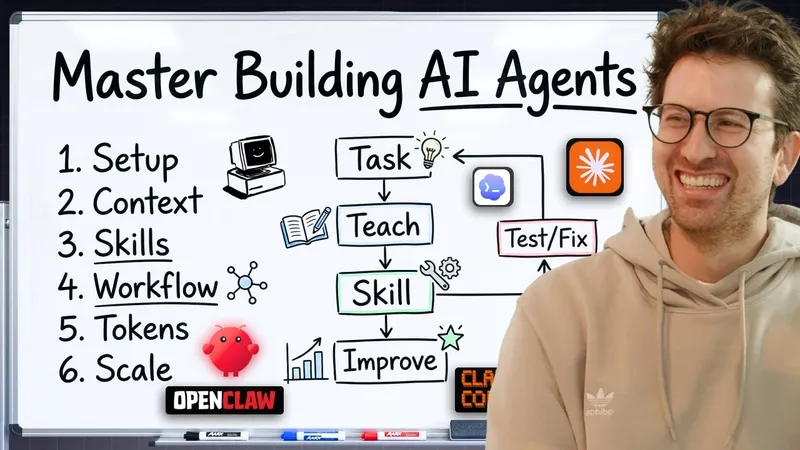
How AI agents & Claude skills work (Clearly Explained)
Greg Isenberg@GregIsenbergHow AI agents & Claude skills work (Clearly Explained)
Ras Mic explains how context windows shape AI agent performance and argues that many users can skip always-loaded agent instruction files. He describes creating skills by working through a workflow with an agent, then refining them from failures, with an emphasis on saving tokens and building reliable workflows before adding agents.

- Views
- 879.8K
- Likes
- 19K
- Comments
- 496
- AI agent workflowsContext window managementBuilding claude skillsToken efficiency
Analysis
Ras Mic explains how context windows shape AI agent performance and argues that many users can skip always-loaded agent instruction files. He describes creating skills by working through a workflow with an agent, then refining them from failures, with an emphasis on saving tokens and building reliable workflows before adding agents.
- InterviewPodcast episodeExplainer

- Title
- How AI agents & Claude skills work (Clearly Explained)
Ross, Mike, welcome back to the pod. By the end of this episode, what are people going to learn? >> I hope I'm going to share some wisdom on how you can use the agents better. There's a lot of information going on right now. I disagree with most of it, and that's what we're going to talk about. So, at the end, whether you're building something, using an agent for some sort of work, you have the best outcome possible. >> And is this going to be a technical dive or, you know, non-technical person can >> Anyone can watch this. There's going to be a lot of diagrams. That's all. >> [laughter] >> You're going to make it clear to understand the concepts, right? >> Easy. >> Okay. >> Basics. >> Let's go. >> So, >> the first thing that I want to announce, previous episodes, we probably disagree with this point, but now what's true is the models are good. The models are exceptionally good. Opus 4.6 is amazing. GPT 5.4 is amazing. I know there's like two sets of camp where, especially when it comes to programming, people are like, "Oh, Opus is the better UI designer. GPT 5.4 is the better back end." Generally speaking, we've reached a point We're not at AGI yet. Well, we reached a point where the models are good. But, context still matters, and you have the power to steer the models in a direction where you can get quality or you can get slop. And that's what I really want to talk about. But, before we get into all that, and feel free to cut me off cuz this topic excites me. Um we need to learn how context works. And context is the model assembling information that it needs to execute an action. And the way the context is assembled, let's say in a coding agent, but really in any sort of agent, is there's this general system prompt, usually by the model provider. So, for example, Claude code leaked recently, and one of the cool things that, um especially as a developer, I got to do is I got to read the system prompt. So, they have this general system prompt that guides the model on how to act, what to do, what not to do. The system prompt is very important. And then you have a lot of people have agent.md files or cloud.md files. Now, I'm just going to say off rip, 95% of people don't need this. The reason being is, again, you have to assume that the models are already good, right? Now, imagine I told you, Greg, every time we're about to shoot a podcast, Greg, you need a microphone. You know you need a microphone, right? You've done this plenty of times, right? So, if I'm building, like, let's say a website with, uh, cloud code, and I'm telling cloud code, "This code base uses React." I don't need to, because it has the code base in context. It can check the code, right? So, there is this disparity where a lot of people are putting a lot of onus on the harness and the context building, and I'm low-key starting to strip things off. Like, I'm going super, super minimal, because, again, not to sound like a Anthropic or OpenAI shill. Unfortunately, I have not been acquired. None of them are paying me. Um, but the models are really, really good. >> Wait, so 95% of the time I don't even need a bot bother with an agent.md file? >> You don't.
- 01Welcome and learning question
It frames the conversation around a viewer-facing learning outcome and invites the guest to define the episode’s value.
The host welcomes a returning guest and asks what viewers will learn by the end.
“Ross, Mike, welcome back to the pod. By the end of this episode, what are people going to learn?”
- 02Promise and disagreement
It establishes an opinionated premise and a broad practical promise, then introduces a disagreement that the discussion is meant to examine.
The guest hopes to share advice on using agents better, says much current information is wrong, and promises a favorable outcome for viewers who build or use agents for work.
“>> I hope I'm going to share some wisdom on how you can use the agents better. There's a lot of information going on right now. I disagree with most of it, and that's what we're going to talk about. So, at the end, whether you're building something, using an agent for some sort of work, you have the best outcome possible.”
- 03Accessibility and format
It lowers the stated technical barrier and sets expectations for how the concepts will be made understandable.
The hosts ask whether the discussion will be technical, promise that anyone can watch, and mention diagrams; laughter follows a brief exchange about making the concepts clear.
“>> And is this going to be a technical dive or, you know, non-technical person can >> Anyone can watch this. There's going to be a lot of diagrams. That's all. >> [laughter] >> You're going to make it clear to understand the concepts, right? >> Easy. >> Okay. >> Basics. >> Let's go.”
- 04Preview and central claim
It previews the episode’s central distinction: capable models still depend on context and on how they are directed. The claim and its implications give the conversation a clear subject without resolving how to do it.
The guest signals a coming announcement and possible disagreement with earlier episodes, asserts that current models are good, and distinguishes that from the unresolved importance of context and steering.
>> So, >> the first thing that I want to announce, previous episodes, we probably disagree with this point, but now what's true is the models are good. The models are exceptionally good. Opus 4.6 is amazing. GPT 5.4 is amazing. I know there's like two sets of camp where, especially when it comes to programming, people are like, "Oh, Opus is the better UI designer. GPT 5.4 is the better back end." Generally speaking, we've reached a point We're not at AGI yet. Well, we reached a point where the models are good. But, context still matters, and you have the power to steer the models in a direction where you can get quality or you can get slop. And that's what I really want to talk about. But, before we get into all that, and feel free to cut me off cuz this topic excites me.
- 05Define context and ground it with an analogy
It begins answering the central question with a definition and a familiar analogy. The opening then contrasts this sufficient context with the extra information people may be adding to agent harnesses.
The guest defines context as information assembled for an action, outlines a general system prompt, and uses a podcast microphone example to explain when an instruction is redundant.
Um we need to learn how context works. And context is the model assembling information that it needs to execute an action. And the way the context is assembled, let's say in a coding agent, but really in any sort of agent, is there's this general system prompt, usually by the model provider. So, for example, Claude code leaked recently, and one of the cool things that, um especially as a developer, I got to do is I got to read the system prompt. So, they have this general system prompt that guides the model on how to act, what to do, what not to do. The system prompt is very important. And then you have a lot of people have agent.md files or cloud.md files. Now, I'm just going to say off rip, 95% of people don't need this. The reason being is, again, you have to assume that the models are already good, right? Now, imagine I told you, Greg, every time we're about to shoot a podcast, Greg, you need a microphone. You know you need a microphone, right? You've done this plenty of times, right? So, if I'm building, like, let's say a website with, uh, cloud code, and I'm telling cloud code, "This code base uses React." I don't need to, because it has the code base in context. It can check the code, right? So, there is this disparity where a lot of people are putting a lot of onus on the harness and the context building, and I'm low-key starting to strip things off. Like, I'm going super, super minimal, because, again, not to sound like a Anthropic or OpenAI shill. Unfortunately, I have not been acquired. None of them are paying me. Um, but the models are really, really good. >> Wait, so 95% of the time I don't even need a bot bother with an agent.md file? >> You don't.