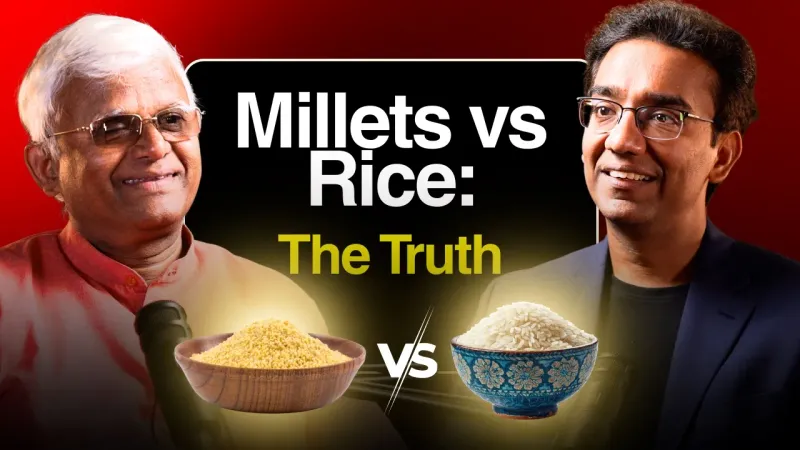
Why Modern Diets Are Destroying Your Gut Microbiome | Millet Scientist Explains
Dr Pal@DrPalWhy Modern Diets Are Destroying Your Gut Microbiome | Millet Scientist Explains
Dr. Pal interviews millet advocate Dr. Khadar Valli about how millets, fiber and fermented foods may support gut bacteria, digestion and blood sugar. They discuss millets versus rice, traditional foods and claims about modern diets and metabolic health; the opening also introduces fiber as a focus of the conversation.

- Views
- 1.2M
- Likes
- 18.9K
- Comments
- 1.6K
- Millets and gut healthFiber and gut bacteriaMillets versus riceTraditional Indian nutritionDiet and metabolic health
Analysis
Dr. Pal interviews millet advocate Dr. Khadar Valli about how millets, fiber and fermented foods may support gut bacteria, digestion and blood sugar. They discuss millets versus rice, traditional foods and claims about modern diets and metabolic health; the opening also introduces fiber as a focus of the conversation.
- InterviewPodcast episode

- Title
- Why Modern Diets Are Destroying Your Gut Microbiome | Millet Scientist Explains
“You have 100 trillion gut microbes. We can supply billion billion from each millet. >> So, you agree that probiotic supplements are not needed, right? >> Absolutely not needed. It is only business. People are thinking my adrenal gland is good. I'll test a cool regulate your gut. Your transmitters, neuro signals will regulate your gut. >> Welcome to the podcast. >> Yeah. Khadar Valli is a Padma Shri awardee who believes millets can save India. >> After three decades of advocacy, >> he believes these ancient grains can redefine both public health and agriculture. >> BP, diabetes, all these are the result of the food that you have chosen. Carbohydrate is not regulated because it is not associated with the fiber. Whereas millets have fiber which is associated with the grain carbohydrate itself. >> But people are moving towards whole wheat, brown rice. >> It's like you cannot compare it. When food is right, no medicine is needed. When your food is wrong, no medicine works. The simple thing is that all humans cannot actually deal with >>”
- 01Opening claims
A consequential-sounding claim establishes the topic and creates interest in whether the stated connection will be explained.
The speaker states a large claim about the subject, then links it to a specific source or example.
“You have 100 trillion gut microbes. We can supply billion billion from each millet.”
- 02Question and pointed answer
The answer challenges the assumption embedded in the question and makes the guest’s reasoning worth hearing.
A question about whether a common product is needed receives a categorical answer and a brief, pointed explanation.
“>> So, you agree that probiotic supplements are not needed, right? >> Absolutely not needed. It is only business.”
- 03Alternative explanation
This develops the opening’s challenge to the familiar product and leaves the specific process open for further discussion.
The speaker gives an example of a mistaken expectation and proposes an alternate process as the explanation.
“People are thinking my adrenal gland is good. I'll test a cool regulate your gut. Your transmitters, neuro signals will regulate your gut.”
- 04Show and guest introduction
Show identification orients the listener; the guest’s award and viewpoint frame whose perspective will shape the discussion.
The speakers identify the podcast, then introduce the guest through an award and his stated belief about the subject.
“>> Welcome to the podcast. >> Yeah. Khadar Valli is a Padma Shri awardee who believes millets can save India.”
- 05Experience and episode themes
The experience and topic framing establish why this guest is relevant, while the specific food comparison advances the opening’s health premise. The claims remain the speakers’ claims, not independently established evidence.
The introduction adds the guest’s years of advocacy, broadens the claimed relevance, and presents health consequences and a fiber-related distinction.
“>> After three decades of advocacy, >> he believes these ancient grains can redefine both public health and agriculture. >> BP, diabetes, all these are the result of the food that you have chosen. Carbohydrate is not regulated because it is not associated with the fiber. Whereas millets have fiber which is associated with the grain carbohydrate itself. >>”
- 06Food claim and transition
This extends the food-and-health premise with an emphatic contrast. The excerpt ends mid-thought, so the introduction’s eventual transition into sustained discussion cannot be identified from the supplied boundary.
A speaker raises a comparison with other grains; the guest makes a categorical claim about food and medicine, then starts a broader statement about human limits.
“But people are moving towards whole wheat, brown rice. >> It's like you cannot compare it. When food is right, no medicine is needed. When your food is wrong, no medicine works. The simple thing is that all humans cannot actually deal with >>”