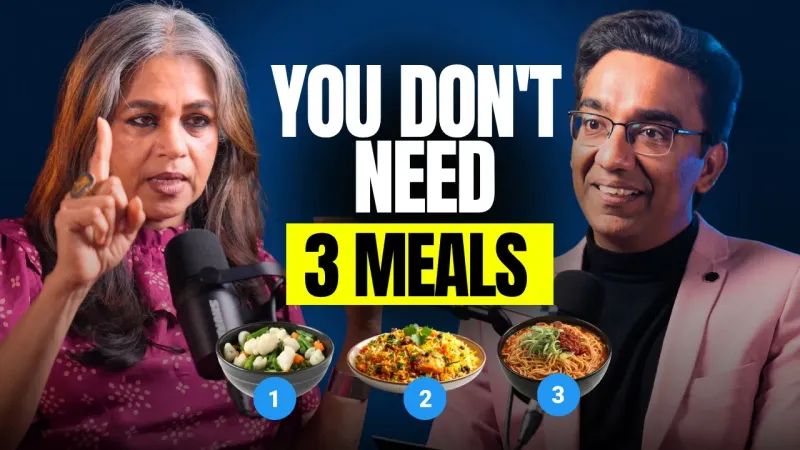
Why Snacking All Day Is Making Indians Fatter and Sicker | Time Restricted Eating Explained
Dr Pal@DrPalWhy Snacking All Day Is Making Indians Fatter and Sicker | Time Restricted Eating Explained
Dr. Pal speaks with Dr. Nisha Chellam about metabolic health, including how meal frequency, eating habits, stress, sleep, and movement may affect energy and health. They discuss fatty liver, insulin resistance, mindful eating, and time-restricted eating, alongside a broader lifestyle approach to lasting change.

- Views
- 303.8K
- Likes
- 3.7K
- Comments
- 233
- Metabolic healthTime-Restricted EatingInsulin resistanceFatty liverLifestyle habits
Analysis
Dr. Pal speaks with Dr. Nisha Chellam about metabolic health, including how meal frequency, eating habits, stress, sleep, and movement may affect energy and health. They discuss fatty liver, insulin resistance, mindful eating, and time-restricted eating, alongside a broader lifestyle approach to lasting change.
- InterviewPodcast episode

- Title
- Why Snacking All Day Is Making Indians Fatter and Sicker | Time Restricted Eating Explained
“Normally when you have a meal, have you seen children? They'll eat a meal and they'll go running. Adults, they eat a meal and they want to go to sleep. So, you eat and then you go to sleep, but that's just not true. Eating the food is very sacred. You have to be in a parasympathetic state. You should eat over a 20 to 35-40 minute window, not under 15 minutes. Dr. Nisha Chellam doesn't just treat patients. >> She teaches them to understand their own bodies. >> Her work in integrated medicine >> empowers people to take control of their health from within. >> [music] >> What's the circadian rhythm to maintain? Is there a particular time that you would recommend? >> If you wake up at 6:00, in 2 hours break your fast. Your exercise part is somewhere between What I find most people tend to do is they talk about their stress over and over and over again. The most important thing when it comes to stress in women as they get older is to find the right partner. If you're not married well, you cannot manage stress. Really, the one thing that I tell my 30-year-olds now, we're building your body for your vibrant 80-year-old self. So, I think yes, our lives are busy, but we're not fueling ourselves to handle that busy life. >> Fuel is food and sleep? >> I would say five pillars of health, right? One is Before we dive in, can I be honest with you? It blows my mind that 57.9% of you who listen regularly still have not subscribed to our channel. If you enjoy the podcast, the stories, the signs, maybe even laugh at our jokes, could you do us a small favor? Hit that subscribe button. It [bell] takes only 2 seconds and helps us keep bringing you better guests and episodes every week. I'm truly blessed to have all your support and I'm sure you will support me in the journey. Now, let's get into today's episode. Hello guys, welcome to another episode of our podcast series Gut Feeling with Dr. Pal. In this podcast, we have Dr. Nisha Chellam. She trained in India, went to US, and got trained in MD general medicine, and she has been seeing patients for the last 30 years. She strongly believes in lifestyle medicine, and we address the root cause of all the problems, which is metabolic health. Dr. Nisha Chelem is a metabolic expert, and she has treated so many patients with so many non-communicable diseases, including fatty liver, PCOS, hypothyroidism, elevated cholesterol levels, you name it. So, we have discussed all the processes, problems, and the solutions in this podcast. I want you to take a pen and a paper, jot down all the notes during the podcast, so that you can start implementing it right after the podcast ends. Let's dive deep into it. So, Dr. Nisha, what is metabolic health, and why should we worry about it? Okay. So, when you talk about metabolism, it's how your body processes energy, stores it, uses it, and it should do it in such a way that you don't have any disease or discomfort. That is good metabolic health. And why should you worry about it? Literally, metabolic health can determine how your quality of your life. Mhm. You may not die because of, you know, poor metabolic health. Um it's not like, um of course, heart attack is a part of metabolic dysfunction. >> Mhm. However, before you have the heart attack, metabolic health begins so many years before.”
- 01Challenge a familiar expectation
This is the cold open: it introduces an everyday eating premise and a counterpoint before the guest is identified, inviting the viewer to hear why the expected explanation may not hold. It begins a discussion of eating, but does not yet establish the packaging's specific claim about snacking or time-restricted eating.
Contrasts how children and adults may behave after eating, then challenges the idea that eating necessarily makes people sleepy and briefly presents a different framing of eating.
“Normally when you have a meal, have you seen children? They'll eat a meal and they'll go running. Adults, they eat a meal and they want to go to sleep. So, you eat and then you go to sleep, but that's just not true. Eating the food is very sacred. You have to be in a parasympathetic state. You should eat over a 20 to 35-40 minute window, not under 15 minutes.”
- 02Introduce the guest's approach
This transition shifts from the opening claim to a short account of the guest's role and approach, preparing the audience for her perspective without yet giving her formal credentials.
A brief host narration describes Dr. Nisha Chellam's approach to patient care and the empowerment associated with her work in integrated medicine.
“Dr. Nisha Chellam doesn't just treat patients. >> She teaches them to understand their own bodies. >> Her work in integrated medicine >> empowers people to take control of their health from within. >>”
- 03Ask about the organizing subject
The question introduces a concrete meal-timing concern and starts an answer, but the excerpt moves away before it is completed. It offers a partial connection to the packaging's subject rather than an explanation of time-restricted eating.
The host asks what circadian rhythm should be maintained and whether there is a recommended time; the guest begins to answer with a conditional example about waking at 6:00 and breaking a fast two hours later, then the answer is cut off.
“[music] >> What's the circadian rhythm to maintain? Is there a particular time that you would recommend? >> If you wake up at 6:00, in 2 hours break your fast. Your exercise part is somewhere between”
- 04Establish expertise and invite application
This exchange broadens the opening from eating to lifestyle and long-term health, while the claimed clinical perspective and future-oriented framing set up a wider conversation. The cutoff leaves the five-pillar answer unresolved.
A later guest passage discusses recurring stress, a claim about women and aging, a long-term health goal for younger patients, and the challenge of fueling busy lives. The host asks whether fuel means food and sleep; the guest begins listing five pillars of health, but the list is interrupted.
“What I find most people tend to do is they talk about their stress over and over and over again. The most important thing when it comes to stress in women as they get older is to find the right partner. If you're not married well, you cannot manage stress. Really, the one thing that I tell my 30-year-olds now, we're building your body for your vibrant 80-year-old self. So, I think yes, our lives are busy, but we're not fueling ourselves to handle that busy life. >> Fuel is food and sleep? >> I would say five pillars of health, right? One is”
- 05Pause for a subscription request
This is a promotional interruption rather than development of the health discussion. It belongs in the identified opening because it occurs before the host announces the episode transition.
Before the episode begins, the host asks listeners to subscribe, citing the podcast and its recurring content, then thanks them for their support.
“Before we dive in, can I be honest with you? It blows my mind that 57.9% of you who listen regularly still have not subscribed to our channel. If you enjoy the podcast, the stories, the signs, maybe even laugh at our jokes, could you do us a small favor? Hit that subscribe button. It [bell] takes only 2 seconds and helps us keep bringing you better guests and episodes every week. I'm truly blessed to have all your support and I'm sure you will support me in the journey.”
- 06Identify the show and guest
The show identification marks the formal start after the cold open and subscription request. The guest's education and long clinical experience provide relevant credentials for the ensuing health discussion.
The host announces the episode, welcomes listeners to the podcast series, and introduces Dr. Nisha Chellam with her training and 30 years of patient experience.
“Now, let's get into today's episode. Hello guys, welcome to another episode of our podcast series Gut Feeling with Dr. Pal. In this podcast, we have Dr. Nisha Chellam. She trained in India, went to US, and got trained in MD general medicine, and she has been seeing patients for the last 30 years.”
- 07Extend the guest's credentials and set expectations
The host further establishes the guest's relevance and presents the podcast as covering health processes, problems, and solutions. The request to take notes and implement the discussion is an explicit practical promise, and the closing invitation leads into the main explanation.
The host characterizes the guest's commitment to lifestyle medicine, names conditions she has treated, summarizes prior podcast coverage, and asks listeners to take notes and implement the advice. The host then invites the discussion to begin.
“She strongly believes in lifestyle medicine, and we address the root cause of all the problems, which is metabolic health. Dr. Nisha Chelem is a metabolic expert, and she has treated so many patients with so many non-communicable diseases, including fatty liver, PCOS, hypothyroidism, elevated cholesterol levels, you name it. So, we have discussed all the processes, problems, and the solutions in this podcast. I want you to take a pen and a paper, jot down all the notes during the podcast, so that you can start implementing it right after the podcast ends. Let's dive deep into it.”
- 08Pose the central question and begin the answer
This question and initial answer set the episode's central explanatory topic and give a brief reason it matters. The guest begins a qualification about consequences, but the supplied excerpt ends mid-explanation, before the introduction's full boundary or any time-restricted-eating explanation can be established.
The host asks what metabolic health is and why it merits concern. The guest defines it in terms of processing, storing, and using energy without disease or discomfort, then links it to quality of life and starts to qualify the consequences of poor metabolic health.
“So, Dr. Nisha, what is metabolic health, and why should we worry about it? Okay. So, when you talk about metabolism, it's how your body processes energy, stores it, uses it, and it should do it in such a way that you don't have any disease or discomfort. That is good metabolic health. And why should you worry about it? Literally, metabolic health can determine how your quality of your life. Mhm. You may not die because of, you know, poor metabolic health. Um it's not like, um of course, heart attack is a part of metabolic dysfunction. >> Mhm. However, before you have the heart attack, metabolic health begins so many years before.”