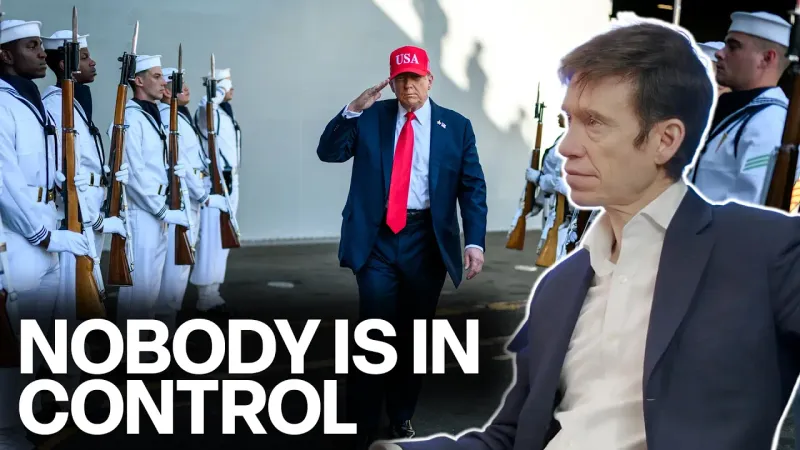
The Collapse of Trump's Operation Epic Fury
The Rest Is Politics@restispoliticsThe Collapse of Trump's Operation Epic Fury
Rory Stewart and Alastair Campbell discuss the US-Iran conflict, Trump's threats against Iranian infrastructure, and the risks of escalation, including a possible humanitarian crisis affecting Gulf water supplies. The episode also previews debate over Britain's role in the war and assisted dying; the excerpt does not establish how these discussions conclude.
- Views
- 930.6K
- Likes
- 14.5K
- Comments
- 3.4K
- US-Iran ConflictTrump's War StrategyGulf water securityUK foreign policyAssisted dying debate
Analysis
Rory Stewart and Alastair Campbell discuss the US-Iran conflict, Trump's threats against Iranian infrastructure, and the risks of escalation, including a possible humanitarian crisis affecting Gulf water supplies. The episode also previews debate over Britain's role in the war and assisted dying; the excerpt does not establish how these discussions conclude.
- Co hosted conversationPodcast episode

- Title
- The Collapse of Trump's Operation Epic Fury
“This is going to be an absolute case study of how hubris and ego and lack of foresight and mixed messaging leads you further and further into a terrible, terrible place. And I think that's where Trump is right now. It's just so difficult to explain why he's doing something that's so clearly not in the US national interest. >> He's provoked a conflict over which now nobody seems to have much control, least of all him. This is probably the most dangerous moment we've had for many, many decades. >> Do you think this is potential World War territory? I think we might be in it. Welcome to The Restless Politics with me, Rory Stewart. >> And with me, Alister Campbell. So, Rory, we're going to talk about Iran, inevitably. We've had the big build-up to Donald Trump saying he's going to be demolishing Iran's energy infrastructure. And we've then had the big, seeming climb-down based upon his claim that they'd had these productive talks with Iran. We'll talk about that. We'll talk about the developments since then, and we'll most importantly try to work out why on earth this is happening and why on earth it's in the mess that it's in. We're also going to talk about assisted dying, which I suspect may lead us to a an agreeable disagreement. But if some of these peers were in the room, Rory, it would not be agreeable. No, you'd be pretty cross with them. I'd be very, very cross with them. We'll talk about that.”
- 01Case-study premise
This opens with a pointed interpretation rather than a neutral topic label. It establishes the episode's critical lens and poses the central question of why the situation is unfolding this way.
The speaker calls the situation a case study in hubris, ego, poor foresight and mixed messaging, then says Trump appears to be in a terrible position and questions why he is acting against US national interests.
“This is going to be an absolute case study of how hubris and ego and lack of foresight and mixed messaging leads you further and further into a terrible, terrible place. And I think that's where Trump is right now. It's just so difficult to explain why he's doing something that's so clearly not in the US national interest.”
- 02Escalation and stakes
The exchange turns the opening's critical premise into a high-stakes question about control and escalation. The answer is qualified, keeping the danger as an assessment rather than a settled fact.
A second speaker says the conflict seems beyond anyone's control, calls it the most dangerous moment in many decades, and asks whether it could become a world war. The response says it might already be there.
“>> He's provoked a conflict over which now nobody seems to have much control, least of all him. This is probably the most dangerous moment we've had for many, many decades. >> Do you think this is potential World War territory? I think we might be in it.”
- 03Show identification and topic route
The show and speaker introductions orient the viewer, while the roadmap identifies the central analysis and a secondary discussion. The hosts' stated plan to work out why events are happening keeps the opening question active. The ledger's next passage begins the substantive Trump discussion, so the introduction ends here.
The hosts identify their show and themselves, then preview a discussion of Iran: Trump's threat to target energy infrastructure, his claimed productive talks and apparent climb-down, subsequent developments, and why events are unfolding as they are. They also announce assisted dying as another topic and briefly anticipate disagreement before shifting to Trump.
“Welcome to The Restless Politics with me, Rory Stewart. >> And with me, Alister Campbell. So, Rory, we're going to talk about Iran, inevitably. We've had the big build-up to Donald Trump saying he's going to be demolishing Iran's energy infrastructure. And we've then had the big, seeming climb-down based upon his claim that they'd had these productive talks with Iran. We'll talk about that. We'll talk about the developments since then, and we'll most importantly try to work out why on earth this is happening and why on earth it's in the mess that it's in. We're also going to talk about assisted dying, which I suspect may lead us to a an agreeable disagreement. But if some of these peers were in the room, Rory, it would not be agreeable. No, you'd be pretty cross with them. I'd be very, very cross with them. We'll talk about that.”