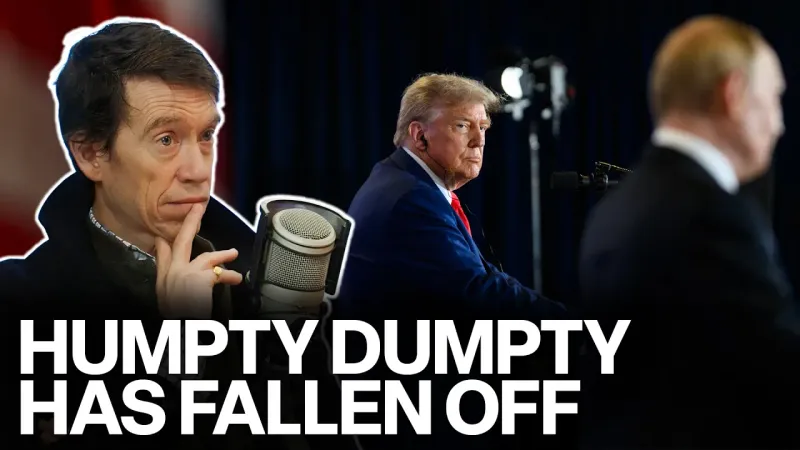
“Russia Is The Only Power That Has Won” | Why Trump’s War In Iran Is Failing.
The Rest Is Politics@restispolitics“Russia Is The Only Power That Has Won” | Why Trump’s War In Iran Is Failing.
Alastair Campbell and Rory Stewart discuss the war in Iran, including whether Russia benefits and how morality, threat and capability shape the case for intervention. The episode also turns to water regulation in England and Ofcom's handling of GB News, which the hosts criticize.
- Views
- 428.5K
- Likes
- 7.1K
- Comments
- 1.4K
- Trump's War in IranRussia's Strategic AdvantageBritish water regulationGB News and Ofcom
Analysis
Alastair Campbell and Rory Stewart discuss the war in Iran, including whether Russia benefits and how morality, threat and capability shape the case for intervention. The episode also turns to water regulation in England and Ofcom's handling of GB News, which the hosts criticize.
- Co hosted conversationPodcast episode

- Title
- “Russia Is The Only Power That Has Won” | Why Trump’s War In Iran Is Failing.
“It's been so catastrophic for Trump not to have had a very clear objective about what he was trying to achieve. >> You don't have a moral obligation to do what you can't do. If you can't fix it, then don't try because you'll often make things worse. >> Trump thinks he can fix anything, which is why last night he was blathering on about I can do what I want with the nuclear and I'm going to do it soon. >> Iran has now demonstrated that it can and will shut down neighboring economies, close the straits of Hormuz. Iran in a sense now feels more powerful and that means there'll be pressure on Israel and the US to just keep going. >> This is going to be terrible for the economy in Britain and in Europe and around the world. >> Welcome to the Rest Is Politics with me, Rory Stewart. >> And with me, Alistair Campbell. And Rory, today we're going to talk about Iran. >> Mhm. >> But unlike recent weeks, not the whole program. Uh we're going to talk about two catastrophic failures of regulation of our water on the back of an astonishing TV program, Dirty Business. And also Ofcom, who I've tried to give the benefit of the doubt to, but their total blind eye to GB News becoming what even Andrew Neil now calls Reform TV in I think total breach of the law that Ofcom is meant to uphold. >> into Iran. One of the fundamental things I I'd like to say in my analysis is MTC, MTC, right? So, M is morality, T is threat, C is capability. >> Okay. >> And my point is this, we confuse when we think about invading a country like Iran. Morality, our moral judgment, right? This is an evil, horrendous regime that's killed tens of thousands of its own people and is profoundly unpopular. That's the M. T, threat. This is a regime that may or may not pose a threat. You know, what kind of threat? Who is it threatening? Is it able to threaten the US? Does it have nuclear weapons? Is it only able to threaten Israel, right? And then the C, which is the most difficult thing of all, which is capability. What can we actually do about it? And we tend to conflate these things. We tend to think it's enough to say if you really think this is an evil horrible regime, therefore we should be intervening. The assumption is if there's a problem somehow we can automatically fix it. And I think the depth of the problem we're in now is about our inability to move clearly between these categories. We get stuck in saying this is a very evil regime, so surely you can't be against intervention. Or getting very confused about threat. You know, is it a threat to Israel? Is it a threat to the US? Is it a threat to Europe? What kind of threat is it? Is it a threat in three years time if it develops nuclear weapons? What kind of threats are these proxies? Is it a threat to the straight for me or is it making it worse threat? And then finally this question capability. What can you actually do about it? Yeah, you can bomb it, you can take out missiles, you can flatten it from the air, you could even invade the country. But is that going to change the moral nature of the regime? So is it going to produce more liberal regime? Is it going to make it less of a threat?”
- 01Open with the consequences
These statements establish the episode’s consequential subject before the show introduction. They frame the conflict in terms of unclear aims and potential harm, but do not settle the larger question of who benefits.
A cold open presents claims about the leader’s unclear objective, advice against attempting what cannot be fixed, and a warning about Iran’s capacity to disrupt economies and the Strait of Hormuz.
“It's been so catastrophic for Trump not to have had a very clear objective about what he was trying to achieve. >> You don't have a moral obligation to do what you can't do. If you can't fix it, then don't try because you'll often make things worse. >> Trump thinks he can fix anything, which is why last night he was blathering on about I can do what I want with the nuclear and I'm going to do it soon. >> Iran has now demonstrated that it can and will shut down neighboring economies, close the straits of Hormuz. Iran in a sense now feels more powerful and that means there'll be pressure on Israel and the US to just keep going. >> This is going to be terrible for the economy in Britain and in Europe and around the world. >>”
- 02Identify the show and set the episode scope
The show identification marks the transition from the opening excerpts to the hosts’ discussion. The scope statement establishes the episode’s topic, though it also signals additional subjects and does not promise to cover Iran exclusively.
The hosts identify the show and themselves, introduce Iran as the subject, and briefly mention two other planned topics before returning to Iran.
“Welcome to the Rest Is Politics with me, Rory Stewart. >> And with me, Alistair Campbell. And Rory, today we're going to talk about Iran. >> Mhm. >> But unlike recent weeks, not the whole program. Uh we're going to talk about two catastrophic failures of regulation of our water on the back of an astonishing TV program, Dirty Business. And also Ofcom, who I've tried to give the benefit of the doubt to, but their total blind eye to GB News becoming what even Andrew Neil now calls Reform TV in I think total breach of the law that Ofcom is meant to uphold. >> into Iran.”
- 03Introduce the analytical framework
Naming the framework previews how the coming discussion will distinguish different questions that can otherwise be collapsed into one judgment. The moral condemnation and qualified threat assessment set up the need for that distinction.
Rory names morality, threat, and capability as the three dimensions of his analysis, then explains that people confuse them when considering an invasion.
“One of the fundamental things I I'd like to say in my analysis is MTC, MTC, right? So, M is morality, T is threat, C is capability. >> Okay. >> And my point is this, we confuse when we think about invading a country like Iran. Morality, our moral judgment, right? This is an evil, horrendous regime that's killed tens of thousands of its own people and is profoundly unpopular. That's the M. T, threat. This is a regime that may or may not pose a threat.”
- 04Apply the framework through questions
The questions make the distinctions concrete and leave the consequences of intervention open for examination. Rory’s criticism of the assumption that a problem can automatically be fixed connects the opening’s caution about making matters worse to the central analytical question. The supplied excerpt ends during this discussion, before the introduction’s later boundary can be established.
Rory asks whom the threat affects, whether it includes the United States or Israel, and what the country can do. He argues that people treat moral condemnation as sufficient reason to intervene and conflate that judgment with assessments of threat and capability.
“You know, what kind of threat? Who is it threatening? Is it able to threaten the US? Does it have nuclear weapons? Is it only able to threaten Israel, right? And then the C, which is the most difficult thing of all, which is capability. What can we actually do about it? And we tend to conflate these things. We tend to think it's enough to say if you really think this is an evil horrible regime, therefore we should be intervening. The assumption is if there's a problem somehow we can automatically fix it. And I think the depth of the problem we're in now is about our inability to move clearly between these categories. We get stuck in saying this is a very evil regime, so surely you can't be against intervention. Or getting very confused about threat. You know, is it a threat to Israel? Is it a threat to the US? Is it a threat to Europe? What kind of threat is it? Is it a threat in three years time if it develops nuclear weapons? What kind of threats are these proxies? Is it a threat to the straight for me or is it making it worse threat? And then finally this question capability. What can you actually do about it? Yeah, you can bomb it, you can take out missiles, you can flatten it from the air, you could even invade the country. But is that going to change the moral nature of the regime? So is it going to produce more liberal regime? Is it going to make it less of a threat?”