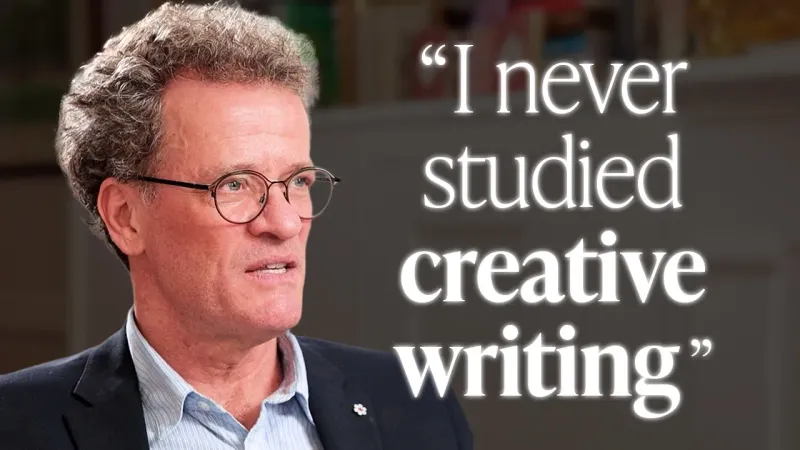
Booker Prize Winner Gives His Best Writing Advice (Yann Martel Interview)
David Perell@DavidPerellChannelBooker Prize Winner Gives His Best Writing Advice (Yann Martel Interview)
Writer and host David Perell interviews Yann Martel about his approach to storytelling and writing. Martel describes researching topics for Life of Pi, collecting notes and scenes, and organizing them into envelopes; the episode description also promises discussion of scenes, characters, endings, AI, and other writing questions.

- Views
- 108.6K
- Likes
- 2.9K
- Comments
- 214
- Creative writing adviceYann Martel's StorytellingResearch and Writing ProcessStory Structure and Endings
Analysis
Writer and host David Perell interviews Yann Martel about his approach to storytelling and writing. Martel describes researching topics for Life of Pi, collecting notes and scenes, and organizing them into envelopes; the episode description also promises discussion of scenes, characters, endings, AI, and other writing questions.
- InterviewPodcast episode
- Title
- Booker Prize Winner Gives His Best Writing Advice (Yann Martel Interview)
Yann Martel is famous for writing Life of Pi, which wasn't just a standout book, but also an Academy Award-winning movie. So, what stood out to me about him? He's strikingly well-read, but also he's developed this really unique approach to storytelling. So many writers say it's all about character, maybe. Yann says, "Eh, there's other things that are more important to me." And where other writers obsess over beginnings, it's the endings of stories that he really falls in love with. So, if you want to learn about place, plot, people, and prose, you're in the right place. Can you paint a picture in my head of I don't know, if I walked into your office or I stepped into your mind, what would I see? What is the architecture of what's going on there? >> Oh, that's very clear. I developed a system that just worked for me, which is kind of a computer become analog. So, I do a lot of research, which is fun. So, let's let's take the example of Life of Pi, my best-known book of mine. You know, I did research on on on animal behavior, zoo biology. I did research on survival at sea. I did a a lot of research on religion, on, you know, the faith experience, conceptions of the divine, on Hinduism, Islam, and Christianity. As I was reading, I took notes. Sometimes quoting from books, sometimes a single word. Indian speak as by our by our conception of slightly old-fashioned, colorful English. I remember once hearing Indians use the word bamboozle, which we hardly use in North America. So, I said, "Okay, so I'm one, you know, one element was the word bamboozle." Have someone use the word bamboozle, a lovely Indian English kind of word in my conception of their English. So, sometimes it's a word, sometimes a little fact, like what kinds of tortoise what kind of turtles do you find in the Pacific? Well, it's ridleys and greens. Good to know. So, you know, if something be factual, sometimes it'd be little scenes that come to my mind. I quickly write them down in a very uncensored way. Anyway, I do this, and [clears throat] after for Pi, after about two, two and a half years of research, I had like 400 pages of of of a hodgepodge of stuff.
- 01Establish the guest and distinction
This supplies context for the conversation and gives viewers a reason to hear how this creator thinks and works.
The host names the guest, connects them to a recognized work, and singles out a distinctive quality of their approach.
“Yann Martel is famous for writing Life of Pi, which wasn't just a standout book, but also an Academy Award-winning movie. So, what stood out to me about him? He's strikingly well-read, but also he's developed this really unique approach to storytelling.”
- 02Frame the interview around a difference
The contrast gives the conversation a specific angle: how the guest's priorities differ from a familiar approach to the craft.
The host contrasts a familiar emphasis in the field with the guest's stated priorities, then previews what the guest especially values.
So many writers say it's all about character, maybe. Yann says, "Eh, there's other things that are more important to me." And where other writers obsess over beginnings, it's the endings of stories that he really falls in love with. So, if you want to learn about place, plot, people, and prose, you're in the right place.
- 03Ask for the guest's mental model
The question turns the announced difference into an invitation to explain the guest's way of thinking, leading naturally into their method.
The host asks the guest to describe an imagined view into their thoughts and asks what its structure would look like.
“Can you paint a picture in my head of I don't know, if I walked into your office or I stepped into your mind, what would I see? What is the architecture of what's going on there?”
- 04Begin the personal method account
The guest moves from the host's abstract question to a concrete personal example, opening an explanation of how research becomes source material.
The guest describes a system that works for them, then starts illustrating it through research and note-taking for a well-known work.
>> Oh, that's very clear. I developed a system that just worked for me, which is kind of a computer become analog. So, I do a lot of research, which is fun. So, let's let's take the example of Life of Pi, my best-known book of mine. You know, I did research on on on animal behavior, zoo biology. I did research on survival at sea. I did a a lot of research on religion, on, you know, the faith experience, conceptions of the divine, on Hinduism, Islam, and Christianity. As I was reading, I took notes. Sometimes quoting from books, sometimes a single word. Indian speak as by our by our conception of slightly old-fashioned, colorful English. I remember once hearing Indians use the word bamboozle, which we hardly use in North America. So, I said, "Okay, so I'm one, you know, one element was the word bamboozle."
- 05Show how varied notes are collected
This extends the method beyond formal research: small details and scenes also become material. The passage remains an introductory method account rather than a sustained explanation of the full process.
The guest explains that notes can be words, facts, or imagined scenes, and says they write them down freely.
“Have someone use the word bamboozle, a lovely Indian English kind of word in my conception of their English. So, sometimes it's a word, sometimes a little fact, like what kinds of tortoise what kind of turtles do you find in the Pacific? Well, it's ridleys and greens. Good to know. So, you know, if something be factual, sometimes it'd be little scenes that come to my mind. I quickly write them down in a very uncensored way. Anyway, I do this, and [clears throat] after for Pi, after about two, two and a half years of research, I had like 400 pages of of of a hodgepodge of stuff.”