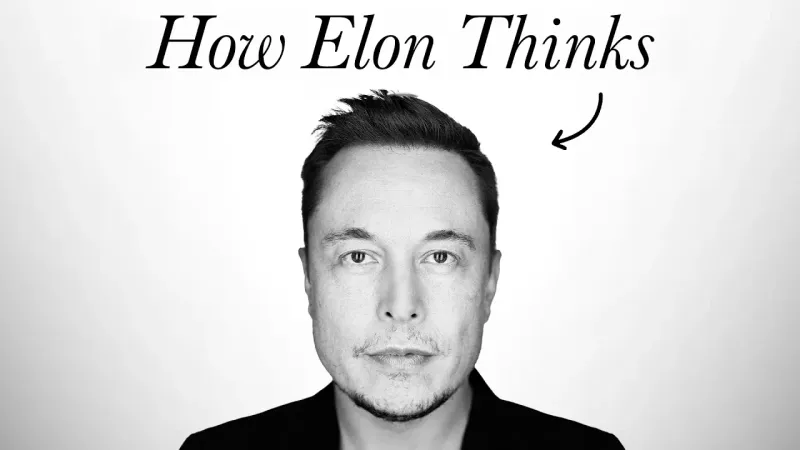
How Elon Thinks
Founders Podcast@founderspodcast1How Elon Thinks
The host introduces Eric Jorgenson’s book, The Book of Elon, and shares selected ideas attributed to Elon Musk. The opening focuses on doing useful work, measuring the help a product provides, improving the future, and using technology to advance humanity.

- Views
- 99.8K
- Likes
- 3.2K
- Comments
- 114
- Elon Musk's IdeasUseful Work and ImpactTechnology and Progress
Analysis
The host introduces Eric Jorgenson’s book, The Book of Elon, and shares selected ideas attributed to Elon Musk. The opening focuses on doing useful work, measuring the help a product provides, improving the future, and using technology to advance humanity.
- CommentaryMonologue

- Title
- How Elon Thinks
My friend Eric Jorgenson has spent a few years and thousands and thousands of hours reading everything that Elon has written, reading everything that has written about Elon, watching every single interview that Elon has ever given, and then he compiled all of Elon's most useful ideas into the book that I'm holding in my hand, which is The Book of Elon. The subtitle is Elon's most useful ideas in his own words. I'm going to read one line from Eric about the benefit that he experienced from doing this, and then from here on out every other thing will be Elon in his own words. Eric writes, "To me, Elon represents the idea that I am capable of more than I ever imagined." And so, I'm just going to run through in chronological order all the notes and highlights I took from reading and rereading this book. The idea is I want us to feel as if Elon is speaking directly to you and I. So, it starts out, Elon says, "I don't mind if my legacy is accurate or inaccurate, as long as I die feeling I've done the right thing for the future of consciousness." Elon gives a lot of advice centered around making sure that you're living a useful life, building things that make other people's lives better is the way I think about this.
- 01Establish the research and source
This opening credential and source description grounds the selection of ideas that follows and gives the viewer context for the book’s connection to Elon.
The speaker describes a friend’s extensive research into Elon’s writings and interviews, then says he compiled useful ideas into a book that the speaker is holding.
“My friend Eric Jorgenson has spent a few years and thousands and thousands of hours reading everything that Elon has written, reading everything that has written about Elon, watching every single interview that Elon has ever given, and then he compiled all of Elon's most useful ideas into the book that I'm holding in my hand, which is The Book of Elon.”
- 02Clarify the material and viewing format
The subtitle and quoted-voice framing clarify what kind of material the viewer can expect before the ideas begin.
The speaker gives the book’s subtitle, explains that he will read a line about the curator’s benefit, and says the rest will be Elon in his own words.
“The subtitle is Elon's most useful ideas in his own words. I'm going to read one line from Eric about the benefit that he experienced from doing this, and then from here on out every other thing will be Elon in his own words.”
- 03Quote the curator and set the route
The quote supplies a personal reason for compiling the material, while the chronological roadmap sets up how the collection will unfold and how the audience should hear it.
A quoted reflection describes the curator’s sense of possibility. The speaker then promises a chronological run-through of notes and highlights from reading and rereading the book, aiming to make it feel like the subject is speaking directly to the viewer and speaker.
Eric writes, "To me, Elon represents the idea that I am capable of more than I ever imagined." And so, I'm just going to run through in chronological order all the notes and highlights I took from reading and rereading this book. The idea is I want us to feel as if Elon is speaking directly to you and I.
- 04Begin the idea sequence
This is the first substantive example of the promised material. It begins the tour and makes the subject’s ideas about usefulness and the future tangible; it remains introductory framing rather than a complete discussion of the ideas.
The speaker introduces a first quotation about legacy and doing the right thing for the future of consciousness, then summarizes related advice about useful living and improving other people’s lives.
So, it starts out, Elon says, "I don't mind if my legacy is accurate or inaccurate, as long as I die feeling I've done the right thing for the future of consciousness." Elon gives a lot of advice centered around making sure that you're living a useful life, building things that make other people's lives better is the way I think about this.