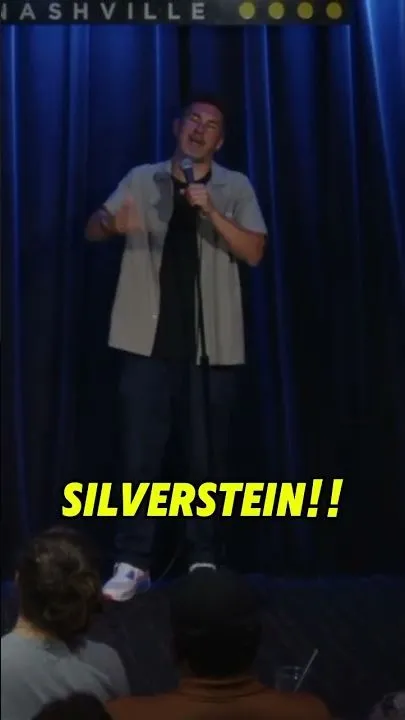
Mark Normand Lovin' the Jews in Nashville!! #shorts
mark normand@marknormandMark Normand Lovin' the Jews in Nashville!! #shorts
A stand-up comedian jokes about anti-Semitism, Jewish identity, and stereotypes, including a punchline about meeting a Jewish ex on PayPal. The set ends with a joke about the audience seeming like a church group in the wrong building.
- Views
- 385.7K
- Likes
- 12.9K
- Comments
- 382
- Jewish identity and stereotypesAnti-SemitismStand-up comedy
Analysis
A stand-up comedian jokes about anti-Semitism, Jewish identity, and stereotypes, including a punchline about meeting a Jewish ex on PayPal. The set ends with a joke about the audience seeming like a church group in the wrong building.
- PerformanceMonologue
- Spoken
- Original
“Jews, where my Jews at?Hey, all right, out on the Sabbath. How about that?”
Jews, where my Jews at?Hey, all right, out on the Sabbath. How about that? Thanks for tunneling. Goodto see you. >> [laughter]>> A lot of anti-Semitism bubbling up these days, huh? Yeah, you hate to see it, youknow. It's weird to hate Jews cuz you can't even tell who's a Jew. You got toget the last name. That's a very inefficient way to beracist. You know, you hate Asian people, you can pretty much, you know, eyeballit. No, no, no, you know what I mean. Youknow what I'm saying. But it's weird. You're like, "What'syour last name? Silverstein? Ah, I knew I hated your ass." It's so crazy to hate a group you can'teven spot. Sometimes you can tell a Jew by theface, but it's a little on the nose. Wait a minute. Hold on.Just joking. My ex-girlfriend was Jewish. Met her on that Jewish app, uh,PayPal. Yeah, all right. >> [laughter]>> All right, spitting gold at you here. >> [cheering][laughter] >> I feel like this is a church group thatcame to the wrong building.
- 01Provocative opening and brief riff
Establishes the comedy topic and gets an early response before shifting into a broader observation.
A direct address to a group is followed by a quick riff and acknowledgment of the audience.
“Jews, where my Jews at?Hey, all right, out on the Sabbath. How about that? Thanks for tunneling. Goodto see you. >> [laughter]>>”
- 02Comparison and escalating examples
Develops the central comic argument through comparison, a specific imagined scenario, and escalation into a deliberately uncomfortable punchline.
The speaker contrasts how easy it is to identify one target of prejudice with the difficulty of identifying another, then extends the idea through a mock exchange and a risky visual stereotype joke.
A lot of anti-Semitism bubbling up these days, huh? Yeah, you hate to see it, youknow. It's weird to hate Jews cuz you can't even tell who's a Jew. You got toget the last name. That's a very inefficient way to beracist. You know, you hate Asian people, you can pretty much, you know, eyeballit. No, no, no, you know what I mean. Youknow what I'm saying. But it's weird. You're like, "What'syour last name? Silverstein? Ah, I knew I hated your ass." It's so crazy to hate a group you can'teven spot. Sometimes you can tell a Jew by theface, but it's a little on the nose.
- 03Backtrack, anecdote, and pun
Reframes the preceding stereotype joke with an explicit joking disclaimer and adds a compact anecdotal payoff.
The speaker briefly signals a joke, then offers an ex-girlfriend anecdote that resolves in a wordplay punchline.
“Wait a minute. Hold on.Just joking. My ex-girlfriend was Jewish. Met her on that Jewish app, uh,PayPal. Yeah, all right. >> [laughter]>>”
- 04Audience tag and final punchline
Closes the routine with a situational punchline based on the audience and setting.
A brief self-congratulatory aside leads into an observation that the audience resembles a group in the wrong venue.
“All right, spitting gold at you here. >> [cheering][laughter] >> I feel like this is a church group thatcame to the wrong building.”