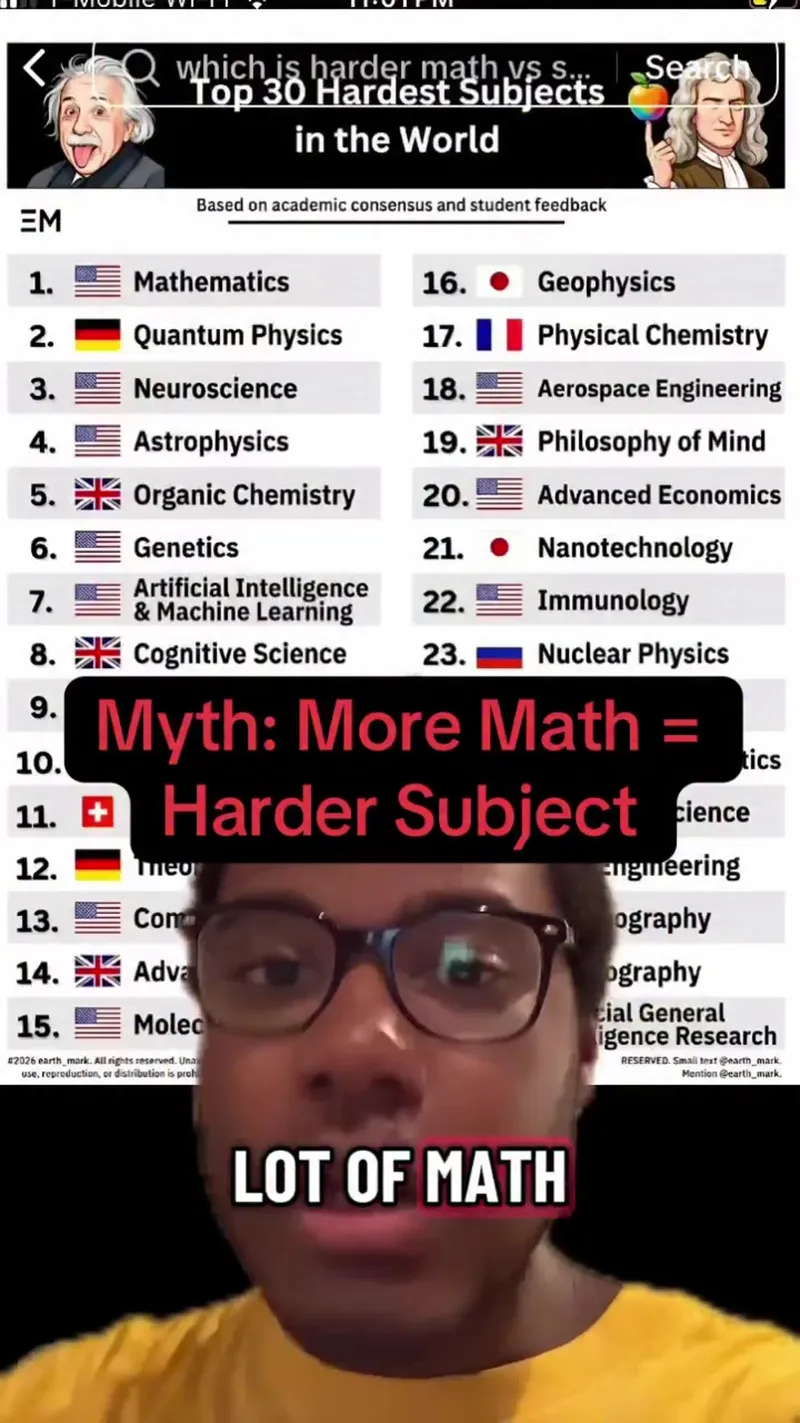
The creator challenges the belief that math-heavy subjects are naturally the most difficult by reviewing a list of the world's hardest university courses. He argues that course difficulty is often tied to teaching styles and promotes his physics study guide as a tool for intuitive understanding.
Are Math Subjects Actually Harder? The Top 30 Ranked
A presenter challenges the idea that math-heavy subjects are automatically harder, using a ranking of difficult university subjects as an example. The video argues that course difficulty can reflect how classes are taught, then promotes a physics guide.
- Likes
- 6.5K
- Comments
- 173
- Hardest academic subjectsMath and subject difficultyPhysics study guide
Analysis
A presenter challenges the idea that math-heavy subjects are automatically harder, using a ranking of difficult university subjects as an example. The video argues that course difficulty can reflect how classes are taught, then promotes a physics guide.
- Talking headGreen screenListicleHot takeProduct showcase
- Spoken
- Original
“Just because a subject has a lot of math doesn't mean it's hard.”
- On-screen text
- Original
“Top 30 Hardest Subjects in the World Myth: More Math = Harder Subject”
- Visual
- Text-led compositionA centered presenter appears in front of a large ranked list, with a bold red-on-black myth statement over the list and word-by-word captions near the presenter.
- The ranked-subject graphic backs the discussion of difficult fields, while the later guide page illustrates the physics product being promoted.
“Just because a subject has a lot of math doesn't mean it's hard. These are the 30 hardest subjects in the world that students go through within their classes, and math and quantum physics were ranked at the very top. But we also see subjects like organic chemistry as well as genetics that are way ahead of many math, physics and engineering courses, meaning that if math was the main bottleneck, this entire list would be dominated by math heavy as well as physics heavy subjects, but we don't really see a correlation at all. The ranking of this list reflects how difficult teachers in universities like to make their classes and not the intrinsic difficulty of these fields themselves. If you understand physics as a science, you will never have to memorize a practice problem again, which is why I created version two of my guide, teaching you how to understand physics intuitively as a science. We have all the topics from version one along with Newton's second law, torque and conservation of energy so you don't fall behind next semester like you did this semester. Link in Bio or you can save 12% by getting the bundle which comes with the Algebra guide for STEM alongside it. Also link in bio.”
- 01Challenge the assumption and establish the ranking
Frames the central claim and supplies the initial evidence that the ranking includes more than just math-heavy subjects.
Rejects the idea that a high amount of one feature automatically makes something difficult, then introduces a ranked list and names examples at the top.
“Just because a subject has a lot of math doesn't mean it's hard. These are the 30 hardest subjects in the world that students go through within their classes, and math and quantum physics were ranked at the very top.”
- 02Use counterexamples to dispute the feature as the main cause
Develops the opening claim by using counterexamples to weaken the idea that math is the main source of difficulty.
Contrasts the top examples with other subjects ranked ahead of many math- and physics-heavy courses, then argues that the overall list shows no clear correlation.
“But we also see subjects like organic chemistry as well as genetics that are way ahead of many math, physics and engineering courses, meaning that if math was the main bottleneck, this entire list would be dominated by math heavy as well as physics heavy subjects, but we don't really see a correlation at all.”
- 03Explain the ranking's alternative cause
Resolves the argument's central question by replacing the proposed cause with a teaching-related explanation.
Attributes the ranking to how teachers make classes rather than to the intrinsic difficulty of the fields.
“The ranking of this list reflects how difficult teachers in universities like to make their classes and not the intrinsic difficulty of these fields themselves.”
- 04Turn the explanation into a resource offer
Connects the educational argument to a concrete learning resource and closes with its contents, offer, and call to action.
Claims that understanding physics scientifically avoids repeatedly memorizing problems, introduces a guide aimed at intuitive understanding, lists its included topics and a bundle discount, and ends with a repeated link-in-bio prompt.
“If you understand physics as a science, you will never have to memorize a practice problem again, which is why I created version two of my guide, teaching you how to understand physics intuitively as a science. We have all the topics from version one along with Newton's second law, torque and conservation of energy so you don't fall behind next semester like you did this semester. Link in Bio or you can save 12% by getting the bundle which comes with the Algebra guide for STEM alongside it. Also link in bio.”