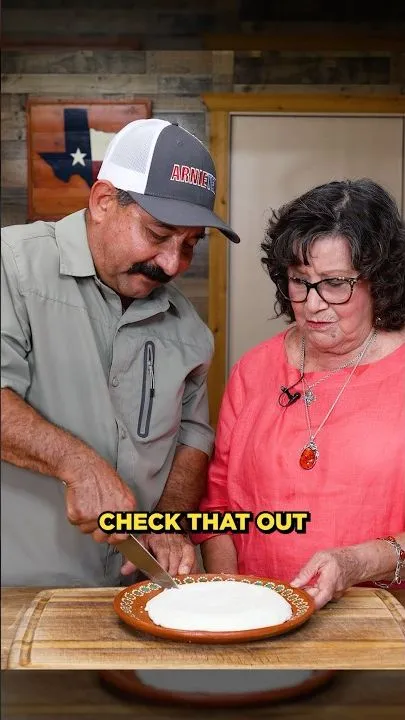
MommaTex makes her Queso Fresco recipe
MommaTex makes her Queso Fresco recipe
The speakers show how to make queso fresco from milk, vinegar, and salt, including heating, straining, and pressing the curds. They finish by tasting it with a tortilla and sharing their reactions.
- Views
- 760.5K
- Likes
- 34.6K
- Comments
- 325
- Homemade queso frescoMilk curdling and strainingCheese and tortilla tasting
Analysis
The speakers show how to make queso fresco from milk, vinegar, and salt, including heating, straining, and pressing the curds. They finish by tasting it with a tortilla and sharing their reactions.
- TutorialDemoVlog
- Spoken
- Original
“Do you know how to say queso fresco in English?”
“Do you know how to say queso fresco in English? So, for our friends out there. Queso fresco. >> [laughter] >> And we're going to use a gallon of milk to get this party started. You want to bring the milk up nice and slow. You want a low heat and you want to stir it cuz if you get too much heat too fast and you're not stirring, you might burn the bottom of the pan with some of your milk and you don't want that. You want that queso fresco to taste like queso fresco. I'm just kidding. Queso. We need 3/4 of a cup of vinegar. All right, friend. It's been a pretty solid 30 minutes. I brought the temperature up really slow. Remember, my milk was almost ice cold when I brought it out here. Mom's going to add a little bit of vinegar a little at a time while I continue to stir. I shall I shall I. You can get it up to 175, 180. You know, some people say 190. So, that was 2/3 of a cup of vinegar. I'll be turning it off in just about 30 more seconds. like >> Yeah. You can see the curds coming out. The whey starting to separate. I think it's time to turn it off. So, I've got a pan here. I've got a colander and I have a strainer. And now we're also going to use a cheesecloth. Now, by the way, you can always keep the liquid. It has a lot of whey in it. And when I was a young man and working out at the gym, all the bodybuilders, the big thing is whey protein. We're going to get all of this out of here. Wait, that gallon makes a lot. Uh, I wouldn't say a lot, but it's a pretty good amount. Kind of what you buy at the store more or less. So, uh now I'm going to take the cheesecloth, fold it up, squeeze it all together. I'm going to twist this off like here and just express or squeeze out as much of that liquid as I can. And I'm going to dump it into this bowl here so we can finish our process. I'm going to take about 3/4 of a tablespoon of salt. We're just going to mix it all up. Make sure that we have all the salt blended in good with the cheese. We're going to put this back into our cheesecloth so we can kind of get it all pressed down and make a nice little round cheese. All right, I think we got all the water that we needed to get out of here. Have a pretty pretty nice little cheese ball here. So I went ahead and pulled it back out, put it back into the cheesecloth and I'm re-pressing it down and I'm going to flip it over onto another bowl and then cover it up, put it into the refrigerator. So what we're going to do, we're going to take a little pie out of here. Wow, check that out. And they cut very pretty. Sure does. All right, I'm going to take a couple of slices here and Mom, you were saying that one of the things that you remember at La Liandra's house was that you would put the queso in the tortilla, a fresh homemade tortilla. Mhm. Why don't we do that? Okay. Cheers. My mouth was watering. Very good. Queso is good, the tortilla, you know, it's that heirloom corn. Super super good. Very good. Very good combination.”
- 01Playful opener and first setup
Names the subject with a light opening, then establishes the starting material and first action.
Ask how to say the featured item in another language, answer with its name, then introduce the main quantity and begin the process.
“Do you know how to say queso fresco in English? So, for our friends out there. Queso fresco. >> [laughter] >> And we're going to use a gallon of milk to get this party started.”
- 02Controlled heating and joke
Gives a practical precaution and its reason, with a brief comic aside before the recipe continues.
Explain the slow, low-heat method, warn against burning the pan, then make a quick joke before naming the next ingredient.
“You want to bring the milk up nice and slow. You want a low heat and you want to stir it cuz if you get too much heat too fast and you're not stirring, you might burn the bottom of the pan with some of your milk and you don't want that. You want that queso fresco to taste like queso fresco. I'm just kidding. Queso. We need 3/4 of a cup of vinegar.”
- 03Add ingredient and show progress
Explains the careful timing and technique, then uses visible process changes to signal that the next stage can begin.
Mark the elapsed time and gradual heating, add the ingredient while stirring, mention a temperature range, and note that the mixture is separating before switching off the heat.
“All right, friend. It's been a pretty solid 30 minutes. I brought the temperature up really slow. Remember, my milk was almost ice cold when I brought it out here. Mom's going to add a little bit of vinegar a little at a time while I continue to stir. I shall I shall I. You can get it up to 175, 180. You know, some people say 190. So, that was 2/3 of a cup of vinegar. I'll be turning it off in just about 30 more seconds. like >> Yeah. You can see the curds coming out. The whey starting to separate. I think it's time to turn it off. So,”
- 04Drain, press, and season
Carries the process from separated mixture to shaped cheese, with an incidental practical note about the leftover liquid.
Set out draining tools, mention keeping the liquid and its protein use, drain and squeeze the mixture, salt it, and press it into shape.
“I've got a pan here. I've got a colander and I have a strainer. And now we're also going to use a cheesecloth. Now, by the way, you can always keep the liquid. It has a lot of whey in it. And when I was a young man and working out at the gym, all the bodybuilders, the big thing is whey protein. We're going to get all of this out of here. Wait, that gallon makes a lot. Uh, I wouldn't say a lot, but it's a pretty good amount. Kind of what you buy at the store more or less. So, uh now I'm going to take the cheesecloth, fold it up, squeeze it all together. I'm going to twist this off like here and just express or squeeze out as much of that liquid as I can. And I'm going to dump it into this bowl here so we can finish our process. I'm going to take about 3/4 of a tablespoon of salt. We're just going to mix it all up. Make sure that we have all the salt blended in good with the cheese. We're going to put this back into our cheesecloth so we can kind of get it all pressed down and make a nice little round cheese.”
- 05Finish, reveal, and taste
Completes the recipe's promised transformation and provides the final sensory payoff through the prepared serving and positive tasting reactions.
Confirm the liquid is removed, describe the cheese, press and refrigerate it, then take it out, slice it, recall a serving tradition, and taste and praise the combination.
“All right, I think we got all the water that we needed to get out of here. Have a pretty pretty nice little cheese ball here. So I went ahead and pulled it back out, put it back into the cheesecloth and I'm re-pressing it down and I'm going to flip it over onto another bowl and then cover it up, put it into the refrigerator. So what we're going to do, we're going to take a little pie out of here. Wow, check that out. And they cut very pretty. Sure does. All right, I'm going to take a couple of slices here and Mom, you were saying that one of the things that you remember at La Liandra's house was that you would put the queso in the tortilla, a fresh homemade tortilla. Mhm. Why don't we do that? Okay. Cheers. My mouth was watering. Very good. Queso is good, the tortilla, you know, it's that heirloom corn. Super super good. Very good. Very good combination.”