WE ARE DOING OUR BEST
The Fitness Marshall@TheFitnessMarshallWE ARE DOING OUR BEST
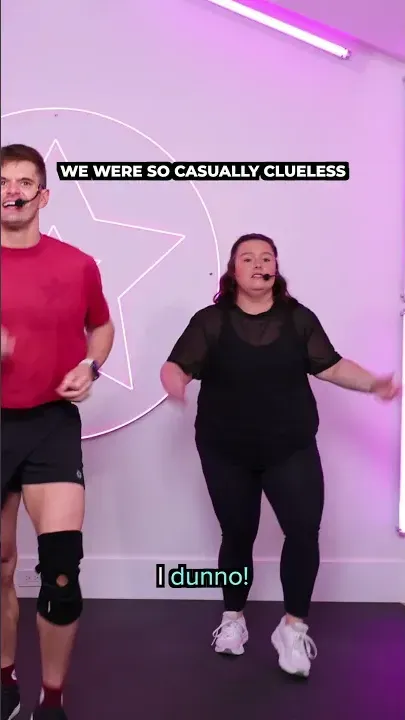
Three people perform a group dance routine in a brightly lit studio, following sung or spoken cues. The opening text frames their actions as a shared moment of being “casually clueless.”
- Views
- 306.3K
- Likes
- 4.3K
- Comments
- 7
- Group dance routineFitness class choreography
Analysis
Three people perform a group dance routine in a brightly lit studio, following sung or spoken cues. The opening text frames their actions as a shared moment of being “casually clueless.”
- PerformanceMontage
- On-screen text
- Original
“WE WERE SO CASUALLY CLUELESS”
- Visual
- Staged group sceneA wide, front-facing view shows one person in the foreground, bent forward with a drink, while two people stand behind. The foreground person’s posture shifts across the supplied frames; the persistent headline sits above the scene.
- The studio footage shows the trio dancing as the transcript repeats brief cues such as “Arms up high to the sky.” The opening headline adds a joking frame to the performance.
“[music] >> Take it. Take it. Take it. >> [laughter] >> [laughter] >> [laughter] >> I should have said it before. I should have said it before. I should have said it before. >> Shouldn't have said something. Am I >> Shouldn't have said something. Am I >> Shouldn't have said something. Am I right? right? right? >> [music] >> [music] >> [music] >> Fake it. Fake it. Fake it. >> Well, I know where to go this way next. Well, I know where to go this way next. Well, I know where to go this way next. Arms up high to the sky. Arms up high to the sky. Arms up high to the sky. >> This is >> This is >> This is the part when I say the part when I say the part when I say >> I don't want to. I don't want to. I don't want to. >> I'm stronger than >> Yes.”
- 01Repeated directive and regret
Establishes a refrain, then pivots from action to second-guessing; the contrast supplies the comic setup for the next self-questioning beat.
A short directive is repeated three times, followed by laughter cues and a repeated regret about not speaking sooner.
“[music] >> Take it. Take it. Take it. >> [laughter] >> [laughter] >> [laughter] >> I should have said it before. I should have said it before. I should have said it before.”
- 02Questioning the remark
Develops the earlier regret into explicit uncertainty, then resolves the thought with a repeated tag question rather than opening a new promise.
The refrain changes to wondering whether something should have been said, ending in a repeated request for confirmation.
“>> Shouldn't have said something. Am I >> Shouldn't have said something. Am I >> Shouldn't have said something. Am I right? right? right? >>”
- 03Claiming confidence, then resisting
Contrasts performed confidence with stated reluctance; the unfinished claim leaves the final fragment unresolved, without enough context to infer what it refers to.
After music cues, repeated assertions of faking it and knowing where to go lead into repeated directional and physical instructions, an unfinished introduction, and a repeated refusal. The final confidence claim is cut off and receives a brief affirmation.
“[music] >> [music] >> [music] >> Fake it. Fake it. Fake it. >> Well, I know where to go this way next. Well, I know where to go this way next. Well, I know where to go this way next. Arms up high to the sky. Arms up high to the sky. Arms up high to the sky. >> This is >> This is >> This is the part when I say the part when I say the part when I say >> I don't want to. I don't want to. I don't want to. >> I'm stronger than >> Yes.”