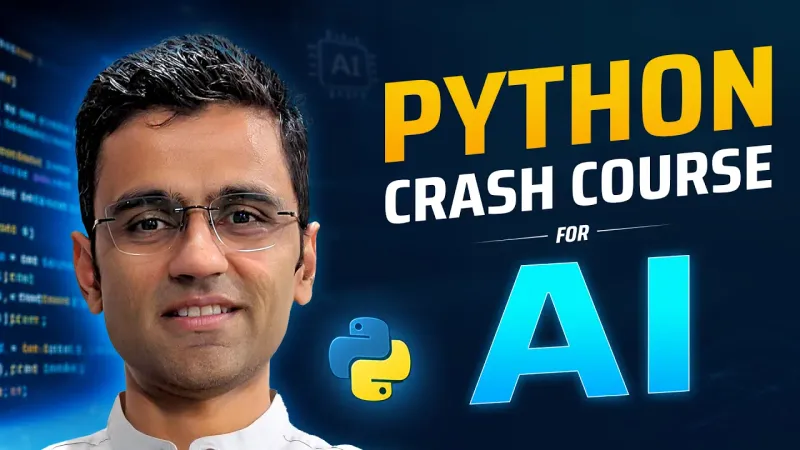
Python Tutorial for AI: Everything You Need in 2 Hours
codebasics@codebasicsPython Tutorial for AI: Everything You Need in 2 Hours
Dhaval introduces a Python crash course focused on the parts of the language useful for learning AI and building AI applications. The listed lessons include Python fundamentals, calling language models, creating a chatbot with memory, working with APIs and databases, and a project; the course is framed around his industry experience.
- Views
- 242.7K
- Likes
- 5.1K
- Comments
- 148
- Python fundamentalsPython for AIBuilding AI applicationsAPIs and Databases
Analysis
Dhaval introduces a Python crash course focused on the parts of the language useful for learning AI and building AI applications. The listed lessons include Python fundamentals, calling language models, creating a chatbot with memory, working with APIs and databases, and a project; the course is framed around his industry experience.
- TutorialCourse
- Title
- Python Tutorial for AI: Everything You Need in 2 Hours
“You will find tons of high-quality You will find tons of high-quality You will find tons of high-quality Python tutorials on YouTube. What I want Python tutorials on YouTube. What I want Python tutorials on YouTube. What I want to do different in this Python crash to do different in this Python crash to do different in this Python crash course is teach you Python by keeping in course is teach you Python by keeping in course is teach you Python by keeping in mind the use case of AI. So, if you are mind the use case of AI. So, if you are mind the use case of AI. So, if you are an AI aspirant who wants to build AI an AI aspirant who wants to build AI an AI aspirant who wants to build AI solutions or who wants to learn AI using solutions or who wants to learn AI using solutions or who wants to learn AI using Python, then this is the right video for Python, then this is the right video for Python, then this is the right video for you. Python is a general-purpose you. Python is a general-purpose you. Python is a general-purpose programming language. If I teach you all programming language. If I teach you all programming language. If I teach you all the features in Python, this tutorial the features in Python, this tutorial the features in Python, this tutorial video will easily be 10 hours. I don't video will easily be 10 hours. I don't video will easily be 10 hours. I don't want to do that. What I want to do want to do that. What I want to do want to do that. What I want to do instead is teach you only those parts of instead is teach you only those parts of instead is teach you only those parts of Python which are used to build AI. You Python which are used to build AI. You Python which are used to build AI. You might be wondering who am I to give you might be wondering who am I to give you might be wondering who am I to give you advice on this. I'm Dhawal. I have 17 advice on this. I'm Dhawal. I have 17 advice on this. I'm Dhawal. I have 17 plus years of experience working for big plus years of experience working for big plus years of experience working for big tech companies like Bloomberg and tech companies like Bloomberg and tech companies like Bloomberg and Nvidia. Right now, I am the co-founder Nvidia. Right now, I am the co-founder Nvidia. Right now, I am the co-founder of AtliQ Technologies, which is an AI of AtliQ Technologies, which is an AI of AtliQ Technologies, which is an AI services company. We serve to our services company. We serve to our services company. We serve to our clients in US and UAE, and my team of AI clients in US and UAE, and my team of AI clients in US and UAE, and my team of AI engineers uses Python on a daily basis. engineers uses Python on a daily basis. engineers uses Python on a daily basis. Whatever I'm going to teach you today is Whatever I'm going to teach you today is Whatever I'm going to teach you today is based on this real industry experience. based on this real industry experience. based on this real industry experience. On the screen, you are seeing the list On the screen, you are seeing the list On the screen, you are seeing the list of topics that we will be covering in of topics that we will be covering in of topics that we will be covering in this video.”
- 01Define the course focus
This establishes what the lesson covers and distinguishes its scope from a much longer treatment. It helps viewers judge whether the course matches their goal.
The speaker introduces a tutorial, contrasts exhaustive coverage with a narrower goal, identifies the relevant audience, and says the video is suited to them.
“You will find tons of high-quality You will find tons of high-quality You will find tons of high-quality Python tutorials on YouTube. What I want Python tutorials on YouTube. What I want Python tutorials on YouTube. What I want to do different in this Python crash to do different in this Python crash to do different in this Python crash course is teach you Python by keeping in course is teach you Python by keeping in course is teach you Python by keeping in mind the use case of AI. So, if you are mind the use case of AI. So, if you are mind the use case of AI. So, if you are an AI aspirant who wants to build AI an AI aspirant who wants to build AI an AI aspirant who wants to build AI solutions or who wants to learn AI using solutions or who wants to learn AI using solutions or who wants to learn AI using Python, then this is the right video for Python, then this is the right video for Python, then this is the right video for you.”
- 02Explain the scope tradeoff
This makes the course's scope choice explicit: rather than covering everything, the lesson concentrates on material relevant to its stated application.
The speaker explains that covering every feature would make the tutorial 10 hours, then states the narrower selection of material they intend to teach.
“Python is a general-purpose you. Python is a general-purpose you. Python is a general-purpose programming language. If I teach you all programming language. If I teach you all programming language. If I teach you all the features in Python, this tutorial the features in Python, this tutorial the features in Python, this tutorial video will easily be 10 hours. I don't video will easily be 10 hours. I don't video will easily be 10 hours. I don't want to do that. What I want to do want to do that. What I want to do want to do that. What I want to do instead is teach you only those parts of instead is teach you only those parts of instead is teach you only those parts of Python which are used to build AI. You Python which are used to build AI. You Python which are used to build AI.”
- 03Establish relevant experience
These stated credentials support the speaker's role as a guide for the course. The claim that the lesson draws on industry experience connects the background to the promised instruction.
The speaker introduces himself and cites industry experience, company roles, clients, and a team that uses the subject regularly, then says the lesson is based on that experience.
“You might be wondering who am I to give you might be wondering who am I to give you might be wondering who am I to give you advice on this. I'm Dhawal. I have 17 advice on this. I'm Dhawal. I have 17 advice on this. I'm Dhawal. I have 17 plus years of experience working for big plus years of experience working for big plus years of experience working for big tech companies like Bloomberg and tech companies like Bloomberg and tech companies like Bloomberg and Nvidia. Right now, I am the co-founder Nvidia. Right now, I am the co-founder Nvidia. Right now, I am the co-founder of AtliQ Technologies, which is an AI of AtliQ Technologies, which is an AI of AtliQ Technologies, which is an AI services company. We serve to our services company. We serve to our services company. We serve to our clients in US and UAE, and my team of AI clients in US and UAE, and my team of AI clients in US and UAE, and my team of AI engineers uses Python on a daily basis. engineers uses Python on a daily basis. engineers uses Python on a daily basis. Whatever I'm going to teach you today is Whatever I'm going to teach you today is Whatever I'm going to teach you today is based on this real industry experience. based on this real industry experience. based on this real industry experience.”
- 04Preview the topics
The preview sets an expectation of structured coverage. The supplied excerpt ends during this introductory overview, so the list's contents and the transition into the main lesson are not available here.
The speaker points to a list of topics and says they will be covered in the video.
“On the screen, you are seeing the list On the screen, you are seeing the list On the screen, you are seeing the list of topics that we will be covering in of topics that we will be covering in of topics that we will be covering in this video.”