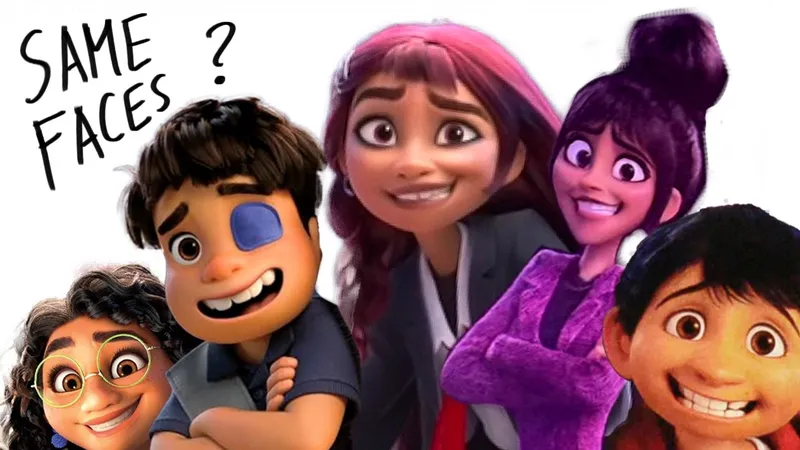
Does Disney Have Same Face Syndrome Now?
SamDoesArts@samdoesartsDoes Disney Have Same Face Syndrome Now?
An artist considers whether Disney characters have begun to share the same facial features, prompted by reactions to the Hexed trailer. The opening compares Disney Renaissance character designs with other studios and sets up a look at how Disney's designs changed from 2D animation to its more recent era.
- Views
- 1M
- Likes
- 50.2K
- Comments
- 4.1K
- Disney character designSame-Face SyndromeAnimation erasFacial feature shapes
Analysis
An artist considers whether Disney characters have begun to share the same facial features, prompted by reactions to the Hexed trailer. The opening compares Disney Renaissance character designs with other studios and sets up a look at how Disney's designs changed from 2D animation to its more recent era.
- CommentaryVideo essay
- Title
- Does Disney Have Same Face Syndrome Now?
All right, guys. Today we're going to be answering a burning question from an artist's perspective. Does Disney have same-face syndrome? Do all of their characters look the same? Now, this topic came up because recently I was watching Disney's trailer for their new IP Hexed, which is a brand new story in an entirely new world, right? It's what everyone's been asking for instead of the live-action remakes and the unnecessary sequels. But still, for some reason, ever since this trailer came out, it's been getting nothing but hate. For every one positive comment, I would see 30 other negative ones. So, I thought, "What the heck is going on?" And naturally, I saw one of the arguments being made that lately people have been feeling like Disney characters have been looking the same. They look like copy and pasted versions of each other. And an artist on X actually did a breakdown of these characters' faces and their face shapes as well as their facial features to draw attention to the similarities between them. Now, as you guys can see on the examples listed on these Disney female characters, they do have very similar facial feature shapes. From the eyes to the eyebrows, there's very little differences between them, especially when you compare them to the works of other studios, to IPs like Arcane or K Pop Demon Hunters. These characters all have very different face shapes and very different facial feature shapes. But I don't think this is a fair comparison. Disney animation is one studio. These characters are all made by the same studio, whereas these characters are made by different studios. What I think would be more helpful is if we go back in time and compare Disney's old work to their current work. Now, most of our popular and well-known Disney characters, especially the princesses, came from an era called the Disney Renaissance. This began in 1989 with The Little Mermaid and ended in 1999 with Tarzan. Believe it or not, just before this period, Disney's animation was actually in a very stagnant phase. They were really struggling. But with the help of Disney legend Glen Keane in designing The Little Mermaid, it essentially gave life to Disney animation once again and launched them into a new era. During these 10 years, Disney went on a legendary run. With The Little Mermaid in 1989, Beauty and the Beast in 1991, Aladdin in 1992, Lion King in 1994, Pocahontas in 1995, ending it off with Mulan in '98 and Tarzan in '99.
- 01Pose the central question
This directly establishes the question the video will address and frames the inquiry as an evaluation of character design.
The speaker announces an artist’s perspective, asks whether Disney has same-face syndrome, and restates the question as whether its characters look alike.
“All right, guys. Today we're going to be answering a burning question from an artist's perspective. Does Disney have same-face syndrome? Do all of their characters look the same?”
- 02Explain what prompted the question
This gives context for why the question matters now and introduces a specific argument for the alleged similarity, without treating online criticism as conclusive proof.
The speaker traces the topic to a new project’s trailer, contrasts it with other releases audiences have wanted, and describes the negative response and an artist’s analysis of character faces.
Now, this topic came up because recently I was watching Disney's trailer for their new IP Hexed, which is a brand new story in an entirely new world, right? It's what everyone's been asking for instead of the live-action remakes and the unnecessary sequels. But still, for some reason, ever since this trailer came out, it's been getting nothing but hate. For every one positive comment, I would see 30 other negative ones. So, I thought, "What the heck is going on?" And naturally, I saw one of the arguments being made that lately people have been feeling like Disney characters have been looking the same. They look like copy and pasted versions of each other. And an artist on X actually did a breakdown of these characters' faces and their face shapes as well as their facial features to draw attention to the similarities between them.
- 03Reframe the comparison
The speaker makes the comparison method part of the question: differences between studios may not be a fair test, so the proposed historical comparison offers a more relevant way to assess change within one studio.
The speaker acknowledges similarities in Disney characters’ facial features, compares them with other studios’ designs, then argues that this is not a fair comparison and proposes comparing Disney’s old work with its current work.
“Now, as you guys can see on the examples listed on these Disney female characters, they do have very similar facial feature shapes. From the eyes to the eyebrows, there's very little differences between them, especially when you compare them to the works of other studios, to IPs like Arcane or K Pop Demon Hunters. These characters all have very different face shapes and very different facial feature shapes. But I don't think this is a fair comparison. Disney animation is one studio. These characters are all made by the same studio, whereas these characters are made by different studios. What I think would be more helpful is if we go back in time and compare Disney's old work to their current work.”
- 04Introduce the historical context
This begins supplying the historical baseline needed for the proposed comparison. It belongs to the introduction as context for the coming assessment, but the supplied excerpt cuts off before the comparison is completed.
The speaker identifies the Disney Renaissance, gives its approximate dates and films, and contrasts that period with Disney’s earlier stagnant phase before describing Glen Keane’s role in the revival. The bounded excerpt ends during the transition toward the present era.
“Now, most of our popular and well-known Disney characters, especially the princesses, came from an era called the Disney Renaissance. This began in 1989 with The Little Mermaid and ended in 1999 with Tarzan. Believe it or not, just before this period, Disney's animation was actually in a very stagnant phase. They were really struggling. But with the help of Disney legend Glen Keane in designing The Little Mermaid, it essentially gave life to Disney animation once again and launched them into a new era. During these 10 years, Disney went on a legendary run. With The Little Mermaid in 1989, Beauty and the Beast in 1991, Aladdin in 1992, Lion King in 1994, Pocahontas in 1995, ending it off with Mulan in '98 and Tarzan in '99.”