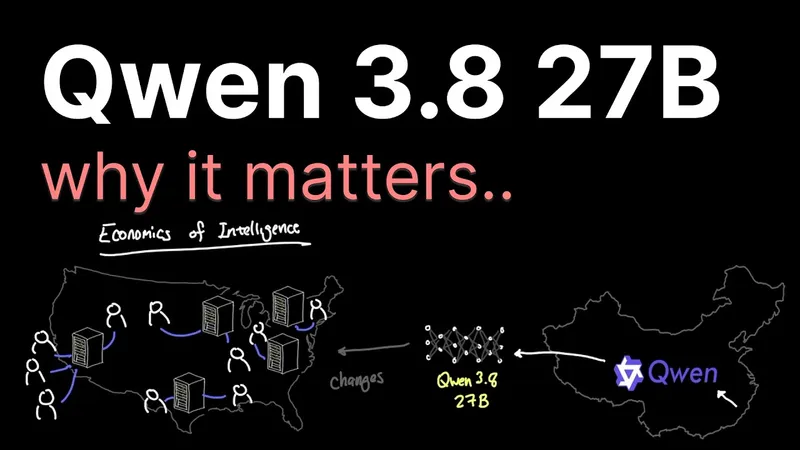
Qwen3.8 27B is something else..
Caleb Writes Code@CalebWritesCodeQwen3.8 27B is something else..
The video discusses Alibaba’s Qwen 3.8 27B model, its reported benchmark performance, and why capable models that run on consumer GPUs could affect the economics of AI inference. It also touches on open-model adoption and the AI industry’s changing balance between local hardware and data centers, with a sponsored mention of DevRev Computer.
- Views
- 388.1K
- Likes
- 3.9K
- Comments
- 300
- Qwen Open-Weight ModelLocal AI inferenceAI model economicsConsumer GPUs
Analysis
The video discusses Alibaba’s Qwen 3.8 27B model, its reported benchmark performance, and why capable models that run on consumer GPUs could affect the economics of AI inference. It also touches on open-model adoption and the AI industry’s changing balance between local hardware and data centers, with a sponsored mention of DevRev Computer.
- CommentaryExplainer
- Title
- Qwen3.8 27B is something else..
“Of all the Chinese labs that are all competing in the AI race, Alibaba's Qwen has been cooking recently specifically for models that run on consumer graphics cards. Labs like Moonshot, MiniMax, Z dot AI, and Deep Seek tend to focus on making models that are bigger than 70 billion parameters in size. Alibaba's approach with Qwen has been the shotgun approach by covering a wide spectrum of models across all sizes. And one that really stuck was models in this band right here where consumer grade graphics cards can run them. Hugging Face made a recent report that shows this distribution of model releases in 2026. As you can see, Alibaba covers a wide spectrum of models on all categories like under 1 billion parameters category to 1 to 8 billion parameters in size, 8 to 70 billion parameters, and over 70 billion parameters. And so far in 2026, Alibaba released a total of 51 models and variations already flooding the market with a wide spectrum of models. So, while other labs continue to push what's capable in the frontier of intelligence, what's worth noting here is this Qwen 3.8 27 billion parameter model right in this band. And in the benchmark, it's landing near GPT-5.6 Luna and Opus 4.6 level, as you can see. And this completely changes the economics of intelligence upside down. The continual infusion of small and capable models like Qwen 3.8 27B totally eats away the aggregate demand that's currently met by data centers that are operated across the country by inference providers. And now, we essentially have a GPT-5.6 Luna or Opus 4.6 equivalent model at home without necessarily relying on data centers. In other words, not only did we see the gap between open and closed models closing in due to models that compete in the frontier like Kimiko 3, GLM-5.3, Deep Seek V4 Pro, which alone is crazy, but we also have a gap closing in between what consumers can run at home and what models are typically only available in data centers. To give you a bit of perspective, Qwen models already surpassed 2 billion downloads in 2026 so far. So, when you judge how fast the adoption of AI is growing, not only in open models, but people who are trying to run open models locally at home. Another way to look at it is this AI stack right here. While the US has an advantage at the chip and infrastructure layer over China, models like Qwen 3.8 27B is showing us that we still have a lot more to improve before chip and infrastructure layer becomes the true bottleneck in terms of model innovation. Now, I think what's worth noting here is that just because Qwen 3.8 27B is a small model, doesn't by virtue make it a good model. There are plenty of other models right here in the 30 billion parameters range from labs like Google, Nvidia, Mistral, and DeepSeek, but Qwen 3.8 27B is single-handedly a unique model that punches way above its class. For example, Qwen 3.8 27B currently ranks ninth place in Code Arena overall. While the similarly sized Gemma 4 31B scores 80th. So, out of the entire spectrum of models here, this band right here is really dominated by Alibaba by a huge margin. Now, of course, given how good Qwen's models are getting, people are going as far as saying that they should just now cancel Claude membership and just run AI at home instead. While I think it's still premature to say that across the board, it does bring to question where the trajectory is going.”
- 01Set up competing approaches
Establishes the comparison that makes Qwen’s strategy distinct and introduces the practical category at the center of the opening.
Contrasts the labs’ focus on very large models with Alibaba’s broad range, then identifies the smaller-model category that drew attention.
“Of all the Chinese labs that are all competing in the AI race, Alibaba's Qwen has been cooking recently specifically for models that run on consumer graphics cards. Labs like Moonshot, MiniMax, Z dot AI, and Deep Seek tend to focus on making models that are bigger than 70 billion parameters in size. Alibaba's approach with Qwen has been the shotgun approach by covering a wide spectrum of models across all sizes. And one that really stuck was models in this band right here where consumer grade graphics cards can run them.”
- 02Give scale and category context
Adds context for the model’s position in the wider field before introducing its claimed benchmark performance.
Uses a report and release counts to describe Alibaba’s breadth across model-size categories, then places Qwen 3.8 27B in the category under discussion.
“Hugging Face made a recent report that shows this distribution of model releases in 2026. As you can see, Alibaba covers a wide spectrum of models on all categories like under 1 billion parameters category to 1 to 8 billion parameters in size, 8 to 70 billion parameters, and over 70 billion parameters. And so far in 2026, Alibaba released a total of 51 models and variations already flooding the market with a wide spectrum of models. So, while other labs continue to push what's capable in the frontier of intelligence, what's worth noting here is this Qwen 3.8 27 billion parameter model right in this band.”
- 03Connect performance to wider implications
Turns the model comparison into a broader significance claim about where AI capability can run and what that could mean for inference providers.
Claims the model approaches more powerful models in benchmarks, then argues that capable smaller models could shift demand away from data centers and make comparable capability available at home.
“And in the benchmark, it's landing near GPT-5.6 Luna and Opus 4.6 level, as you can see. And this completely changes the economics of intelligence upside down. The continual infusion of small and capable models like Qwen 3.8 27B totally eats away the aggregate demand that's currently met by data centers that are operated across the country by inference providers. And now, we essentially have a GPT-5.6 Luna or Opus 4.6 equivalent model at home without necessarily relying on data centers. In other words, not only did we see the gap between open and closed models closing in due to models that compete in the frontier like Kimiko 3, GLM-5.3, Deep Seek V4 Pro, which alone is crazy, but we also have a gap closing in between what consumers can run at home and what models are typically only available in data centers.”
- 04Widen the adoption and infrastructure context
Broadens the significance argument from a single model to local use and the relationship between infrastructure and model innovation.
Cites a claimed download total as perspective on adoption, then contrasts U.S. infrastructure advantages with the model’s demonstration of remaining room for improvement.
“To give you a bit of perspective, Qwen models already surpassed 2 billion downloads in 2026 so far. So, when you judge how fast the adoption of AI is growing, not only in open models, but people who are trying to run open models locally at home. Another way to look at it is this AI stack right here. While the US has an advantage at the chip and infrastructure layer over China, models like Qwen 3.8 27B is showing us that we still have a lot more to improve before chip and infrastructure layer becomes the true bottleneck in terms of model innovation.”
- 05Qualify the claim and offer comparative evidence
Adds a qualification and concrete supporting comparison, sharpening the claim that this example is notable for more than its size.
Warns that small size alone does not make a good model, asserts Qwen’s distinctive standing, and gives a ranking comparison with a similarly sized alternative.
“Now, I think what's worth noting here is that just because Qwen 3.8 27B is a small model, doesn't by virtue make it a good model. There are plenty of other models right here in the 30 billion parameters range from labs like Google, Nvidia, Mistral, and DeepSeek, but Qwen 3.8 27B is single-handedly a unique model that punches way above its class. For example, Qwen 3.8 27B currently ranks ninth place in Code Arena overall. While the similarly sized Gemma 4 31B scores 80th. So, out of the entire spectrum of models here, this band right here is really dominated by Alibaba by a huge margin.”
- 06End on a qualified open question
Keeps the implications unresolved: the speaker acknowledges the strong claim without endorsing it across the board, then leaves the direction of change as the question leading onward.
Mentions claims that users should cancel a subscription and run AI locally, cautions that this is premature as a general conclusion, and ends by asking where the trajectory is going.
“Now, of course, given how good Qwen's models are getting, people are going as far as saying that they should just now cancel Claude membership and just run AI at home instead. While I think it's still premature to say that across the board, it does bring to question where the trajectory is going.”