Jev explained in 7min..
Jev explained in 7min..
The video introduces Jev, a TypeSafe AI model positioned as an alternative to models optimized for chat and coding tasks. It discusses the source's claims about Jev's speed and probabilistic decisions, and how those traits might support workflow automation; a brief sponsor segment promotes JetBrains Junie.
- Views
- 773.3K
- Likes
- 6.9K
- Comments
- 203
- Jev AI modelWorkflow automationProbabilistic decisionsAI model speed
Analysis
The video introduces Jev, a TypeSafe AI model positioned as an alternative to models optimized for chat and coding tasks. It discusses the source's claims about Jev's speed and probabilistic decisions, and how those traits might support workflow automation; a brief sponsor segment promotes JetBrains Junie.
- Explainer
- Title
- Jev explained in 7min..
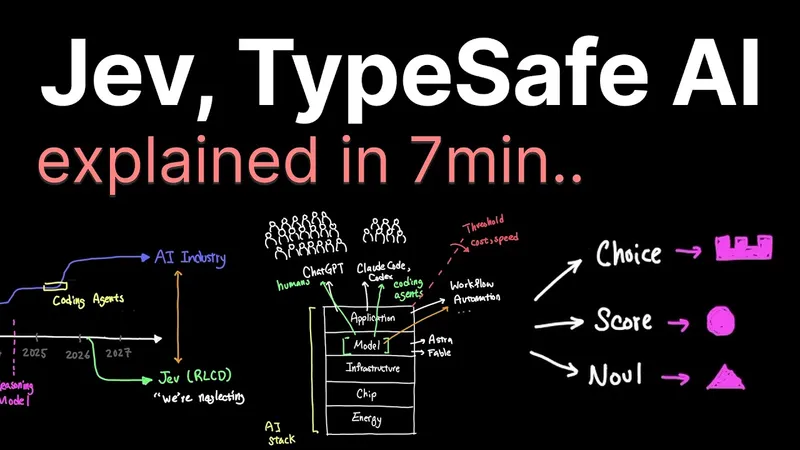
“Jev is a new type of model that makes us question how we should really think about optimizing LLMs. When we follow the orthodox path in AI from ChatGPT that was released in 2022, models have been optimized to assist humans in chat applications. Of course, as coding agents like Claude Code and Codex became mainstream around 2025, we also optimized the models for this as well. But, when we look at the AI stack, how AI actually gets end up being used in the application layer often puts a downward pressure on the layers below. And as a consequence, they tend to morph themselves to optimize for the best outcome in the application layer. And models continue to optimize to be more helpful to humans and also optimize to be more helpful in coding agents. But, one area that always felt short in use cases was workflow automation. Even a highly intelligent model like Astra and Fable couldn't really cross a threshold here without a huge cost on the way. And TypeSafe AI that made Jev is making an assertion here that the reason why this threshold is notoriously difficult to cross even for highly intelligent models is because the state-of-the-art models are optimized for different things. The way that they articulate this is a schism in the orthodox line where the optimizing the model for human preference and further optimizing them for verifiable reward doesn't really carry over when decisions need to be quick given the uncertainty. Now, what we're talking about here isn't that one path is ultimately superior than the other, but Jev is sort of this antithesis to our current trajectory in AI and arguing that we really have been neglecting the use cases that stand to make a huge difference in automation. And TypeSafe AI is arguing that trying to force a model that's optimized for human interaction and agentic use cases into automation is fundamentally wrong way to go about it. When we look at all the different projects that people are showing off on social media using Jev, a lot of them are actually more showing off the speed of execution rather than the depth of understanding. Sorting emails, improving rag, playing games, model routing are all tasks that current LLMs can do, but certainly not at the speed of Jev that according to them are 40 to 200 times faster where end-to-end response time is 70 to 500 milliseconds. Functionally, current LLMs can do everything that Jev offers, including mimicking the response so that it returns a result just like Jev would, but matching the latency of 70 to 500 milliseconds is not something that auto regressive models can easily do, especially since tokens are generated one after another until completion. But Jev is inherently designed to do parallel sampling and typed probabilistic decisions, which is something that LLMs don't do in the architecture. So, it's less about what Jev is functionally capable of, but what we're optimizing the model so that we can cover more ground in the application layer so that automation, game playing, mass sortings, these types of tasks are practically possible. Now, let's take a closer look at the model Jev and see how it actually works.”
- 01Introduce the new approach
States the central subject and frames the episode around whether the usual optimization goal is the right one.
Names Jev as a new type of model and says it prompts a reconsideration of how LLMs should be optimized.
“Jev is a new type of model that makes us question how we should really think about optimizing LLMs.”
- 02Set the conventional path
Gives the viewer a familiar baseline for understanding the later contrast, including the speaker's stated timeline and examples.
Summarizes how models developed from ChatGPT toward chat applications and coding agents.
“When we follow the orthodox path in AI from ChatGPT that was released in 2022, models have been optimized to assist humans in chat applications. Of course, as coding agents like Claude Code and Codex became mainstream around 2025, we also optimized the models for this as well.”
- 03Frame the automation problem
Makes the problem consequential to the main premise: optimizing for visible application outcomes may shape lower layers, while a desired use case remains costly or difficult.
Explains that application-layer use can put pressure on lower layers, then says workflow automation has remained a shortfall despite highly intelligent models and costly attempts to cross a threshold.
“But, when we look at the AI stack, how AI actually gets end up being used in the application layer often puts a downward pressure on the layers below. And as a consequence, they tend to morph themselves to optimize for the best outcome in the application layer. And models continue to optimize to be more helpful to humans and also optimize to be more helpful in coding agents. But, one area that always felt short in use cases was workflow automation. Even a highly intelligent model like Astra and Fable couldn't really cross a threshold here without a huge cost on the way.”
- 04Explain the proposed difference
Offers the speaker's proposed explanation, preserves its attribution and qualification, and develops the contrast without claiming that one path is universally better.
Attributes to TypeSafe AI the claim that the threshold is difficult because state-of-the-art models are optimized for different things. It then describes a schism between human preference and verifiable reward under quick, uncertain decisions, while clarifying that Jev is not simply declared superior.
“And TypeSafe AI that made Jev is making an assertion here that the reason why this threshold is notoriously difficult to cross even for highly intelligent models is because the state-of-the-art models are optimized for different things. The way that they articulate this is a schism in the orthodox line where the optimizing the model for human preference and further optimizing them for verifiable reward doesn't really carry over when decisions need to be quick given the uncertainty. Now, what we're talking about here isn't that one path is ultimately superior than the other, but Jev is sort of this antithesis to our current trajectory in AI and arguing that we really have been neglecting the use cases that stand to make a huge difference in automation. And TypeSafe AI is arguing that trying to force a model that's optimized for human interaction and agentic use cases into automation is fundamentally wrong way to go about it.”
- 05Give examples and a claimed capability comparison
Moves from the broad claim to examples and stated figures that help clarify what Jev is claimed to offer, while keeping the speed comparisons attributed to the source.
Mentions projects and tasks associated with Jev, cites a claimed speed range and response times, and explains that conventional models can mimic its results but may not match its latency.
“When we look at all the different projects that people are showing off on social media using Jev, a lot of them are actually more showing off the speed of execution rather than the depth of understanding. Sorting emails, improving rag, playing games, model routing are all tasks that current LLMs can do, but certainly not at the speed of Jev that according to them are 40 to 200 times faster where end-to-end response time is 70 to 500 milliseconds. Functionally, current LLMs can do everything that Jev offers, including mimicking the response so that it returns a result just like Jev would, but matching the latency of 70 to 500 milliseconds is not something that auto regressive models can easily do, especially since tokens are generated one after another until completion.”
- 06Summarize the distinction and transition
Brings the overview's contrast to a clear summary and signals that the introduction is handing off to the main explanation of the model.
Says Jev's architecture is designed for parallel sampling and typed probabilistic decisions, then reframes the distinction as covering more ground in the application layer so automation and other tasks become practically possible. The speaker announces a closer look at how Jev works.
“But Jev is inherently designed to do parallel sampling and typed probabilistic decisions, which is something that LLMs don't do in the architecture. So, it's less about what Jev is functionally capable of, but what we're optimizing the model so that we can cover more ground in the application layer so that automation, game playing, mass sortings, these types of tasks are practically possible. Now, let's take a closer look at the model Jev and see how it actually works.”