EEVblog 1771 - A Tricky OpAmp Exam Question
EEVblog 1771 - A Tricky OpAmp Exam Question
Dave works through a tricky op-amp exam question, discussing what the schematic leaves unspecified and how to approach the analysis. The video description also promises a bonus tutorial on op-amp biasing and covers related filter concepts, including high-pass and ripple-removal filters.
- Views
- 319.6K
- Likes
- 4.5K
- Comments
- 344
- Op-Amp Circuit AnalysisElectronics exam reasoningOp-Amp BiasingFilter circuits
Analysis
Dave works through a tricky op-amp exam question, discussing what the schematic leaves unspecified and how to approach the analysis. The video description also promises a bonus tutorial on op-amp biasing and covers related filter concepts, including high-pass and ripple-removal filters.
- TutorialExplainer
- Title
- EEVblog 1771 - A Tricky OpAmp Exam Question
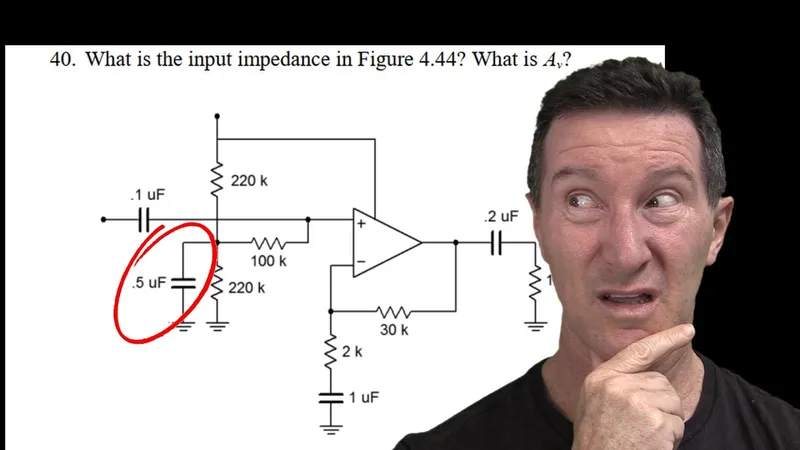
Hi, it's exam question time again. This one was posted on the EVblog forum and I thought I'd answer it not only because it's an interesting exam question about what they expect you to do in electronics engineering exam questions like this one, but also I'm about op-amps and biased op-amps and all sorts of things like that. So, let's get into it, shall we? Thank you very much Vihan is a new user on the forum. And um the post says, "How to analyze the op-amp circuit?" Now, normally we don't answer questions on the EVblog forum if you just go, "Please give me the answer." You know, but in this particular case, Vihan has asked, "How do I analyze the below circuit?" So, not just asking for the answer, he wants to know how we analyze it. What is the starting point? Wants to know how you know, the starting point of this because it looks a bit complicated, doesn't it? You know, if you don't know a lot about op-amps and everything else. I've done a whole series of op-amp videos. I'll link the playlist in down below, by the way. But anyway, let's go to the DaveCad, shall we? Where we can draw on this sucker. Let's analyze it. So, it looks a bit tricky, doesn't it? We've got AC input coupling capacitors which go in here and it goes around and it goes up there and it goes down here and there's another cap here. And look, there's a little secret squirrel cap down here. What's going on there? We've got some AC coupling on the output and and various things. So, yeah, as far as rudimentary op-amp questions go, this one's pretty involved and we'll get into that later, but I'm actually going to answer the question first before we get into the more technical detail side of what's happening in this op-amp here.
- 01Introduce the question
Establishes the episode's subject and why the speaker is taking it on, while setting up a particular problem for the viewer to follow.
The speaker introduces an exam question from a community forum, explains why they chose it, and connects it to their interest in the subject.
“Hi, it's exam question time again. This one was posted on the EVblog forum and I thought I'd answer it not only because it's an interesting exam question about what they expect you to do in electronics engineering exam questions like this one, but also I'm about op-amps and biased op-amps and all sorts of things like that. So, let's get into it, shall we? Thank you very much Vihan is a new user on the forum.”
- 02Clarify what is being asked
Defines the actual learning goal and why the question is worth unpacking, giving the walkthrough a more specific promise than simply supplying a result.
The speaker quotes the forum question, distinguishes a request for an analysis method from a bare request for the answer, and notes that the circuit looks complicated.
And um the post says, "How to analyze the op-amp circuit?" Now, normally we don't answer questions on the EVblog forum if you just go, "Please give me the answer." You know, but in this particular case, Vihan has asked, "How do I analyze the below circuit?" So, not just asking for the answer, he wants to know how we analyze it. What is the starting point? Wants to know how you know, the starting point of this because it looks a bit complicated, doesn't it? You know, if you don't know a lot about op-amps and everything else. I've done a whole series of op-amp videos. I'll link the playlist in down below, by the way. But anyway, let's go to the DaveCad, shall we? Where we can draw on this sucker. Let's analyze it.
- 03Frame the challenge and begin
Confirms that the analysis has a meaningful challenge and sets the order of the forthcoming explanation. The introduction ends when the speaker moves from framing into sustained technical analysis.
The speaker describes the problem as tricky and involved, previews answering the question before the deeper technical discussion, and begins identifying features of the circuit.
“So, it looks a bit tricky, doesn't it? We've got AC input coupling capacitors which go in here and it goes around and it goes up there and it goes down here and there's another cap here. And look, there's a little secret squirrel cap down here. What's going on there? We've got some AC coupling on the output and and various things. So, yeah, as far as rudimentary op-amp questions go, this one's pretty involved and we'll get into that later, but I'm actually going to answer the question first before we get into the more technical detail side of what's happening in this op-amp here.”