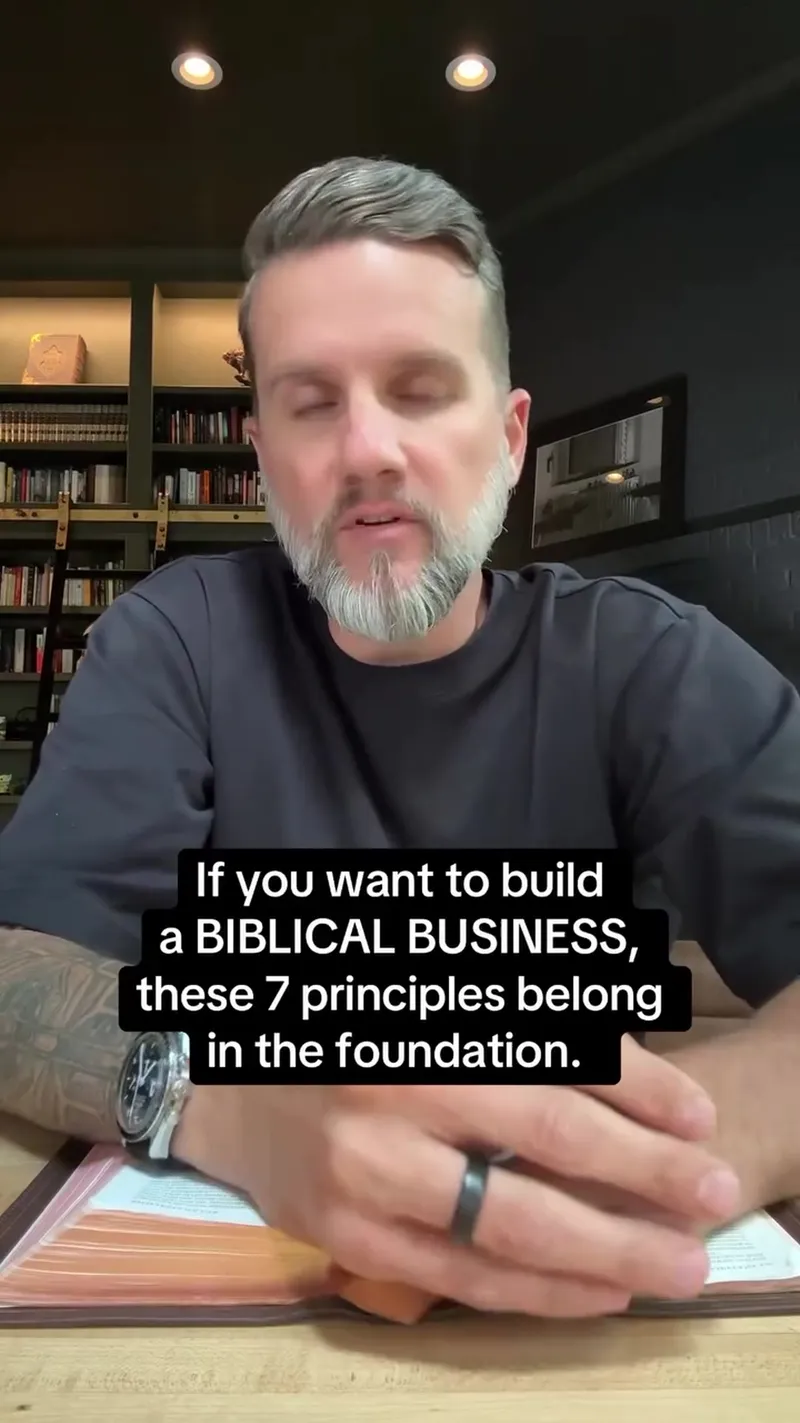
The video outlines seven foundational principles for building a business rooted in biblical teachings. It covers essential practices like leading with a purpose beyond profit, practicing disciplined financial stewardship, and building systems that allow a business to thrive independently of its owner.
7 Biblical Principles for Your Business Foundation
The video outlines seven foundational principles for building a business rooted in biblical teachings. It covers essential practices like leading with a purpose beyond profit, practicing disciplined financial stewardship, and building systems that allow a business to thrive independently of its owner.
- Views
- 296.7K
- Likes
- 23.2K
- Comments
- 167
- Topics
Analysis
If you want to build a biblical business, these seven principles belong in the foundation.
If you want to build a biblical business, these seven principles belong in the foundation. Baby, I'm drenched Living water flowing Ain't no manifest I'm reaping what I'm sowing. First thing is, you need to have a purpose that's bigger than just making money. If your only reason to do this is to make money, you're already going down a path that you've been warned about. You cannot serve God and money. And Proverbs tells us that where there is no vision, the people will perish. So you need to have a vision in your business that tells people what your big purpose is more than just making the money. Second is you test assumptions, and you don't just blindly follow the world. First, Thessalonians 5:21 says to test everything and to hold fast to what is good. So that means that you want to make sure that you have first principles, objective truth in how you approach running this business. Third, you're going to steward your finances or your cash with discipline. Proverbs 21:5 says that the plans of the diligent lead surely to abundance, but haste leads to poverty. Understanding your profit and loss, your balance sheet, your cash flow, you need to understand the language of finance so that you can steward what is God's will. Fourth is that you build a reputation rooted in truth. Matthew 5:16 says to Let your light shine before men, that they may see your good works and give your Father in heaven glory. When you're building a brand, you are through excellence, showing a reputation, and in that reputation people can see the light that you're shining, and then you can point them to Jesus. Fifth is that you move with clarity and conviction in your execution. Proverbs 4 We read, Let your eyes look straight ahead, don't go to the left or to the right. You need to have focus in your execution. So you want to set goals, and then you need to run in accountable cycles of execution along the way, and rinse and repeat. So set three goals and then run toward those goals and hold people accountable along the way, because accountability is how you keep momentum moving forward. Sixth is that you serve and develop your people. In Philippians 2, at verses 3 and 4, it says to value others above yourself, not looking to your own interests, but to the interest of others. This means that you lead people from a servant's perspective, understanding that the people, just like the money, are something for you to steward and to take care of, because they are gods. And so you're going to serve them well by going first and asking them constantly what can I do to serve you better? Number seven is that you build something that doesn't depend on you. You build something that makes you dispensable. In Psalm 90, at verse 12, we read, Teach us to number our days that we may gain a heart of wisdom. Your days are numbered, and when you lead a business that only relies on you, you're leading selfishly. If you were gone tomorrow, the husbands and wives and children and brothers and sisters would all be affected because that business would fail. And so you understand it's not your business, and so you build it by documenting your processes, by documenting KPIs, and by automating and building systems that don't rely on you being involved in it. Those are the seven laws of biblical business, and I hope that you let them shape the way you lead, discern, decide, and execut in the business that God's given you to steward.
- 01The Core Promise Hook
Establish the specific goal and the high-value number of steps required to achieve it.
- 02The Pattern Interrupt
A brief moment of music, branding, or a change in tone to signal the main content is starting.
- 03Principle 1: The Big Why
State a purpose-driven requirement and use a quote or source to explain why the standard approach is dangerous.
- 04Principle 2: Critical Thinking
Advise against following trends and suggest using first principles instead.
- 05Principle 3: Resource Management
Focus on the technical discipline required to manage assets correctly.
- 06Principle 4: Reputation & Brand
Connect external quality with an internal or moral value.
- 07Principle 5: Execution & Focus
Provide a tactical framework for staying on track with goals.
- 08Principle 6: People Leadership
Address how to treat others involved in the process.
- 09Principle 7: Legacy & Systems
Explain how to make the work sustainable and independent of the creator.
- 10The Wrap-Up Wish
Summarize and give a final encouragement.