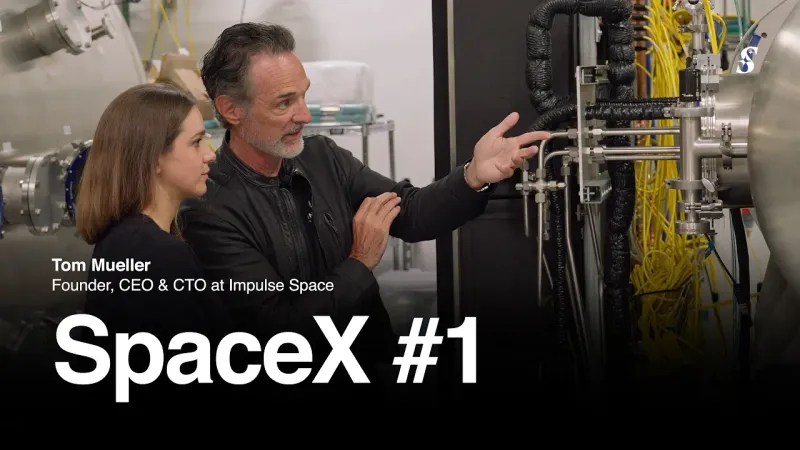
Tom Mueller: SpaceX's #1 Employee Built the Merlin Engine. Now He's Building Impulse Space
Sourcery with Molly O'Shea@SourceryVCTom Mueller: SpaceX's #1 Employee Built the Merlin Engine. Now He's Building Impulse Space
Tom Mueller, Impulse Space’s founder and former SpaceX founding employee, explains why he shifted from launch vehicles to moving cargo in space. The episode begins a factory tour, including the avionics assembly area, and the description promises looks at the Mira and Helios spacecraft, the Deneb engine, and Impulse’s design and testing approach.

- Views
- 311.3K
- Likes
- 4.2K
- Comments
- 232
- In-Space TransportationRocket engine developmentImpulse space factoryTom Mueller's Career
Analysis
Tom Mueller, Impulse Space’s founder and former SpaceX founding employee, explains why he shifted from launch vehicles to moving cargo in space. The episode begins a factory tour, including the avionics assembly area, and the description promises looks at the Mira and Helios spacecraft, the Deneb engine, and Impulse’s design and testing approach.
- InterviewWalkthroughPodcast episode
- Title
- Tom Mueller: SpaceX's #1 Employee Built the Merlin Engine. Now He's Building Impulse Space
“I was a founding employee at SpaceX. I led the development of the propulsion systems for Falcon and Dragon and also started the origins of what became Starship. My proudest development was the Merlin engine, which is currently flying on Falcon 9, the most reliable rocket engine ever developed and also the highest thrust-to-weight of any rocket engine ever developed. I worked on Starship for the last 6 years at SpaceX. So, when I left, I had the plan of launch mostly being solved or is being solved. Like, the next big opportunity is to move all that payload, all that cargo around in space. So, I started Impulse Space to do in-space transportation as opposed to from Earth to space transportation, which was SpaceX. We feel like the next step is in-space transportation, including to the moon and landing on the moon. [music] >> Tom Mueller, welcome to Sourcery. >> Thank you. Great to be here. >> Okay, so before we start, I believe we're in a very special part of the office. What are we standing on right now? >> Uh Oh, you mean right here? >> Yeah. >> Uh this used to be my parking spot. >> This was your parking spot? >> But, now I moved to new offices. Now, I I lost my parking spot. >> No. Okay, so I want to know and we'll get into Impulse in a second, but could you name every car model that you own?”
- 01Credentials and standout work
This establishes why the guest has relevant experience and offers a concrete achievement to anchor the profile. Attribute superlative claims to the speaker rather than treating them as independently verified.
The guest summarizes a significant role, related work, and a proudest accomplishment, with a claim about its standing or performance.
“I was a founding employee at SpaceX. I led the development of the propulsion systems for Falcon and Dragon and also started the origins of what became Starship. My proudest development was the Merlin engine, which is currently flying on Falcon 9, the most reliable rocket engine ever developed and also the highest thrust-to-weight of any rocket engine ever developed. I worked on Starship for the last 6 years at SpaceX.”
- 02The next opportunity
The turn from completed or advancing work to a different opportunity creates the opening's central forward-looking question: what comes next, and how will the new venture address it?
The guest explains the premise for leaving and identifies a new opportunity, then says what the new organization is meant to do.
“So, when I left, I had the plan of launch mostly being solved or is being solved. Like, the next big opportunity is to move all that payload, all that cargo around in space. So, I started Impulse Space to do in-space transportation as opposed to from Earth to space transportation, which was SpaceX. We feel like the next step is in-space transportation, including to the moon and landing on the moon.”
- 03Welcome and personal exchange
The welcome identifies the interview format, while the short office anecdote brings the guest's new workplace into the conversation in an informal way before the interviewer signals a fuller discussion of the organization.
The interviewer welcomes the guest to the show, then asks about a special part of the office; the guest explains it used to be his parking spot but he moved and lost it.
“[music] >> Tom Mueller, welcome to Sourcery. >> Thank you. Great to be here. >> Okay, so before we start, I believe we're in a very special part of the office. What are we standing on right now? >> Uh Oh, you mean right here? >> Yeah. >> Uh this used to be my parking spot. >> This was your parking spot? >> But, now I moved to new offices. Now, I I lost my parking spot. >> No.”
- 04Bridge into the interview
This closes the brief workplace exchange and sets up an informal personal question before the company discussion. The excerpt then moves into a detailed answer, so the introduction ends with that exchange rather than extending into the later workplace tour.
The interviewer says the discussion will get into the company shortly, then asks the guest to name every car model he owns.
“Okay, so I want to know and we'll get into Impulse in a second, but could you name every car model that you own?”