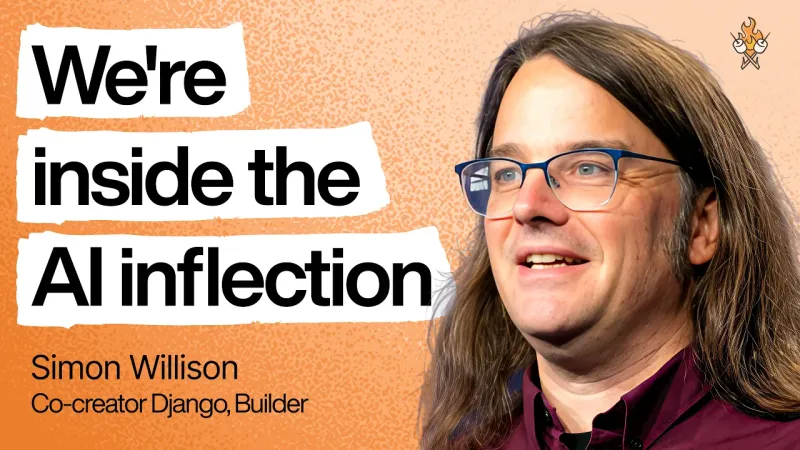
An AI state of the union: We’ve passed the inflection point & dark factories are coming
Lenny's Podcast@LennysPodcastAn AI state of the union: We’ve passed the inflection point & dark factories are coming
Lenny Rachitsky interviews software developer Simon Willison about AI coding agents and how they are changing software work. They discuss agentic engineering practices, the pressure on experienced engineers, and risks such as prompt injection; the episode also covers Willison’s tools and views on where AI development may be headed.

- Views
- 202.6K
- Likes
- 4.2K
- Comments
- 411
- AI coding agentsSoftware engineering workPrompt injection securityAgentic engineering practices
Analysis
Lenny Rachitsky interviews software developer Simon Willison about AI coding agents and how they are changing software work. They discuss agentic engineering practices, the pressure on experienced engineers, and risks such as prompt injection; the episode also covers Willison’s tools and views on where AI development may be headed.
- InterviewPodcast episode

- Title
- An AI state of the union: We’ve passed the inflection point & dark factories are coming
A lot of people woke up in January and February and started realizing, "Oh, wow, I can turn out 10,000 lines of code in a day." It used to be you'd ask ChatGPT for some code and it would spit out some code, and you have to run it and test it. The coding agents, they take that step for you. And an open question for me is how many other knowledge work fields are actually prone to these agent loops. Now that we have this power, people almost underestimate what they can do with it. >> Today, probably 95% of the code that I produce, I didn't type it myself. I write so much of my code on my phone, it's wild. I can get good work done walking the dog along the beach. My New Year's resolution, every previous year, I've always told myself, "This year, I'm going to focus more. I'm going to take on less things." This year, my ambition was take on more stuff and be more ambitious. Such an interesting contradiction. AI is supposed to make us more productive. It feels like the people that are most AI pilled are working harder than they've ever worked. >> Using coding agents well is taking every inch of my 25 years of experience as a software engineer. I can fire up four agents in parallel and have them work on four different problems. By 11:00 a.m., I am wiped out. You have this prediction that we're going to have a massive disaster at some point. You call it the Challenger disaster of AI. Lots of people knew that those little O-rings were unreliable, but every single time you get away with launching a space shuttle without the O-rings failing, you institutionally feel more confident in what you're doing. We've been using these systems in increasingly unsafe ways. This is going to catch up with us. My prediction is that we're going to see a Challenger disaster. Today, my guest is Simon Wilson. Simon, in my opinion, is one of the most important and useful voices right now on how AI is changing the way that we build software and how professional work is changing broadly. What I love about Simon is that he doesn't just pontificate in the clouds. He's been what you'd call a 10x engineer for over 20 years. He co-created Django, the web framework that powers Instagram, Pinterest, Spotify, and thousands of other platforms. He coined the term prompt injection, popularized the ideas of AI slop and agentic engineering. And amongst his hundred plus open source projects, he created Datasette, a data analysis tool that has become a staple of investigative journalism. What makes Simon rare is that very few engineers have made the leap from the old way of building to the new way as fully and visibly as he has. And as he's leaned into this new way of building, he's been sharing everything he's learning in real time. There's incredible blog.simonwillson.net. Simon does not do a lot of podcasts, and this conversation opened my mind up in a bunch of new ways. I am so excited for you to get to learn from Simon. Don't forget to check out Lenny's Product Hunt Pass.com for an incredible set of deals available exclusively to Lenny's newsletter subscribers. With that, I bring you Simon Wilson. Simon, thank you so much for being here and welcome to the podcast. Hey, Lenny. It's really great to be here. I am so excited to have you here. I've been such a fan of yours from afar for so long.
- 01A sudden shift and a question
Establishes a recent change and a question that opens beyond coding to other kinds of knowledge work.
The speaker describes people recognizing a new capability, contrasts it with an earlier way of working, and asks how far the pattern may extend.
A lot of people woke up in January and February and started realizing, "Oh, wow, I can turn out 10,000 lines of code in a day." It used to be you'd ask ChatGPT for some code and it would spit out some code, and you have to run it and test it. The coding agents, they take that step for you. And an open question for me is how many other knowledge work fields are actually prone to these agent loops.
- 02A concrete example and contradiction
Makes the broader change tangible and raises the central tension: a tool meant to increase productivity may coincide with people working harder.
A speaker gives a striking personal example of AI-assisted work, then the host contrasts that productivity with reports of increased effort.
Now that we have this power, people almost underestimate what they can do with it. >> Today, probably 95% of the code that I produce, I didn't type it myself. I write so much of my code on my phone, it's wild. I can get good work done walking the dog along the beach. My New Year's resolution, every previous year, I've always told myself, "This year, I'm going to focus more. I'm going to take on less things." This year, my ambition was take on more stuff and be more ambitious. Such an interesting contradiction. AI is supposed to make us more productive. It feels like the people that are most AI pilled are working harder than they've ever worked.
- 03Experience, risk, and forecast
Adds concrete evidence of the demands involved and stakes the discussion on a forecast of what may happen when unsafe practices persist.
The guest describes the experience required to use coding agents, then the speakers raise a possible disaster and explain the risk through an analogy.
“>> Using coding agents well is taking every inch of my 25 years of experience as a software engineer. I can fire up four agents in parallel and have them work on four different problems. By 11:00 a.m., I am wiped out. You have this prediction that we're going to have a massive disaster at some point. You call it the Challenger disaster of AI. Lots of people knew that those little O-rings were unreliable, but every single time you get away with launching a space shuttle without the O-rings failing, you institutionally feel more confident in what you're doing. We've been using these systems in increasingly unsafe ways. This is going to catch up with us. My prediction is that we're going to see a Challenger disaster.”
- 04Introduce the guest and establish relevance
Connects the coming conversation to AI's effects on software and professional work while giving the audience specific reasons to trust the guest's perspective.
The host names the guest, explains why his perspective matters, and supports that assessment with experience, projects, and his public writing.
“Today, my guest is Simon Wilson. Simon, in my opinion, is one of the most important and useful voices right now on how AI is changing the way that we build software and how professional work is changing broadly. What I love about Simon is that he doesn't just pontificate in the clouds. He's been what you'd call a 10x engineer for over 20 years. He co-created Django, the web framework that powers Instagram, Pinterest, Spotify, and thousands of other platforms. He coined the term prompt injection, popularized the ideas of AI slop and agentic engineering. And amongst his hundred plus open source projects, he created Datasette, a data analysis tool that has become a staple of investigative journalism. What makes Simon rare is that very few engineers have made the leap from the old way of building to the new way as fully and visibly as he has. And as he's leaned into this new way of building, he's been sharing everything he's learning in real time. There's incredible blog.simonwillson.net. Simon does not do a lot of podcasts, and this conversation opened my mind up in a bunch of new ways. I am so excited for you to get to learn from Simon.”
- 05Sponsor message and handoff
Completes the opening's sponsor obligation and the formal guest handoff. The excerpt ends during introductory pleasantries, so the transition into the main interview is not present in the supplied material.
The host promotes a subscriber offer, transitions to the conversation, and welcomes the guest; the guest responds before the host repeats their welcome.
“Don't forget to check out Lenny's Product Hunt Pass.com for an incredible set of deals available exclusively to Lenny's newsletter subscribers. With that, I bring you Simon Wilson. Simon, thank you so much for being here and welcome to the podcast. Hey, Lenny. It's really great to be here. I am so excited to have you here. I've been such a fan of yours from afar for so long.”